


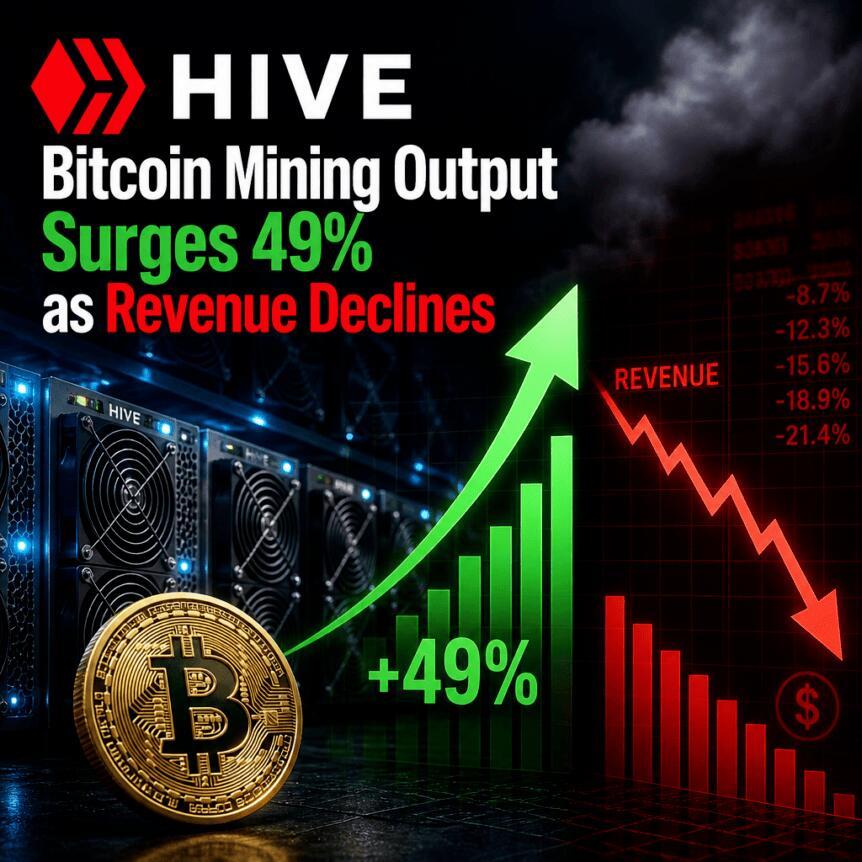
HIVE Bitcoin Mining Output Surges 49% As Revenue Declines


The contrast extends beyond mining. Both firms are pushing deeper into high-performance computing (HPC) and artificial intelligence infrastructure as a potential source of steadier, recurring demand-an approach that may help offset volatility in mining margins, even as power costs and equipment write-downs continue to pressure results.
Key takeaways- HIVE 's Bitcoin production rose 49% year over year to 1,070 BTC, but mining revenue fell 7.4% to $76 million. MARA increased output 5% to 2,247 BTC, while Bitcoin mining revenue dropped 34% to $159 million. MARA sold 13,597 BTC for about $1.1 billion after Sept. 30 and used $750 million to repay Bitcoin-backed term loans in full. Both companies reported higher electricity and equipment-related charges, including noncash write-downs tied to weaker mining economics. HIVE and MARA are expanding AI/HPC businesses to diversify revenue, with HIVE's HPC hosting revenue up sharply in the quarter.
According to their regulatory filings, HIVE and MARA both mined more Bitcoin in the September quarter than they did a year earlier. HIVE's production increased 49% to 1,070 BTC, yet its Bitcoin mining revenue declined 7.4% to $76 million, suggesting that lower Bitcoin pricing outweighed the benefit of higher output.
MARA showed a similar pattern. The company reported Bitcoin production rising 5% to 2,247 BTC, while Bitcoin mining revenue fell 34% to $159 million. In other words, even modest gains in mined volumes were not enough to offset the revenue drag from a weaker price environment during the period.
These results reinforce a recurring dynamic for the sector: miners can scale hashrate and improve uptime, but near-term revenues remain heavily dependent on the spot price of Bitcoin and the effective margin after energy and operating costs.
MARA's post-quarter Bitcoin sale and loan repaymentMARA also provided an update that came after the quarter ended. In a disclosure made with its reporting documents, the company said it sold 13,597 BTC for about $1.1 billion. It used $750 million of the proceeds to repay its Bitcoin-backed term loans in full.
As part of the repayment, MARA said it released 17,477 BTC that had been pledged as collateral. While the sale and repayment occurred after Sept. 30, the company's disclosure helps investors understand how it is managing balance-sheet exposure to financing structures tied to Bitcoin holdings.
The move may also signal an emphasis on reducing financial leverage when the company believes it can convert inventory into cash at a price that supports debt reduction. The extent to which the company will continue selling Bitcoin holdings going forward remains a key question for traders monitoring liquidity and balance-sheet strategy.
Costs climb and impairments land in both companiesAlongside revenue pressure, both firms reported higher costs in areas that can directly impact earnings quality. HIVE's electricity costs rose 20% to $45.6 million. MARA reported purchased energy costs increasing 12% to $48.1 million as it expanded owned mining operations.
Each company also recorded equipment-related impairments. HIVE reported a $31.2 million noncash write-down on mining equipment, attributing it to“depressed mining economics.” MARA, in a separate write-off, disclosed a $12 million reduction related to mining rigs and equipment under restructuring plans.
Write-downs like these are particularly important for investors because they reflect management's assessment that the expected future economic benefit from certain assets has deteriorated-often due to changes in margin assumptions, power costs, or the broader Bitcoin price outlook.
Looking outward, the filings align with broader signals of stress seen across parts of the mining industry. Earlier reporting from Cointelegraph highlighted weaker mining margins at American Bitcoin despite a treasury-influenced quarterly profit, and noted that Core Scientific plans to leave Bitcoin mining by year-end.
HIVE and MARA push into AI and HPC to diversifyWhile some miners in recent months have moved away from pure-play mining, HIVE and MARA are continuing to invest in mining alongside AI and HPC infrastructure. The companies appear to be betting that computational demand from AI-related workloads can provide a more durable revenue base than Bitcoin-only exposure.
HIVE reported that its HPC hosting revenue rose 71% to $8.8 million in the September quarter. The company said this segment accounted for 10.4% of total revenue. HIVE described its strategy as combining cash flow from mining with recurring revenue potential from AI infrastructure, aiming to create a business mix less dependent on Bitcoin spot price alone.
For investors tracking execution risk, HIVE also outlined a planned expansion effort. The company said it expects to spend up to $493 million over 36 months to grow its HPC operations, including land acquisition, data center buildouts, and GPU purchases. As of the filing, HIVE reported spending $145.3 million toward the expansion. In addition, it said it plans to invest about $35 million to convert its Toronto facility into a Tier-III data center, while it continues building mining infrastructure, including a targeted 100-megawatt substation expansion at its Yguazú site in Paraguay during 2026.
MARA's approach is similarly oriented toward flexible compute. The company said it is developing AI infrastructure through its Exaion subsidiary and a partnership with Starwood Digital Ventures. MARA stated its intent to operate sites that can shift between workloads based on economics, demand, and grid conditions, with Bitcoin mining remaining the foundation of the platform.
The core difference between these strategies lies in how each company frames adaptability. HIVE is emphasizing a larger, scaled HPC buildout with clear budget disclosures, while MARA is emphasizing operational flexibility-potentially allowing it to respond more dynamically to changes in workload pricing and grid constraints.
Quarterly performance underscores the tension between mining scale and margin realityHIVE reported fiscal second-quarter revenue of $84.9 million, down 2.7% year over year but above a consensus range that MarketBeat listed at $79.4 million. Despite the revenue uptick versus expectations, HIVE reported a quarterly loss.
MARA reported net income attributable to common stockholders of $634.4 million, up from $123.1 million a year earlier, and it said results included substantial fair-value gains on digital assets and digital asset receivables. On operating revenue, MARA reported quarterly revenue of $164.2 million, down 35% year over year, while diluted earnings rose to $1.28 per share from 27 cents a year earlier-again reflecting the importance of accounting movements and asset remeasurement in the company's profitability picture.
For readers, the practical takeaway is that“more Bitcoin mined” does not automatically translate into stronger headline mining revenue, and in some cases profitability can be influenced materially by digital asset valuation effects rather than only by mining operations. As the sector enters periods of price volatility, that distinction can matter when comparing miners with different accounting exposures and balance-sheet structures.
Going forward, investors should watch whether HIVE and MARA's AI/HPC initiatives can generate margin-stable contribution while mining economics remain under pressure, and-on MARA specifically-how the company balances further Bitcoin inventory management against continued debt reduction and reinvestment.
Risk & affiliate notice: Crypto assets are volatile and capital is at risk. This article may contain affiliate links.
Legal Disclaimer:
MENAFN provides the
information “as is” without warranty of any kind. We do not accept any
responsibility or liability for the accuracy, content, images, videos,
licenses, completeness, legality, or reliability of the information
contained in this article. If you have any complaints or copyright issues
related to this article, kindly contact the provider above.


Comments
No comment