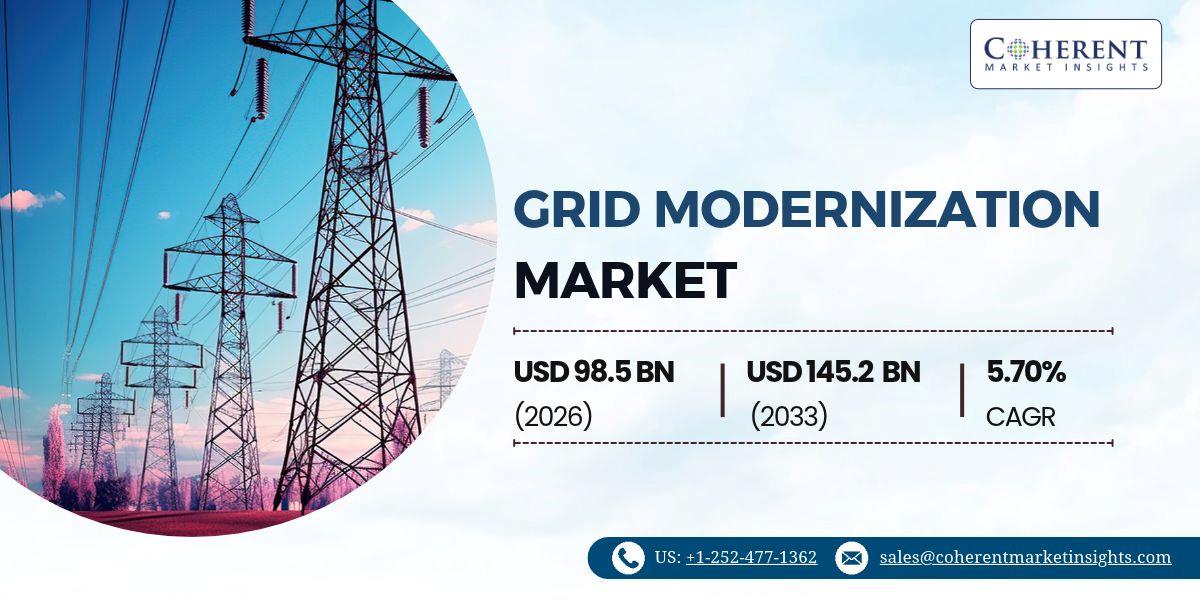
(MENAFN- GlobeNewsWire - Nasdaq) Rising Investments in Smart Grid Technologies, Renewable Energy Integration, and Electricity Distribution Infrastructure Drive Market Growth CopyBurlingame, CA,, Nov. 09, 2026 (GLOBE NEWSWIRE) -- The Global Grid Modernization Market is estimated to be valued at USD 98.5 billion in 2026 and is projected to reach USD 145.2 billion by 2033, exhibiting a compound annual growth rate (CAGR) of 5.70% during 2026–2033. Market growth is primarily driven by increasing investments in smart grid technologies, the growing integration of renewable energy sources, and the rising need for reliable, efficient, and resilient electricity transmission and distribution systems. Utilities are increasingly investing in digital grid infrastructure, advanced monitoring and control systems, and distribution network upgrades to accommodate rising electricity demand, improve operational efficiency, and support the growing penetration of decentralized power generation.
Request a Sample Copy of the Report @
Global Grid Modernization Market Key Takeaways
According to Coherent Market Insights (CMI), the global grid modernization market size is estimated at USD 98.5 Bn in 2026 and is projected to grow at a CAGR of 5.7% during the forecast period, reaching USD 145.2 Bn by 2033.
Based on component, hardware segment is expected to dominate the market, accounting for a share of 61.7% in 2026, owing to rising investments in transformers, smart meters, switchgear, and other grid equipment.
By grid level, distribution grid segment is expected to hold a leading market share of 55.6% in 2026, thanks to growing investments in upgrading local electricity networks and improving power distribution.
Grid automation and control segment is slated to account for 28.5% of the global grid modernization market share in 2026, owing to increasing adoption of automated monitoring, fault detection, and control technologies.
Asia Pacific is expected to dominate the global grid modernization market with a share of 43.5% in 2026, mostly due to rising electricity demand and growing investments in power infrastructure.
North America, holding a share of 24.2% in 2026, is poised to emerge as the fastest-growing market for grid modernization technologies during the forecast period.
Rising Investments in Aging Power Infrastructure Fuel Grid Modernization Market Growth
Coherent Market Insights' latest grid modernization market analysis outlines major factors spurring industry growth. These include rising investments in aging power infrastructure, growing electricity demand, increasing renewable energy integration, and expanding adoption of smart grid technologies.
Electricity demand is increasing globally due to industrial expansion, urbanization, growing use of electric vehicles, and rising data center power consumption. According to the International Energy Agency (IEA), global electricity demand is forecast to grow at an average annual rate of 3.6% between 2026 and 2030. This increasing demand is encouraging governments and electric utilities to upgrade existing power networks and improve electricity distribution, thereby boosting sales of grid modernization solutions.
Many existing power grids were designed decades ago and are struggling to meet changing electricity requirements. Aging transformers, transmission lines, and distribution equipment can increase power losses and affect electricity supply reliability. Grid modernization solutions help utilities replace outdated equipment, improve network monitoring, and manage electricity distribution more efficiently. These factors are expected to boost grid modernization market growth during the forecast period.
High Capital Investment and Integration Challenges Hampering Market Growth
The global grid modernization market outlook remains positive due to rising electricity demand and growing investments in renewable energy infrastructure. However, high initial investment costs and difficulties in integrating modern technologies with existing power systems may limit market growth to some extent during the forecast period.
Grid modernization projects require significant investment in transformers, substations, smart meters, transmission lines, automation systems, and other advanced equipment. These expenses can create financial challenges for smaller utilities and developing countries with limited infrastructure budgets.
In addition, integrating advanced grid technologies with older power infrastructure can be complex. Modern systems often require upgrades to communication networks, control systems, and existing electrical equipment. These challenges can increase project costs and implementation time, thereby slowing the adoption of grid modernization solutions in some regions.
Immediate Delivery Available | Buy This Premium Research Report:
Growing Renewable Energy Integration Creating Growth Opportunities
Increasing adoption of renewable energy sources is creating lucrative growth opportunities for grid modernization companies. Governments across the world are expanding solar and wind power capacity to reduce dependence on fossil fuels and achieve their clean energy targets.
However, renewable energy generation depends on weather conditions and can fluctuate throughout the day. This creates challenges for electricity grids that were traditionally designed around centralized and predictable power generation.
Modern grid technologies help utilities manage these changing electricity flows through advanced monitoring systems, automated controls, smart meters, and energy management solutions. These technologies also support the integration of distributed energy resources, including rooftop solar panels, battery storage systems, and electric vehicle charging infrastructure.
For instance, in September 2025, the World Bank approved USD 500 million in financing for Indonesia's Electricity Network Transformation Program. The initiative aims to modernize electricity distribution networks, accelerate grid digitalization, and support renewable energy integration across Java, Madura, and Bali. Such investments are expected to create new opportunities for grid equipment manufacturers, technology providers, and infrastructure developers during the forthcoming period.
Emerging Grid Modernization Market Trends
Increasing adoption of automated grid management and control systems is an emerging trend in the grid modernization market. Utilities are using advanced sensors, automated switches, and digital control systems to monitor electricity networks, identify faults, and restore power more quickly. These technologies improve grid reliability, reduce power interruptions, and support efficient electricity distribution. For instance, in May 2025, ABB introduced its Relion REC615 relay for grid automation applications. The solution supports protection, monitoring, fault indication, and control in medium-voltage distribution networks.
Shift towards smart grid technologies and advanced metering infrastructure is another key market-shaping trend. Utilities in the contemporary world are increasingly deploying smart meters and advanced metering systems to collect real-time electricity consumption data. These technologies have the tendency to help monitor energy usage, improve billing accuracy, support demand-side management, and enable consumers and utilities to make better decisions about electricity consumption.
Increasing Use of AI and Predictive Analytics is creating new growth avenues within the grid modernization industry. Artificial intelligence and data analytics are becoming important in modern grid operations. Utilities are using predictive maintenance, demand forecasting, and automated grid management to identify potential equipment failures, optimize electricity distribution, and reduce operational costs. For instance, in September 2026, Itron introduced IEE Cloud AI, an AI-enabled cloud solution designed to help utilities improve grid visibility, outage monitoring, forecasting, and anomaly detection using advanced metering data.
Growing emphasis on grid cybersecurity and system reliability is supporting expansion of grid modernization market. As electricity networks become more connected and dependent on digital technologies, protecting grid infrastructure from cyber threats is becoming increasingly important. Utilities are focusing on secure communication systems, better access controls, and advanced monitoring solutions to protect critical electricity infrastructure. This growing focus on cybersecurity is encouraging demand for modern grid equipment and technologies with built-in security features.
Request For Customization:
Analyst's View
“The global grid modernization market is poised for steady growth over the forecast period, driven by rising electricity demand, increasing investments in aging power infrastructure, and growing integration of renewable energy sources. Expanding adoption of smart meters, grid automation, and advanced monitoring technologies will also support market growth," said a senior CMI analyst.
Current Events and Their Impact on the Grid Modernization Market
CONTACT: Contact Us:
Mr. Shah
Coherent Market Insights
533 Airport Boulevard,
Suite 400, Burlingame,
CA 94010, United States
US: + 12524771362
UK: +442039578553
AUS: +61-8-7924-7805
India: +91-848-285-0837
Email:...
For Latest Update Follow Us:
LinkedIn | Facebook | Twitter






Comments
No comment