


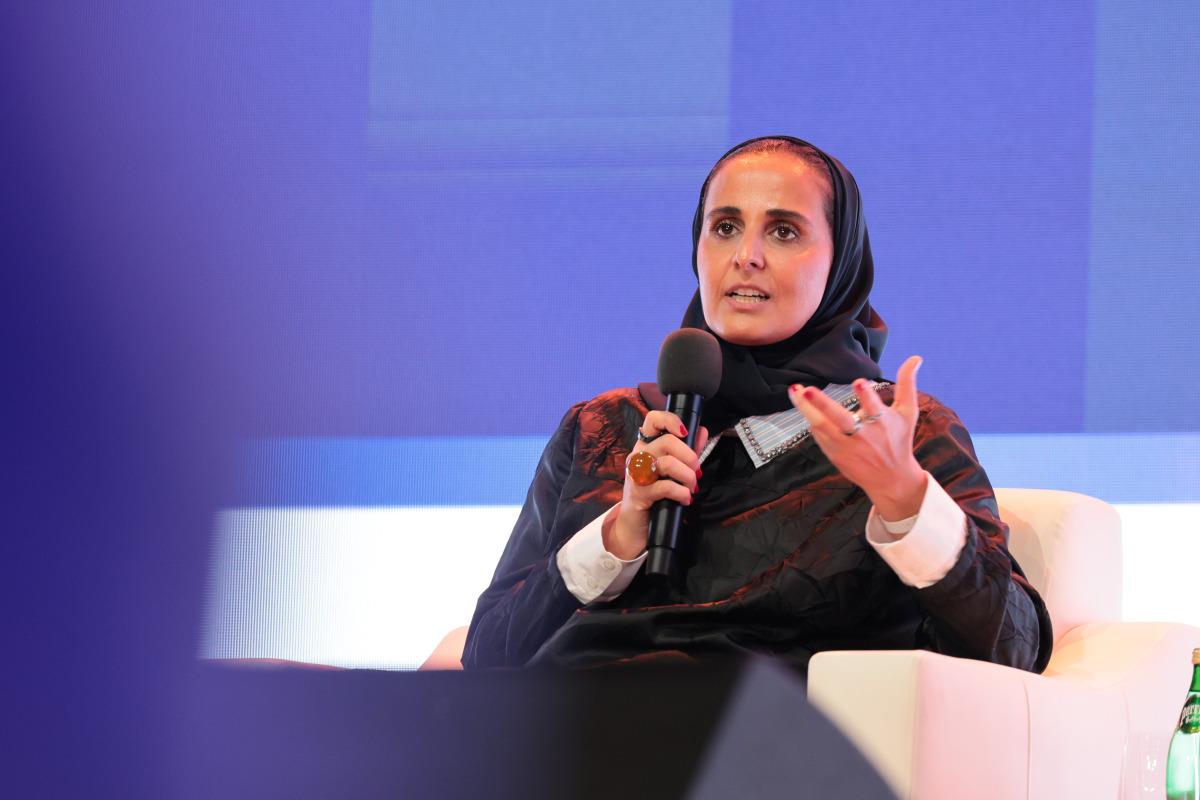
Sheikha Al Mayassa Highlights Leadership Vision, Creativity And Investment In People As Foundations For Qatar's Future


DOHA: Chairperson of Qatar Museums HE Sheikha Al Mayassa bint Hamad bin Khalifa Al Thani spoke about Qatar's ability to deliver its most ambitious cultural season yet despite ongoing global challenges, during a conversation with internationally renowned architect Lord Norman Foster at the 11th Art for Tomorrow conference.
Held on 5 November at Fereej Al Asmakh as part of Design Doha Biennial 2026 opening, the conversation, titled The Future is a Design Question, was moderated by Aric Chen, Director of the Zaha Hadid Foundation.
HE Sheikha Al Mayassa pointed to the extensive programme of exhibitions, cultural events and creative initiatives launched across Qatar over the past two weeks as part of the Qatar Creates Fall/Winter 2026–27 season. She spoke about the country's determination to pursue its cultural ambitions despite the uncertainty and challenges affecting the wider region.
“With the unlimited challenges that we face due to the geopolitics, we're still able to realise the most ambitious season yet,” she said.
Her remarks followed two weeks of major cultural openings and international gatherings across Qatar as part of the Qatar Creates Fall/Winter 2026–27 season, including the opening of the second edition of Design Doha Biennial. The biennial has welcomed artists, designers, architects and cultural leaders from around the world, demonstrating Qatar's ability to continue developing its cultural sector and connecting creative communities despite the wider geopolitical climate.
During the conversation, HE Sheikha Al Mayassa also discussed how Qatar's cultural development is guided by a clear national vision, supported by investment in education, creative industries and opportunities for future generations.
“I think what Qatar had with its leadership is a political will,” she said, explaining that every development is guided by an intention and an understanding of what is needed in society.
She referred to the Qatar Blueprint initiative, which encourages coordination between stakeholders in planning neighbourhoods and public spaces, and Qatar National Vision 2030, initiated under the leadership of the late His Highness the Father Amir Sheikh Hamad bin Khalifa Al Thani and carried forward by His Highness the Amir Sheikh Tamim bin Hamad Al Thani. Qatar Blueprint is a peninsula-wide initiative led by Qatar Museums, integrating national development with cultural activation.
“You cannot think about the hardware without thinking about the software,” she said, recalling her father's belief that Qatar's greatest asset is its people, including Qataris and those who have chosen to make the country their home.
She explained that this approach has guided Qatar Museums' cultural development, where the construction of museums and creative institutions has been accompanied by investment in education, professional and vocational training and local expertise.
When speaking about vocational training, HE Sheikha Al Mayassa pointed to workshops with leading international architects and partnerships that connect young designers with professional practice.
The conversation also addressed Lusail City, including Lusail Stadium, which hosted the FIFA World Cup Qatar 2022 final, and the Al Sa'ad Plaza Towers designed by Foster + Partners.
HE Sheikha Al Mayassa described the development as part of Qatar's national vision to create modern cities while maintaining a connection to the country's architectural heritage.
Lord Norman Foster discussed the towers' climate-responsive design, drawing on traditional shading and courtyard architecture. He also praised Qatar's vision and determination to transform ambitious plans into major developments.
“The realisation of the city, as we experience it today, is the outcome of a political will,” he said, describing the courage, determination and willingness to take risks behind Qatar's development as inspirational.
Turning to Design Doha Biennial 2026, HE Sheikha Al Mayassa explained that the event was established to showcase the region's creative talent, connect designers and artisans with international industries, and create new professional opportunities.
“Our intention with Design Doha is to show the talent that we have, which is enormous in our parts of the world,” she said, emphasising the importance of connecting creative professionals with architects, developers and manufacturers to support the growth of the design industry.
The second edition of Design Doha Biennial features more than 500 objects by 300 designers from 20 countries, presented across 20 exhibitions and five public design commissions. Its flagship exhibition, Arab Design Now 2026, features 81 designers, 78 new commissions and 17 films, highlighting the relationships between designers and artisans, traditional craftsmanship and contemporary design practices across the region.
She also discussed the recently launched Qatar Fashion and Crafts Council (QFCC), a regional initiative connecting industry leaders across the 22 Arab countries to share knowledge, preserve craftsmanship and create opportunities for artisans to contribute to major projects.
Addressing the growing influence of artificial intelligence, HE Sheikha Al Mayassa spoke about the importance of protecting human creativity and the relationships between artists, designers and craftspeople.
“I would never want to replace a creative with an AI,” she said, describing the creative economy as a powerful and resilient response to technological change.
Her Excellency further emphasised that Qatar's international cultural ambitions begin with its own heritage and creative communities.“You have to invest in the local as well as global,” she said, explaining that cultural authenticity and traditional knowledge can inspire contemporary design while attracting international interest.
Lord Norman Foster concluded by discussing the ingredients needed to create successful neighbourhoods, including public transport, pedestrian connections, shaded spaces and community life. He praised Qatar's approach to planning and investment in infrastructure for future generations.
“Planning here [in Qatar] has a very positive vibration. It's an investment in the future,” he said.
The discussion formed part of Redesigning Dialogues, presented by Art for Tomorrow in collaboration with Design Doha Biennial 2026, with the Biennial's exhibitions running until 31 January 2027.

Legal Disclaimer:
MENAFN provides the
information “as is” without warranty of any kind. We do not accept any
responsibility or liability for the accuracy, content, images, videos,
licenses, completeness, legality, or reliability of the information
contained in this article. If you have any complaints or copyright issues
related to this article, kindly contact the provider above.


Comments
No comment