


Qatar Advances Vision For Seamless Terrestrial And Satellite Connectivity At MWC26 Doha


Doha, Qatar: Qatar has reaffirmed its commitment to building a resilient, sustainable and globally competitive digital economy through enhanced international cooperation and advanced connectivity infrastructure.
Speaking at a high-level ministerial panel on the opening day of MWC26 Doha yesterday Minister of Communications and Information Technology HE Mohammed bin Ali Al Mannai highlighted Qatar's progress in integrating terrestrial and satellite networks, strengthening digital resilience and unlocking new opportunities for innovation, investment and economic growth.
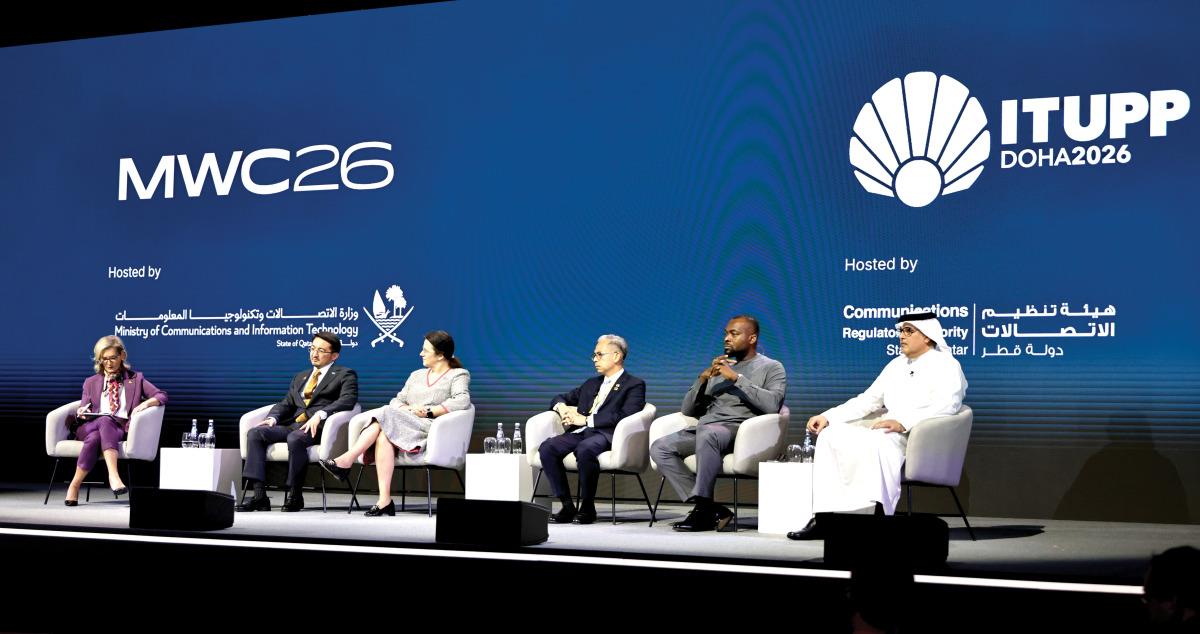
The panel titled 'Accelerating Cooperation for a Connected Digital Future' explored opportunities to strengthen international cooperation in developing secure, reliable and resilient communications networks, as well as the role of regulatory policies, investment and emerging technologies in expanding connectivity and supporting sustainable digital transformation.
The panel brought together Deputy Prime Minister and Minister of Artificial Intelligence and Digital Development of the Republic of Kazakhstan H E Zhaslan Madiyev, Minister of Justice and Digital Affairs of the Republic of Estonia H E Liisa-Ly Pakosta, Minister of Communications of Malaysia H E Ahmad Fahmi Fadzil, and Minister of Communications, Innovation and Digital Economy of the Federal Republic of Nigeria H E Dr. Bosun Tijani.
The discussion was moderated by Doreen Bogdan-Martin, Secretary-General of the International Telecommunication Union (ITU).
During the discussion, the Minister highlighted Qatar's experience in developing advanced digital infrastructure, with a focus on integrating terrestrial and satellite communications networks to strengthen service continuity and support the growing adoption of cloud computing, artificial intelligence and digital services.
Qatar's ambitions extend beyond developing telecommunications networks to building the foundations of a resilient and globally competitive digital economy. Integrating terrestrial and satellite networks provides additional connectivity options, strengthens the continuity of essential services and economic activities, and creates new opportunities for investment and innovation, Minister Al Mannai pointed out.
He also highlighted Qatar's efforts to expand satellite connectivity capabilities and advancements in satellite-based services offered by telecommunications operators, supporting critical sectors including energy, aviation, maritime transport and logistics.
Addressing the challenges of integrating terrestrial and satellite networks, the Minister pointed to spectrum management, network interoperability and the protection of critical infrastructure. He outlined Qatar's approach to addressing these challenges through long-term planning, progressive regulatory frameworks, public-private partnerships and international collaboration.
Regarding Qatar's Digital Agenda 2030 he stressed the importance of translating digital infrastructure investments into tangible economic value by fostering innovation, improving productivity, attracting investment and creating new opportunities for business growth and economic development.
Deputy Prime Minister and Minister of Artificial Intelligence and Digital Development of the Republic of Kazakhstan H E Zhaslan Madiyev said the country's vast geographical area presents significant challenges in expanding connectivity, requiring sustained investment and innovative approaches.
He noted that Kazakhstan, the world's ninth-largest country, covers 2.7 million square kilometres, with an average population density of just eight people per square kilometre.
Despite these challenges, Kazakhstan has developed an advanced digital government ecosystem, with almost all public services available online. Madiyev said more than 90% of transactions in the country are cashless, underlining the importance of reliable connectivity.
He revealed that the government is investing in fibre-optic infrastructure to extend coverage to more than 3,000 additional villages, with the aim of providing over 90% of villages with fibre-optic access by the end of next year.
He also highlighted the launch of a direct-to-cell solution with mobile operator Beeline and the Trans-Caspian Fibre Optic project, developed with Azerbaijani partners to diversify international internet traffic and improve network resilience.
Meanwhile, Estonia's Minister of Justice and Digital Affairs H E Liisa-Ly Pakosta highlighted her country's experience in digital transformation, noting that all public services have been digital since 2024.
She said Estonia already has 260 AI-based services and is continuing to expand their use.
“Connectivity, networks, mobile communications, it's not about technology. Technology is the easy part,” Pakosta said, stressing that the greater challenge is ensuring everyone can access and benefit from digital services.

Legal Disclaimer:
MENAFN provides the
information “as is” without warranty of any kind. We do not accept any
responsibility or liability for the accuracy, content, images, videos,
licenses, completeness, legality, or reliability of the information
contained in this article. If you have any complaints or copyright issues
related to this article, kindly contact the provider above.


Comments
No comment