


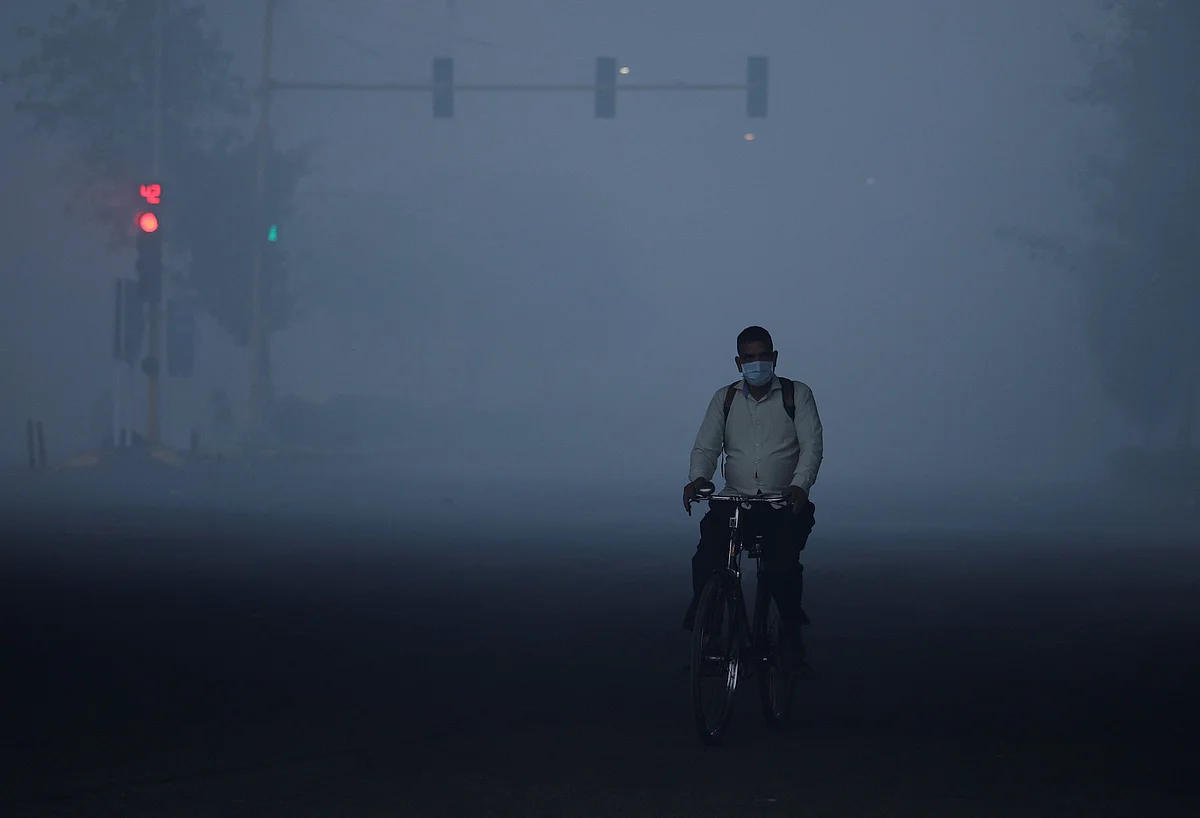
'Can't Breathe Properly': India's Delhi Records Very Poor Air Quality After Diwali


The Air Quality Index was recorded at 370 - seven times the upper limit of“good air quality”, as per the World Health Organisation, at 7am. Several private monitoring stations had recorded AQI readings of more than 400, with air quality levels in the“severe” category.
Recommended For You Saudi-led coalition targets Houthi missile launchers used in attempted Riyadh attackA reading between zero and 50 is considered good, 51-100 is satisfactory, 101-200 is moderate, 201-300 is considered poor, 301-400 is very poor, and 401-500 is severe, according to the government's Central Pollution Control Board.
Stay up to date with the latest news. Follow KT on WhatsApp Channels.
The PM2.5 concentration in the city was 218 micrograms per cubic metre, according to IQAir, a Swiss air quality technology company that analyses global air quality data.
These fine particles, called particulate matter, penetrate deep into the lungs and bloodstream and are blamed for chronic respiratory and cardiac diseases.
People were complaining of throat congestion, burning eyes and difficulty in breathing.
Watch KT India correspondent Taniya Dutta explaining the situation in Delhi on Monday:
Inhaling, exhaling poison
“I can't breathe here properly, the air is dense. We planned to see the President's House from India Gate but it is hardly visible. We are carrying masks,”Mahalaxmi Iyer,48, a tourist at India Gate told Khaleej Times on Modnay. She was visiting the city from Gujarat.
Dr Vijay Hadda, a professor at India's premier government hospital All India Institute of Medical Sciences, said "air like this is not suitable for human survival."
"As time goes on, we'll start to see its effects. We are inhaling and exhaling poison," he added.
A ten-year-old boy named Rishi in the capital's Narela district had died after a firecracker exploded in his chest.
“My younger brother was bursting small firecrackers...while my younger brother was lighting one, it exploded and struck him in the chest from behind, causing severe injuries,” his brother Mohit told the media.
'Missing Data'Opposition political parties raised questions over the reliability of the AQI tracking exercise as they claimed that several monitoring stations had stopped recording data on real time.
Some private AQI monitoring organisations such as IQAir reported over 1000 AQI-hazardous levels-on Monday in at least two locations. Some people on social media claimed that air quality levels were at 2000.
Saurabh Bhardwaj from Aam Aadmi Party, that ruled the city until last year, accused the Delhi government led by Bharatiya Janata Party of“data manipulation” to manipulate air quality readings to downplay pollution levels, putting people's lives at risk.
“Water is being sprayed directly on top of AQI monitoring stations to manipulate Delhi's AQI data. They reduce the pollution, but like GDP, they are fudging data to show AQI is coming down,” Bhardwaj alleged said on X.
“This is dangerous and life-threatening, as elderly and kids will trust the fake data and risk going outdoors when unsafe,” he added.
Ajay Makan, a parliamentarian from the opposition Congress party, claimed that 25 of the city's 39 stations were not recording PM 2.5 data.
“According to CPCB data, no PM2.5 readings were recorded at 25 of Delhi's stations between 2 and 3 am on the night of November 8–9...Air pollution 38.4 times the WHO limit, yet no readings recorded at 25 stations,” he said on X.
World's most polluted capitalDelhi, home to a population of 22 million, is ranked as the world's most polluted capital city, with a chronic pollution problem throughout the year. However, toxic air levels spike during winter due to emissions that are further aggravated by the millions of firecrackers set off during the Hindu festival of Diwali.
The Supreme Court banned firecrackers in 2018 that contain toxic substances like lead, arsenic and barium but allowed the use of less polluting varieties. It also called Delhi a“gas chamber” in 2019 over its deteriorating air.
The top court had last week permitted designated hours for green or certified low-polluting fireworks, with a complete ban on firecrackers to be reinstated from November 9. However, tens of millions of firecrackers were burst throughout the night and well into Monday morning.
A thick layer of toxic smog had covered the city. The India Gate, a prominent landmark in central Delhi, close to government offices and parliament, remained enveloped in a thick layer of smoke.
The city has been reeling under a dangerous spell of pollution for the past one week.
Authorities have imposed a slew of measures, including banning diesel vehicles older than 10 years and petrol vehicles older than 15 years from entering the city. They have also banned the use of coal and firewood in roadside eateries, imposed restrictions on mechanical or vacuum sweeping of roads and raised parking fees to discourage the use of personal vehicles.
Delhi's labour minister Kapil Mishra said the pollution crisis was due to stubble farming in the neighbouring state of Punjab, the breadbasket of India.
Stubble burning, a practice in which farmers in the vast farmlands of neighbouring Punjab and Haryana burn paddy stubble to clear their fields for the next crop.
Most of the smoke travels to Delhi due to southwestern winds and mixes with the city air to form a noxious blanket of smog aggravating the pollution crisis.
Experts, however, say that stubble burning is not the only reason for the city's toxic pollution levels. A concoction of pollutants from construction sites, vehicular emissions, and road dust combined with smoke from stubble burning and firecrackers gets trapped in air in winters
Various administrations have promised to clean the city's air and introduce policy reforms, but the issue of pollution, including this year, has persisted.
ALSO READ- Toxic smog blankets Indian capital as Diwali firecracker concerns mount India orders Delhi schools to offer online classes as air quality worsens ahead of Diwali Delhi air quality worsens as revellers celebrate Diwali with illegal fireworks

Legal Disclaimer:
MENAFN provides the
information “as is” without warranty of any kind. We do not accept any
responsibility or liability for the accuracy, content, images, videos,
licenses, completeness, legality, or reliability of the information
contained in this article. If you have any complaints or copyright issues
related to this article, kindly contact the provider above.


Comments
No comment