


Commentary: How UAE Oil Deal Could Strengthen Philippines' Energy Security


- By: Imran Khalid
The author is a geostrategic analyst and senior fellow at Foreign Policy In Focus - USA. His work centres on international affairs and global security.
Filipino motorists learn how far the oil market has moved every Tuesday, when pump prices are reset across the country. For most of this year, the Tuesday news has been grim.
Recommended For You Saudi-led coalition targets Houthi missile launchers used in attempted Riyadh attackThe Philippines was the first country to declare a national energy emergency after the conflict around Iran disrupted traffic through the Strait of Hormuz, and even after weeks of emergency buying, its stocks covered fewer than 60 days, most of them privately held. For a country that imports nearly all of its oil, that is a thin cushion, and since March the question in Manila has been who might help make it thicker.
The most practical answer so far has come from Abu Dhabi. Recently, Filipino senator Erwin Tulfo, chairman of the Senate energy committee, sat down with ADNOC chairman Sultan Al Jaber to discuss a strategic oil facility on Philippine soil.
Stay up to date with the latest news. Follow KT on WhatsApp Channels.
According to Senate President Sherwin Gatchalian, ADNOC is prepared to pay for both the tanks and the oil inside them if the Philippine National Oil Company (PNOC) provides the land, and Manila would get priority access to the stock in an emergency. Both sides are aiming for a rollout by mid-2027.
The arithmetic explains why Manila is keen. The country burns about 460,000 barrels a day, and the state depot planned for Bataan will open with a single tank of one million barrels, about two days of demand. Building a real reserve would mean buying tens of millions of barrels at the worst possible prices. Manila brings the land. Abu Dhabi brings the storage tanks and the oil.
Why should a tank farm in Bataan matter to a jeepney driver in Quezon City? Because of how his diesel is priced. Oil companies reset pump prices each Tuesday based on the previous week's Mean of Platts Singapore, the regional benchmark, plus shipping, and they charge what it will cost to replace their stock, not what they paid for it.
When a fifth of the world's oil was trapped behind Hormuz, Asian buyers fought over the remaining cargoes, Singapore prices jumped, and freight and risk premiums followed. Philippine diesel rose by 100 to 177 per cent. A tank in Bataan cannot set the world price, but it removes the fear of running dry, which is what turns an expensive week into a panic.
Proven ventureThis is not an experiment. Japan has given ADNOC free tank space since 2009 and Saudi Aramco the same in Okinawa since 2011, counting half the barrels towards its national reserve and holding first claim on them in an emergency. South Korea does the same at Yeosu, where ADNOC first stored crude in 2013, and at Ulsan, where Aramco keeps 5.3 million barrels. Korea's national oil company reckoned that buying 4 million barrels of Emirati crude itself would have cost about $300 million. ADNOC also holds 5.86 million barrels in India's Mangalore caverns and plans to raise its holdings in India's reserves to 30 million barrels.
This year, the model passed its first real test. In late March, Tokyo moved to draw on the roughly 13 million barrels held there by Saudi, Emirati and Kuwaiti companies, and Seoul exercised its first-purchase right over 2 million barrels of ADNOC crude at Yeosu, sending all of it to Korean refiners. In May, Japan's industry minister, Ryosei Akazawa, said the UAE had promised to replenish what Tokyo had drawn and to enlarge the stockpile. The hosts got a second line of supply without carrying its cost.
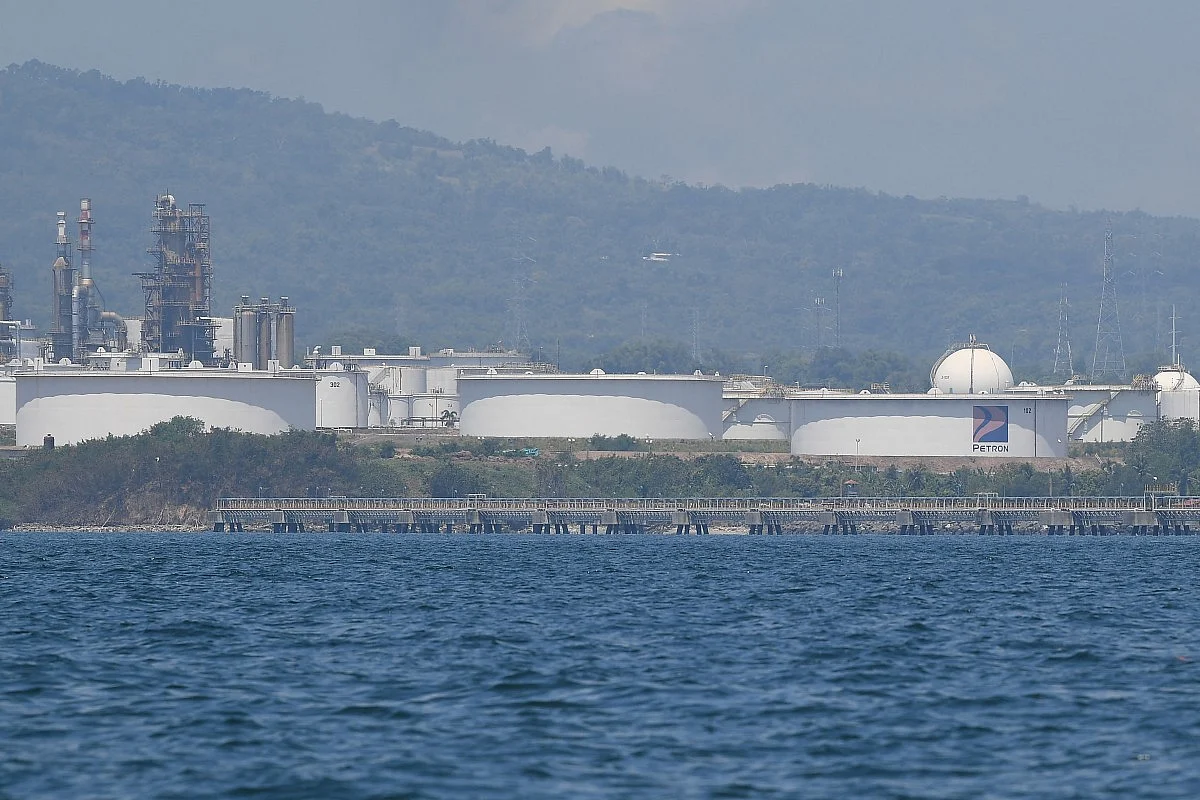
For obvious reasons, geography makes the Philippine version especially useful. The UAE already supplies 28 per cent of the crude refined at Petron's Bataan plant, and the Emirates and Saudi Arabia can both export through pipelines that avoid Hormuz. ADNOC's Habshan-Fujairah line carries up to 1.5 million barrels a day to the Gulf of Oman, and a second line due in 2027 should double that capacity. Add a tank farm in Bataan, and the chain runs from Abu Dhabi's oilfields to Luzon without touching the strait.
Part of CEPAThe storage plan is also part and parcel of a relationship that has thickened quickly. In January this year, the two countries signed a trade agreement (UAE–Philippines Comprehensive Economic Partnership Agreement or CEPA), Manila's first with any Middle Eastern state, and both want the oil facility to anchor a wider energy pact. The human link is just as palpable: the UAE was the top land-based destination for Filipino workers last year, with 397,892 deployments, and their families at home depend on fuel too.
Manila is not alone. Saudi Arabia has made a similar storage offer, Aramco will store crude in Singapore's Jurong Rock Caverns from late 2027, and Thailand wants to host Middle Eastern producers too. We must expect more of Southeast Asia to look at the Philippine template.
The offer is generous, and that is exactly why Manila should do its homework before it signs. Three issues deserve attention.
First, refining. Petron's refinery, the country's only one, processes 180,000 barrels a day, about a third of demand, and most refined fuel comes from Asia. A hub holding only crude would help the refinery more than the jeepney driver. Manila should ask for a fixed share of diesel.
Second, the emergency terms. Priority access secures supply, not a discount, so pricing and release rules must be settled before the next crisis. ADNOC has already accepted written strategic terms in India. This is a negotiation over detail, not principle.
Third, Manila's own capacity to deliver. The land, permits and port access are PNOC's job, and in 2022 Gatchalian complained that its reserve plan had been put on hold. The mid-2027 target depends more on Manila's paperwork than on Abu Dhabi's money.
There was a view in Manila in March that the lesson of the crisis was to buy less from the Gulf. It seems the opposite lesson is the sounder one. What failed was the sea route, not the supplier, and a reserve already sitting on Philippine soil takes the route challenge out of the equation.
When the Emirati contract framework lands on PNOC's desk, the headline number will be capacity. The clauses worth reading are the ones on land, product mix and emergency release, because those will decide whether a tank in Bataan becomes the reserve the Philippines was missing in March.
ALSO READ- Petrol prices drive highest Philippine inflation in years Philippines in talks with UAE, Saudi, US, Russia, Kuwait, Australia on oil storage Commentary: From Oman to Iran, Strait of Hormuz remains central to Gulf security

Legal Disclaimer:
MENAFN provides the
information “as is” without warranty of any kind. We do not accept any
responsibility or liability for the accuracy, content, images, videos,
licenses, completeness, legality, or reliability of the information
contained in this article. If you have any complaints or copyright issues
related to this article, kindly contact the provider above.


Comments
No comment