


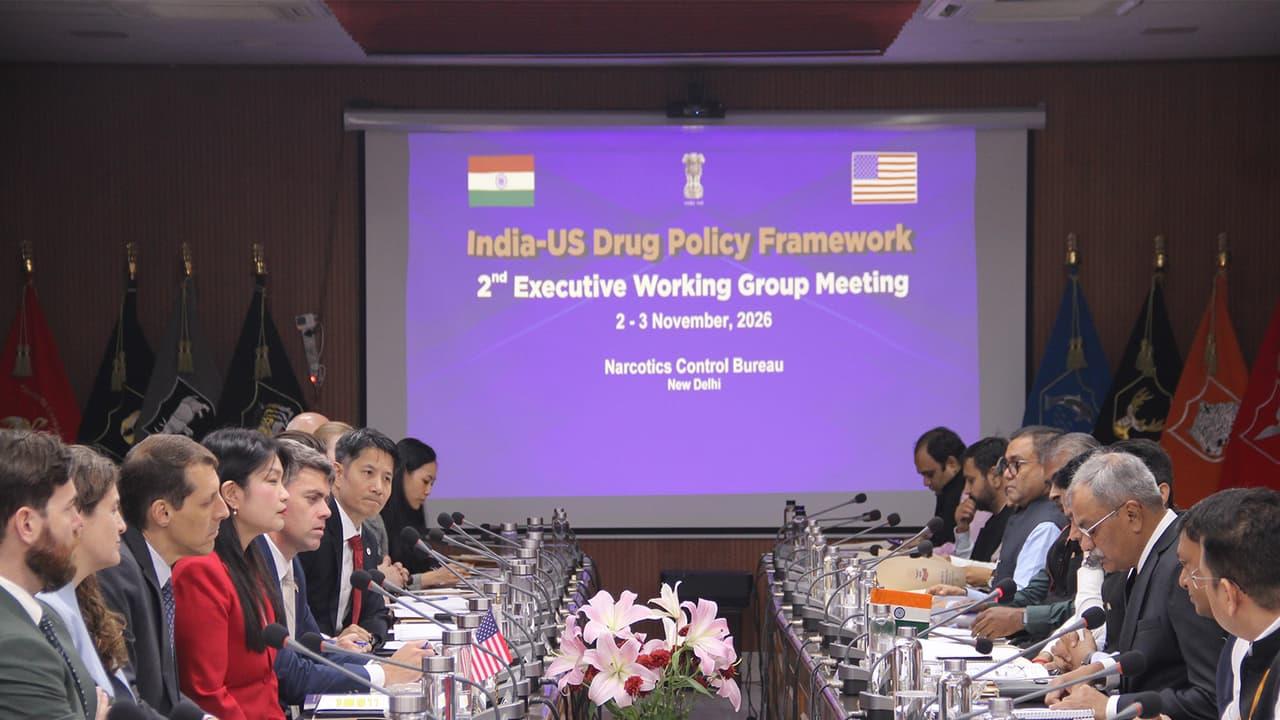
India And US Strengthen Counter-Narcotics Cooperation In New Delhi


Strengthening India-US Counter-Narcotics Cooperation
The Narcotics Control Bureau (NCB), Ministry of Home Affairs, Government of India, hosted the 2nd India-US Drug Policy Executive Working Group Meeting on November 2-3 in New Delhi. According to a press release, a wide spectrum of policymakers and law enforcement officials working closely on counternarcotics from both countries participated in the meeting. The Indian delegation was led by Anurag Garg, Director General, NCB, and the US delegation was headed by Debbie Seguin, Acting Deputy Director, Office of National Drug Control Policy (ONDCP).
Pursuant to the terms of reference of the US-India Drug Policy Framework, the meeting reviewed bilateral cooperation in combatting illicit drug trafficking and identified priority areas for strengthening intelligence sharing, coordinated law enforcement action, precursor control, pharmaceutical supply chain integrity, and drug demand reduction.
Strategic Roadmap and Enforcement Approach
As per the release, in his opening remarks, Anurag Garg highlighted the India Vision Roadmap 2026–2029, formulated under the guidance of Prime Minister Narendra Modi and the leadership of Union Home Minister Amit Shah. The roadmap outlines a comprehensive strategy to combat the illicit narcotics trade, emphasising network-centric investigations, precursor control, financial investigations, prevention, and rehabilitation. The Director General also highlighted India's adoption of a network-centric approach to decisively dismantle drug trafficking networks by targeting their entire ecosystem, including financiers, suppliers, facilitators and logistical networks.
Separately, ONDCP Director Sara Carter, US Drug Czar, emphasised that“the Executive Working Group and bilateral cooperation between the United States and India is vital to disrupting transnational drug trafficking networks and preventing the diversion of synthetic drugs and chemical precursors into global markets”. Director Carter elaborated further, stating,“Under President Trump's 2026 National Drug Control Strategy, we recognise that the criminal networks and foreign terrorist organisations we face today operate like sophisticated, multinational logistics enterprises. To defeat an adversary built like a global business, our strategy must be equally targeted: we must partner across borders to secure the commercial supply chains they exploit.”
Operational Outcomes and Future Collaboration
Highlighting the operational strength of the partnership on the ground, US Ambassador to India Sergio Gor stated,“President Trump has been clear: protecting our people starts with securing our borders and cutting off illicit drug networks at the source. India and the United States aren't just talking about cooperation; we are delivering real operational results-choking off illicit precursor chemicals, securing commercial supply chains, and dismantling the cartels that exploit them. When our two law enforcement communities coordinate with this level of speed and trust, we protect American and Indian families alike.”
According to the release, the United States and India built on the progress of the first Executive Working Group meeting, held in Washington, DC, in January 2026. The delegations discussed current drug trafficking trends and emerging threats. They welcomed joint and national initiatives at the operational and regulatory levels, including Operation MedMax, Operation WIPE, and India's Voluntary Code of Conduct to prevent the diversion of precursor chemicals used to make synthetic drugs. The meeting underscored the importance of sustained institutional engagement, timely intelligence exchange, and coordinated action to address emerging narcotics threats and promote demand reduction. Both sides agreed to further sharing of best practices in targeted law enforcement topics. The meeting signified the abiding and shared commitments by India and the United States to advance bilateral counternarcotics cooperation towards ensuring the safety and well-being of their communities. The White House Office of National Drug Control Policy leads and coordinates US drug policy, develops and implements the President's National Drug Control Strategy, and supports communities through the Drug Free Communities Support (DFC) and High Intensity Drug Trafficking Area (HIDTA) programs. (ANI)
(Except for the headline, this story has not been edited by Asianetnews Editorial staff and is published from a syndicated feed.)
Legal Disclaimer:
MENAFN provides the
information “as is” without warranty of any kind. We do not accept any
responsibility or liability for the accuracy, content, images, videos,
licenses, completeness, legality, or reliability of the information
contained in this article. If you have any complaints or copyright issues
related to this article, kindly contact the provider above.


Comments
No comment