


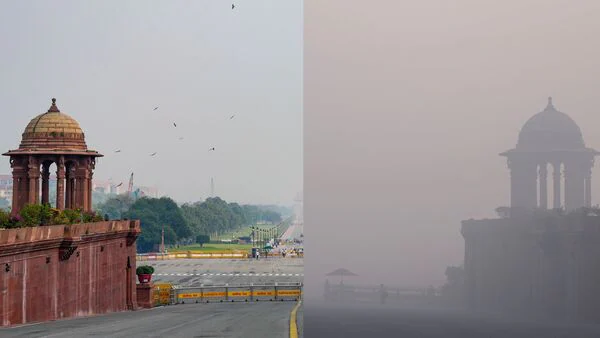
Panchgaon Tops Pollution Chart With AQI Of 365, Delhi Ranks Eleventh


Kaithal in Haryana ranked second with an AQI of 355, followed by Anpara and Baraut in Uttar Pradesh at 336 and 330, respectively. Khora in Uttar Pradesh recorded an AQI of 329, while Ujjain in Madhya Pradesh registered 327. Both were in the 'very poor' category.
Gurugram in Haryana recorded an AQI of 321. Noida and Faridabad registered 313 each, while Bahadurgarh in Haryana recorded 310. Mandi Gobindgarh in Punjab had an AQI of 309. New Delhi and Charkhi Dadri recorded 307 each, placing them 11th on the list.
Quick answers to key questions
.5 QUESTIONS1What was Panchgaon's AQI, and which city ranked highest for pollution?⌵Panchgaon in Haryana recorded an AQI of 365 at 7:05 am on Tuesday, the highest reading among the listed cities. It was classified as 'very poor' air quality.
2Why was an AQI of 365 classified as very poor?⌵Under CPCB's classification, AQI readings from 301 to 400 are 'very poor'. Prolonged exposure at these levels is associated with respiratory illness, even among healthy people.
3What was Delhi's position in the city pollution ranking?⌵New Delhi and Charkhi Dadri each recorded an AQI of 307, placing them 11th on the list. Several Delhi localities had readings above 350.
4What restrictions apply under GRAP Stage 3 in Delhi-NCR?⌵Stage 3 bans BS-III petrol and BS-IV diesel or older four-wheelers in Delhi and specified NCR districts, and prohibits dust-generating construction and demolition across NCR. It also restricts certain older commercial and goods vehicles.
5What health effects are associated with severe AQI levels?⌵CPCB classifies AQI readings from 401 to 500 as 'severe'. At these levels, even healthy people may experience respiratory effects, while people with existing health conditions may face more serious impacts.
Several localities in Delhi also recorded AQI readings above 350 at 7:05 am on Tuesday, indicating very poor to severe air quality. Among the areas with high pollution levels were Aya Nagar (354), Burari Crossing (360), Chandni Chowk (395), Commonwealth Sports Complex (380), CRRI Mathura Road (369), IIT Delhi (364), JNU (369), North Campus, Delhi University (372), NSUT Jaffarpur (382), Punjabi Bagh (355), Pusa (395), Siri Fort (371) and Talkatora Garden (372).
Also Read | How Waaree Energies dumped toxic effluents in a Gujarat villageThe concentration of highly polluted cities across Haryana, Uttar Pradesh, Punjab and Delhi highlights the growing air-quality challenge in northern India. The rise in pollution levels has renewed concerns over the region's air quality and the need for stricter enforcement of pollution-control measures.
AQI categoriesAccording to the CPCB classification, an AQI between 0 and 50 falls under the 'good' category, indicating minimal health impact. A reading between 51 and 100 is classified as 'satisfactory', while an AQI of 101-200 falls under the 'moderate' category.
An AQI between 201 and 300 is categorised as 'poor', which may cause breathing discomfort to people with prolonged exposure, particularly those with respiratory conditions. The next category, 'very poor', covers readings between 301 and 400 and is associated with respiratory illness on prolonged exposure, even among healthy people.
The highest category, 'severe', applies to AQI levels between 401 and 500. At these pollution levels, even healthy people may experience respiratory effects, while those with existing health conditions may face more serious impacts.
"The situation across the NCR is grim. Pollution levels have surged, leading to a sharp rise in patients coming to the OPD and emergency rooms with severe respiratory distress, incessant coughing, watery eyes, and bronchospasm-induced chest pain. It is not just vulnerable groups-even individuals with no prior history of breathing ailments are suffering, while young children and patients with asthma or interstitial lung disease are bearing the brunt," said Dr. Bobby Bhalotra, senior consultant pulmonologist at Apollo Hospitals, Gurugram.
Also Read | Delhi air pollution crisis: Does India have a health adaptation plan? GRAP curbsStage 3 of the Graded Response Action Plan (GRAP) is currently active across Delhi-NCR, alongside special vehicle and dust-control rules that will be enforced starting 1 November 2026.
Under GRAP Stage 3, imposed on Friday, there is a ban on the plying of BS-III petrol and BS-IV diesel or below emission-standard light motor vehicles (LMVs, four-wheelers) in Delhi and in the districts of Gurugram, Faridabad, Sonipat, Ghaziabad and Gautam Buddha Nagar.
Dust-generating construction and demolition (C&D) activities are also prohibited across the entire NCR. In addition, Delhi-registered commercial diesel vehicles and medium goods vehicles of BS-IV and below emission standards are barred from plying. Similar medium and light goods vehicles registered outside Delhi are completely barred from entering the capital.
GRAP is a set of emergency measures designed to prevent further deterioration in air quality once pollution levels cross specified thresholds.
Also Read | Centre considers ₹1,150 crore scheme to curb industrial pollution in NCR
Legal Disclaimer:
MENAFN provides the
information “as is” without warranty of any kind. We do not accept any
responsibility or liability for the accuracy, content, images, videos,
licenses, completeness, legality, or reliability of the information
contained in this article. If you have any complaints or copyright issues
related to this article, kindly contact the provider above.


Comments
No comment