


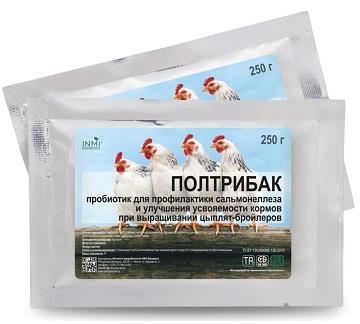
Manufacture And Supply Of Probiotic "POULTRYBAC" For Preventing Salmonellosis, Upgrading Assimilation Of Fodder And Raising Productivity Of Broilers


(MENAFN- RCTT)
The Institute of Microbiology of the National Academy of Sciences of Belarus offers consumers probiotic ((POULTRYBAC)) for preventing salmonellosis, upgrading assimilation of fodder and raising productivity of broilers under a manufacturing agreement and is looking for partners interested in a distribution services agreement.
Description
The Institute of Microbiology of the National Academy of Sciences of Belarus together with EE ((Grodno State Agrarian University)) has developed probiotic ((POULTRYBAC)), designed for:
* preventing salmonellosis;
* upgrading assimilation of fodder;
* raising productivity of broilers.
The based of preparation is freeze-dried cells of:
* lactic acid bacteria Lactobacillus paracasei (or Lactobacillus paraplantarum) and Lactococcus lactis;
titer – not less than 1,0x10¹⁰ CFU/g;
* bifidobacteria Bifidobacterium adolescentis;
titer – not less than 1,0x10⁹ CFU/g.
Feed additive includes bacteria screened for presence of antagonistic activity against Salmonella typhimuriumand for ability to synthesize enzymes hydrolyzing oligo- and polysaccharides in fodder, leading to normalization of gut microbiota, improved nutrient assimilation and acceleration of broiler growth.
((POULTRYBAC)) fed with water to broilers results to:
* increase in the average daily growth over the growing periods by 4.9%;
* live weight of chickens gain by 4.8%;
* reduction of fodder expense per 1 kg of live weight gain by 4.5%;
* rise of rearing efficiency index by 31.9%.
The probiotic increases eviscerated meat yield by 5.1%. The profitability of broiler breeding process reaches 10.27%.
Application guidelines for broilers: 4 g of preparation / 100 l of water in first 2..3 weeks after hatching.
Treatment is possible in combination with means of substitution therapy, as well as antibacterial drugs to which bifidobacteria, lactobacilli and propionic acid bacteria are resistant.
Application of ((POULTRYBAC)) promotes output of eco-friendly farm products.
Application area: agriculture (poultry farming).
Institute of Microbiology offers partners:
* probiotic ((POULTRYBAC)) for preventing salmonellosis, upgrading assimilation of fodder and raising productivity of broilers under a manufacturing agreement;
* probiotic ((POULTRYBAC)) for preventing salmonellosis, upgrading assimilation of fodder and raising productivity of broilers under a distribution services agreement.
Product catalog of the ((Institute of Microbiology of NAS of Belarus)) 2023, p.19.
Link on the Institute of Microbiology site (in Russian). Advantages and Innovations Import substitution of probiotic preparations:
((IMMUNOBACK)) (((Veda)) LLC, Russian Federation);
((Broiler Probiotics)) (((Pangoo Biotech)), China);
((PoultryStar®)) (((Biomin)), Austria). Stage of development Already on the market Comments regarding stage of development ТУ BY 100289066.157-2019
Registration certificate No 14-1469-030320 Funding source State budged
Internal
IPR status Exclusive rights
Secret know-how
Trade marks
Sector group Agrofood
BioChemTech
Materials
Client information Type R&D institution Year established 1975 NACE keywords A.01.62 - Support activities for animal production
C.20.20 - Manufacture of pesticides and other agrochemical products
M.72.11 - Research and experimental development on biotechnology
M.72.19 - Other research and experimental development on natural sciences and engineering
M.74.90 - Other professional, scientific and technical activities n.e.c.
Turnover (in EUR) 10-20M Already engaged in transnational cooperation Yes Additional comments The Institute of Microbiology is the leading research center of the Republic of Belarus in the field of microbiology and biotechnology. The Institute's arsenal of innovative developments includes substances for medicines and diagnostics, biopreservatives, feed and food additives, biodisinfectants, probiotics, plant protection products, microbial fertilizers, wastewater and environmental treatment technologies that are in demand by the economy, and specific recommendations for combating biodamage.
Main areas of scientific activity:
- Study of the biodiversity, ecology, physiology, biochemistry, and genetics of microorganisms; development of a national repository of microbial biological resources.
- Selection and genetic engineering of microbial strains capable of producing biologically active compounds of practical significance.
- Development of microbial biotechnologies for industry, agriculture, medicine, and environmental protection.
Key objectives:
- Ensuring the preservation and operation of the Belarusian Collection of Non-Pathogenic Microorganisms (designated as a National Heritage Asset, No. 5), which is registered with the World Federation for Culture Collections (acronym: BIM; collection number: 909). Expanding the collection and the DNA bank of industrially valuable microorganisms.
- Phenotypic and molecular-genetic identification of microorganisms; selection and genetic engineering of strains that produce biologically active compounds.
- Elucidating the mechanisms underlying the biogenesis of enzymes and low-molecular-weight metabolites. Developing production technologies and pilot-scale manufacturing of enzyme preparations for the chemo-enzymatic synthesis of pharmaceutical substances, the production of diagnostic agents, and applications in the food industry and waste processing.
- Developing and implementing technologies for the production of microbial preparations for agriculture and forestry, including biological plant protection agents, microbial fertilizers, bio-preservatives, feed additives, and probiotics.
- Creating environmental biotechnologies and preparations for the remediation of natural and industrial environments contaminated with xenobiotics or petroleum-based pollutants.
- Establishing biotechnological platforms for the production of vaccines. - Development of biotechnologies for the microbial conversion of plant-based raw materials and the production of high-quality animal feed.
- Pilot-scale industrial production of environmentally safe biological preparations for various applications.
- Scientific support for biotechnological manufacturing processes.
Official website of the Institute of Microbiology. Languages spoken English
Russian
Information about partnership Type of partnership considered Distribution services agreement
Manufacturing agreement
Type and role of partner sought Consumers interested in purchasing probiotic ((POULTRYBAC)) for preventing salmonellosis, upgrading assimilation of fodder and raising productivity of broilers under a manufacturing agreement.
Partners interested in purchasing probiotic ((POULTRYBAC)) for preventing salmonellosis, upgrading assimilation of fodder and raising productivity of broilers under a distribution services agreement. Type and size of partner sought > 500
251-500
SME 51-250
SME 11-50
SME <= 10
R&D Institution
University
Sole proprietor

Legal Disclaimer:
MENAFN provides the
information “as is” without warranty of any kind. We do not accept any
responsibility or liability for the accuracy, content, images, videos,
licenses, completeness, legality, or reliability of the information
contained in this article. If you have any complaints or copyright issues
related to this article, kindly contact the provider above.


Comments
No comment