


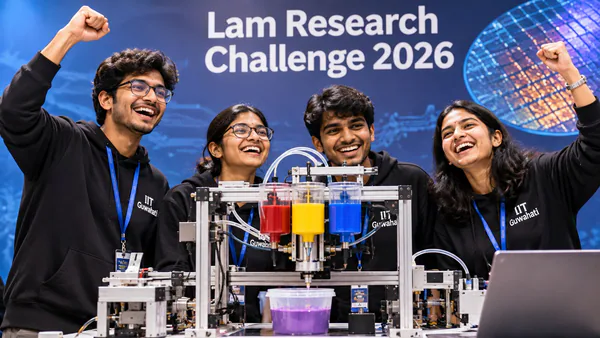
IIT Guwahati Tops Lam Research's Semiconductor Engineering Challenge Winners Share ₹10 Lakh


IIT Ropar secured the runner-up position, while NIT Calicut finished third. The winners were announced at the grand finale held at PES University in Bengaluru.
The top teams shared prize money worth ₹10 lakh, while select participants will also receive internship opportunities with Lam Research.
The competition saw participation from 803 teams representing 189 colleges across the country. Each team comprised four students from multidisciplinary academic backgrounds.
After a three-month selection process involving qualification and hardware-building rounds, 25 teams from 20 colleges progressed to the finale.
Also Read | Shorter tenures, tougher jobs: the challenge facing India's CEOs IIT Guwahati team showcases multidisciplinary engineering skillsThe winning team from IIT Guwahati comprised Suhani Maheswari from Electronics and Communication Engineering, Aakash Kumar Meena from Mechanical Engineering, and Shrut Jain and Kummari Premaja from Electrical and Electronics Engineering.
The IIT Ropar team included students from Mechanical Engineering and Engineering Physics, while the NIT Calicut team comprised students from Mechanical Engineering, Electrical and Electronics Engineering, and Computer Science Engineering.
The finalists included students from 10 IITs, two NITs and two BITS campuses.
Also Read | Who is Neela Nataraj? IIT Bombay math professor earns global recognition What was the engineering challenge?As part of the competition, teams were required to build a tabletop paint factory that could automatically mix three base colours to produce three litres of a target colour, matching a reference sample in the first attempt.
The task required precision in calculating and dispensing the colours, as paint could be added but not removed.
On the second day, teams had to automate the entire process through a single button press. This involved integrating pipeline flushing, tank cooling and colour dosing without human intervention.
During the final round, participants tackled complex technical problems that required them to combine hardware, software, automation, data science, process engineering and advanced controls.
Focus on semiconductor systems engineeringUnlike conventional engineering competitions that focus on individual disciplines, the Lam Research Challenge emphasised systems-level thinking and the ability to develop integrated solutions for complex semiconductor manufacturing operations.
Entries were evaluated on innovation, technical excellence, collaboration, problem-solving and performance under pressure.
Rangesh Raghavan, corporate vice-president and managing director, Lam Research India, said,“The Lam Research Challenge is designed to help students build these capabilities while gaining exposure to the kinds of engineering problems shaping the future of our industry. It further demonstrates our continuing commitment to inspire the next generation of innovators.”

Legal Disclaimer:
MENAFN provides the
information “as is” without warranty of any kind. We do not accept any
responsibility or liability for the accuracy, content, images, videos,
licenses, completeness, legality, or reliability of the information
contained in this article. If you have any complaints or copyright issues
related to this article, kindly contact the provider above.


Comments
No comment