


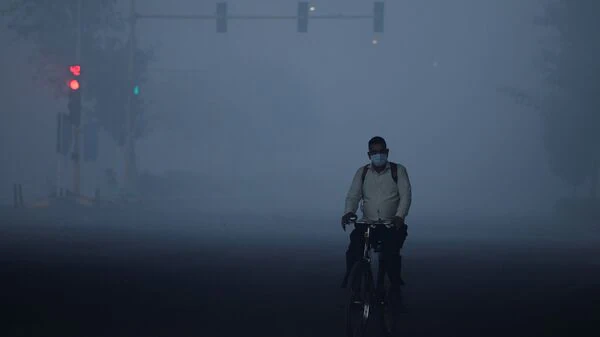
Bahadurgarh Tops Air Pollution Chart With AQI Of 400, Delhi Ranks 10Th


Charkhi Dadri in Haryana ranked second with an AQI of 389, followed by Khora in Uttar Pradesh at 380 and Rohtak at 378. Khairthal in Rajasthan recorded an AQI of 362, while Anpara in Uttar Pradesh registered 355, putting both cities in the 'very poor' category.
Faridabad and Panchgaon in Haryana and Sri Ganganagar in Rajasthan recorded an AQI of 350. Kaithal in Haryana recorded an AQI of 347, while Gurugram registered 345. New Delhi registered an AQI of 344, placing the national capital 10th on the list.
Quick answers to key questions
.5 QUESTIONS1Which city recorded the highest AQI in the 4 pm pollution bulletin?⌵Bahadurgarh in Haryana topped the list with an AQI of 400, in the 'very poor' category. New Delhi recorded 344 and ranked 10th.
2How was the AQI in the 4 pm bulletin calculated?⌵The CPCB bulletin on its SAMEER app reported 24-hour average AQI readings as of 4 pm on Monday.
3Why did air pollution rise after Diwali in Delhi and northern India?⌵The reports linked the post-Diwali rise to firecracker emissions and other pollution sources. They also cited vehicle emissions, stubble burning and weather conditions that limited pollutant dispersion.
4What does an AQI of 400 mean under CPCB categories?⌵An AQI from 301 to 400 is classified as 'very poor' and is associated with respiratory illness after prolonged exposure, even among healthy people. The 'severe' category begins at 401.
5What restrictions were in force under GRAP Stage 3 in Delhi-NCR?⌵Stage 3 barred BS-III petrol and BS-IV or older diesel four-wheelers in Delhi and specified NCR districts, and banned dust-generating construction and demolition across NCR. Restrictions also applied to certain commercial diesel goods vehicles.
Also Read | Fertilizer supply looks ample, yet rabi sowing trails last year Also Read | Post offices to serve as dark stores as govt expands farmer e-commerce modelThe data showed that nine of the 12 listed cities recorded AQI levels of 350 or above, indicating a significant deterioration in air quality across parts of northern India.
The concentration of highly polluted cities across Haryana, Uttar Pradesh, Punjab, Rajasthan and Delhi highlights the growing air-quality problem in northern India. According to an official, several cities across north India reported a spike in air pollution following Diwali, with air quality deteriorating amid increased emissions from firecrackers and other pollution sources. The rise in pollution levels has renewed concerns over the region's air quality and the need for stricter enforcement of pollution-control measures.
Capital punishmentMeanwhile, Delhi recorded one of its most polluted Diwalis, with the average AQI touching 376 on 8 November.
On Monday, several localities in Delhi recorded AQI levels above 350, indicating very poor to severe air quality. Areas with high pollution levels included Delhi Technical University (409), Narela (399), Chandni Chowk (394), Bawana (392), Burari crossing (390) and Lodhi Road (384).
Under CPCB's classification, an AQI between 0 and 50 falls is considered 'good', indicating minimal health impact. A reading between 51 and 100 is classified as 'satisfactory', while an AQI of 101-200 falls under the 'moderate' category. An AQI between 201 and 300 is categorised as 'poor', and may cause breathing discomfort to people with prolonged exposure, particularly those with respiratory conditions. The 'very poor' cetegory covers AQI readings between 301 and 400 and is associated with respiratory illness on prolonged exposure, even among healthy people. The highest category, 'severe', applies to AQI levels between 401 and 500. At these pollution levels, even healthy people may experience respiratory effe cts, while those with existing health conditions may face more serious impacts.
Stage 3 of the Graded Response Action Plan (GRAP), an emergency framework designed to prevent air quality from deteriorating once pollution crosses specific thresholds, is currently active across Delhi-NCR, alongside special vehicle and dust-control rules that took effect on 1 November.
Imposed on 6 November, GRAP Stage 3 bans BS-III petrol and BS-IV diesel (or older) four-wheelers from plying in Delhi and the NCR districts of Gurugram, Faridabad, Sonipat, Ghaziabad, and Gautam Buddha Nagar. Dust-generating construction and demolition (C&D) activities are banned across NCR. Additionally, Delhi-registered BS-IV (and older) commercial diesel medium goods vehicles are barred from plying, while similar vehicles registered outside the capital face a total entry ban.
Also Read | India seeks clearer evidence of air pollution's health impact as smog worsens
Legal Disclaimer:
MENAFN provides the
information “as is” without warranty of any kind. We do not accept any
responsibility or liability for the accuracy, content, images, videos,
licenses, completeness, legality, or reliability of the information
contained in this article. If you have any complaints or copyright issues
related to this article, kindly contact the provider above.


Comments
No comment