


Know Thy AI Pessimists


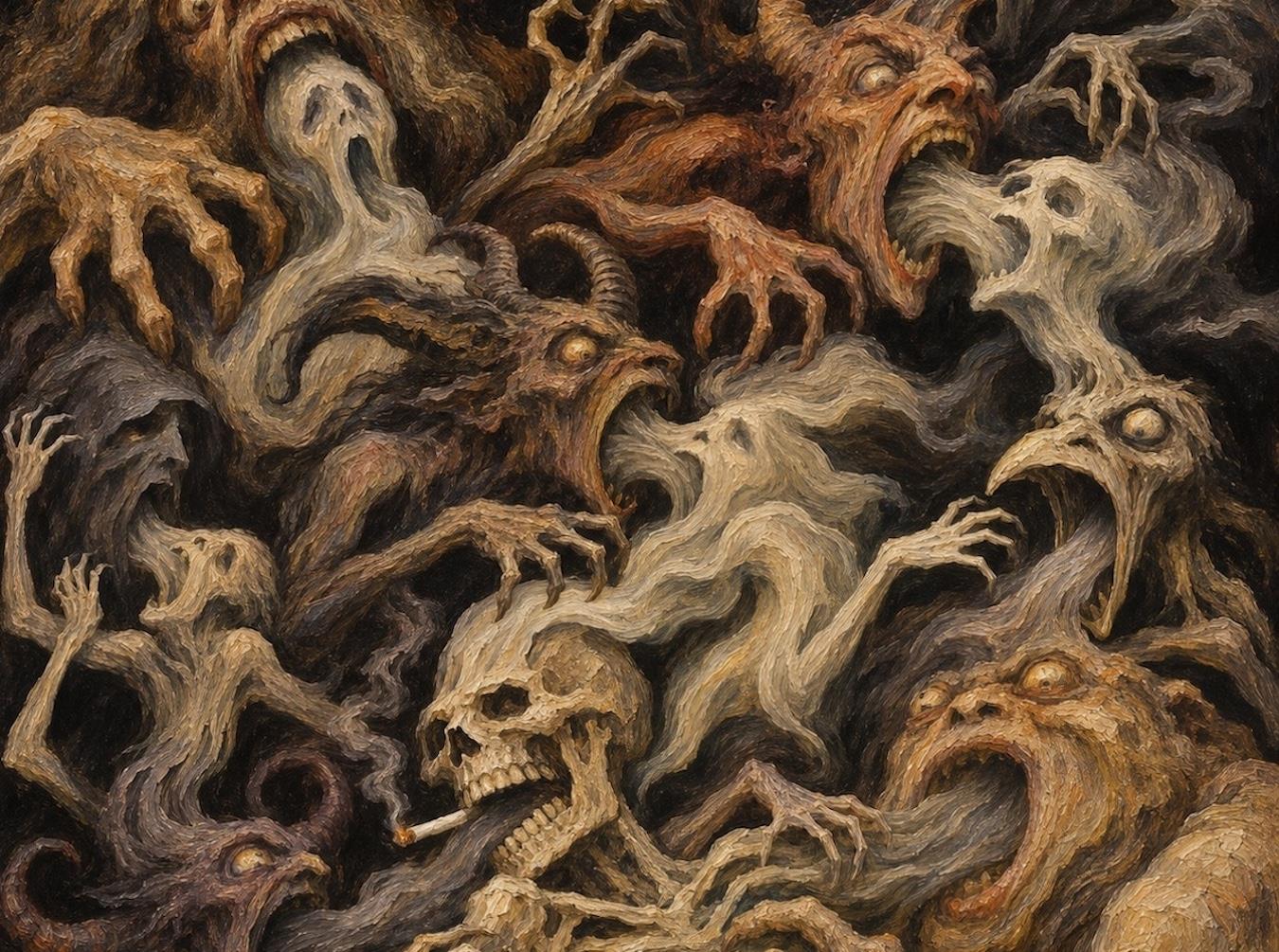
Markets lately look like a protest march against AI, a coalition of people who agree on very little beyond the thing they are marching against.
The pacifist walks beside the man with the pitchfork. Some came for the cause, some for the spectacle and a few only because the march happened to pass their door. The chant is the same. The reasons behind it could hardly be further apart.
Marches end. The crowd goes home. What remains is the damage and the question of what comes next. That question depends on which burning issues get picked up for servicing. As of now, we deal with the slogans that fit placards. The genuine reasons fill a library. The march is a ladder of gloom. To know what survives requires an attempt to parse the pessimism.
The ladder starts with those who see gloom in whatever happens. It ends with those who see gloom in anything that keeps money away from what they already hold. In between come those who think AI does nothing and those who think it does too much.
Then come the worriers over jobs, cyberattacks and power lines, the auditors of spending and of egos, and two quieter breeds of market bear: those who doubt the profits and those who doubt the prices.
The stakes are real. In their zeal, pessimists could push the US into outsourcing its compute, the way it once outsourced manufacturing and then software development. That road ends with the frontier in other hands and another Sputnik moment. Much of the gloom rests on bad data, fast-moving data, and numbers hallucinated by accident or on purpose.
That does not make the fear harmless. Fear needs no accuracy to move markets. In an era this dependent on confidence, its effect on mood, financing, and prices can be enormous, whatever started it. Parsing pessimism, camp by camp, is the only way to tell the dangers apart.
Once again, during the march, like right now through the gyrations of financial markets, these differences are hard to see. Afterward, which fears prevail decides the course ahead, with its own unique set of opportunities and threats.
In the write-up below, each camp gets a short description, then advice for three audiences. The Waverers are pessimists, but with an open mind, so they get a list of what to watch. Optimists get what the camp should teach them and the signals they cannot afford to ignore.
The Devotees need no further data or evidence. They get a harder question: how to stay in the marketplace, and what their own scenario would mean for the economy if it came true. Before joining the march, it helps to know which future the banner is asking for.
Doom collectorsThe Camp. Some pessimists have been waiting for World War III since before the Berlin Wall fell. They have warned about government debt-to-GDP and financial repression for three decades. Now the collection has a fresh piece: AI ending humanity. Every path they examine ends in a vicious cycle.
Every short-term fix only stores up longer-term pain. If they expect bond yields to reach 5.5%, they will happily add that 5.5% solves nothing, so 6.5% must follow, then 8.5% or 20.5%. Ask them to find a single hopeful route through their interlinked gloom. They struggle in earnest. Some hold portfolios that match their forecasts, including a bunker.
The Waverers' Watch. There is little to watch. Their arguments are time-invariant and event-invariant. If doom has not arrived today, it will only be more brutal when it does. No data point can confirm the thesis early or refute it late. With no date attached, the forecast becomes a hobby wearing the costume of a prediction.
The Optimists' Watch. Optimists can trim a position or two if signs of the end appear. Beyond that, the scenario sets them no useful homework. If hellfire is coming to burn everything, no asset, country, or bunker will offer shelter.
The Devotees' Path. Logic says the true believer should pray for delay. Every year the fire holds off is one more year of ordinary life, which their own thesis says is the best they can get. Yet most in this camp seem to want the show to start at once, on the grounds that anything later will only hurt more.
Of all the camps in this essay, it is the only one whose happiest ending is the worst one for everyone, its members included.
Parrot puristsThe Camp. For them, the technology has no utility, or so little that the difference hardly matters. It is a statistical parrot repeating what it has read, with no new intelligence anywhere. They may accept every ROI argument higher up the chain, for chipmakers, memory makers, and cloud operators. None of it survives at the final user. The company or household paying the bill gets a higher cost and no return. In their eyes, the industry is selling lemons, pure and simple.
The Waverers' Watch. The waverer should keep a tally of the moments that jar. Work across codebases running to millions of lines counts. So do tasks that once took whole teams and now take an afternoon. Buyers who taste the lemon and then order a crate count most of all. Plenty of people, ourselves included, find genuine utility in almost every dollar spent on AI. Some keep raising that spending at the cost of everything else in their budgets. The real exercise is to multiply such users across hundreds of millions of people and companies worldwide. The total may or may not justify the buildout. It should at least retire the claim that end users find nothing of value.
The Optimists' Watch. The optimist's real work is steady observation, statistical and anecdotal, of whether people keep taking AI into new tasks. Today that means agents handling multi-step work. Tomorrow it should mean the physical world. The question is whether the range of uses keeps widening or starts to stall. Anecdotes can glow while the aggregate sags. The aggregate is the test that counts.
The Devotees' Path. Suppose the purist is entirely right: AI spending is digging holes and filling them up again. The money still pays engineers, electricians, and builders. It still lays power lines and fiber. It comes from the most concentrated pools of wealth and cash in the world, at a time when many governments have little room left to spend.
Useless activity funded by idle fortunes is an old Keynesian remedy. Its removal would leave a hole of its own. Wishing it away means idling the busiest construction crew on earth and getting nothing in its place.
Off-switch brigadeThe Camp. The Parrot Purists have an exact mirror image. The two camps rarely seem to notice each other. Both are sure the shares should fall. For the Brigade, AI does far too much. Models improve with every release. AGI may have arrived. Progress runs at double speed. If one Navier-Stokes-class problem falls today, a dozen will fall tomorrow. Humanity is handing its decisions to machines whose reasoning it cannot follow and may never comprehend. The only sane response is to throttle the technology before it outruns us.
The Waverers' Watch. The waverer should track what the new intelligence actually does with its power. Calculators did things beyond human ability, too. The same test applies to drug discovery, scientific research, and the administrative and economic grind of daily life. Each case where superhuman ability turns into human benefit is a small argument against the off-switch.
The Optimists' Watch. For optimists, this camp matters through regulations. A growing public sense that AI works beyond human comprehension can sit alongside excellent business results. This is likely to be a perpetual watch, though, as the topic is unlikely to ever vanish from economic and political arguments from here on, as we explained in this article months ago.
The Devotees' Path. The fully convinced should join every protest and every forum on AI control. They should also face the practical arithmetic we laid out in Speaking Plainly. Rules take years to write. Competitors rarely sign up. Any policy worth backing has to survive a map. A country that pauses alone will hear about the next breakthrough from someone else's laboratory.
Pink slip prophetsThe Camp. After the two extremes come the practical in-betweeners. Whether AI is a parrot or a coming superintelligence matters less. It is already pushing people around. Whole professions are under pressure. In this camp's view, no policy ends the story. Universal basic income, retraining schemes, and every other remedy will, at best, change the shape of the problem. Displacement has joined the political and economic conversation for good.

Legal Disclaimer:
MENAFN provides the
information “as is” without warranty of any kind. We do not accept any
responsibility or liability for the accuracy, content, images, videos,
licenses, completeness, legality, or reliability of the information
contained in this article. If you have any complaints or copyright issues
related to this article, kindly contact the provider above.


Comments
No comment