


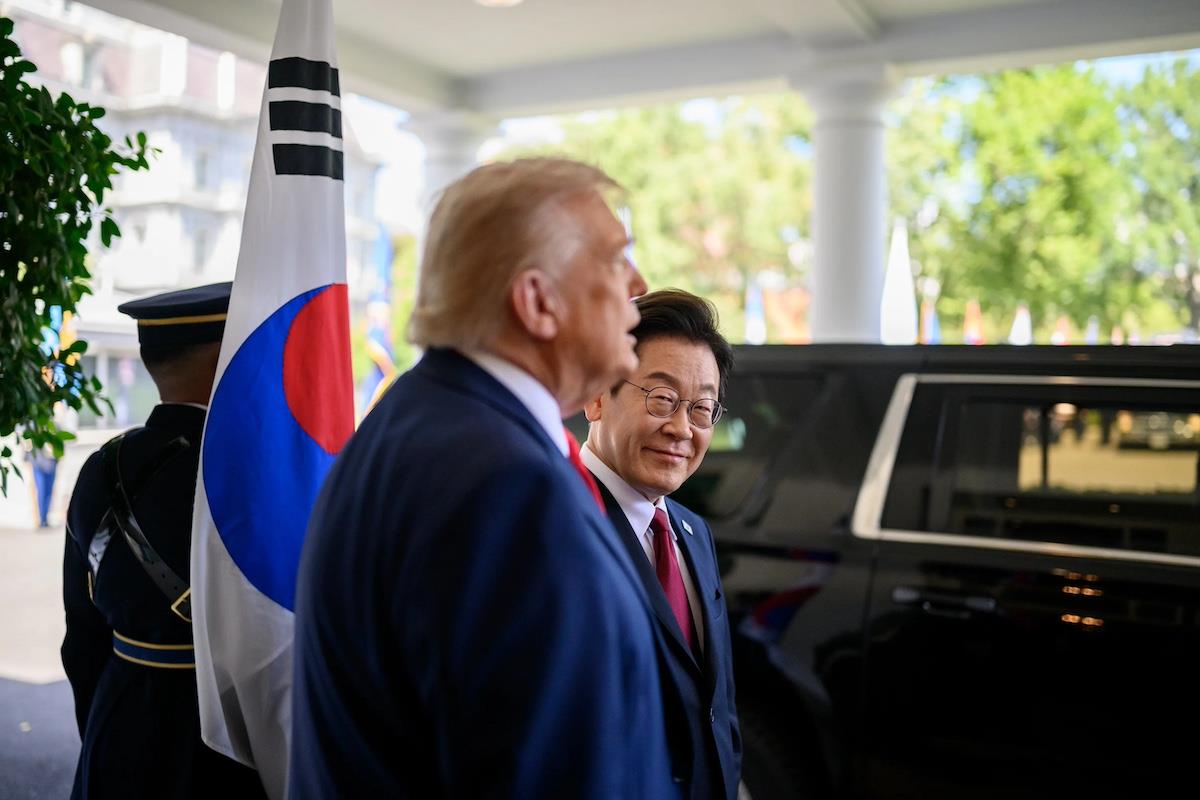
Even After Midterms, Trump's Still A Problem For Seoul And Tokyo


Having taken control of both houses of the US Congress, the Democrats are likely to push back against Trump's war on Iran, brutal immigration and customs enforcement (ICE) and attacks on the environment, but they are just as protectionist as the Republicans and just as likely to put Europe and the Middle East ahead of East Asia when it comes to defense.
On Wednesday, Japan's Chief Cabinet Secretary Minoru Kihara told the Japanese media that the alliance with the US“remains the cornerstone of Japan's foreign and security policy” and is key to“maximizing its national interests,” regardless of the outcome of the US midterm elections, adding that the government will monitor financial markets“with a high sense of urgency.”
What is new here? Not the evident case of nerves. It is Trump's war on Iran that has driven up energy costs and Trump's approach to China and North Korea that has put the Japanese government on edge.
The US has a history of dealing with China behind Japan's back dating back to Nixon and Kissinger, and Trump has been talking about reviving his special relationship with North Korean leader Kim Jong Un.
In August, Trump said he expected to meet with Kim by year's end.“The fact that I get along with him, that's a very good thing. Not a bad thing,” particularly because North Korea has“57 very powerful nuclear weapons.”
In October, while speaking at a campaign rally in Ohio, Trump said.“I get along great with Kim Jong Un. You know who that is? When people have 112 nuclear missiles, it's nice to get along.”
So far, no progress toward a meeting has been reported. Still, a senior Japanese official told the Yomiuri newspaper:“We don't want them [the United States and North Korea] bypassing us to make deals.” But they might. The same goes for China and Russia, which the government of Prime Minister Sanae Takaichi continues to alienate despite China's importance as a trade partner and Russia's as a key supplier of oil and gas.
A delegation of about 200 Japanese business leaders from the Japan-China Economic Association, including senior representatives of Keidanren (Japan Business Federation), had planned to visit China last January.
However, they were forced to cancel the trip due to the blowback following Takaichi's remark that a Chinese blockade of Taiwan could be seen as a“survival-threatening situation” for Japan, justifying a military response. The Japanese business organizations found that they simply could not arrange meetings with Chinese officials.

Legal Disclaimer:
MENAFN provides the
information “as is” without warranty of any kind. We do not accept any
responsibility or liability for the accuracy, content, images, videos,
licenses, completeness, legality, or reliability of the information
contained in this article. If you have any complaints or copyright issues
related to this article, kindly contact the provider above.


Comments
No comment