


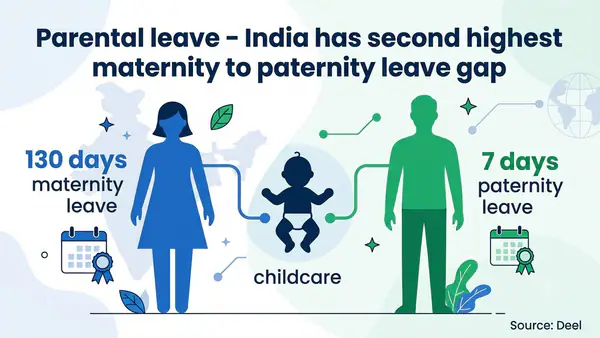
Indian Fathers Only Take 7 Days-2Nd-Widest Maternity To Paternity Leave Gap Among 12 Major Economies, Mothers Leave Jobs


The analysis covered close to 5,000 parents in 12 major economies, and results showed that while a country's shared parental leave policies may look equitable and generous on paper, this does not necessarily translate into more equal leave-taking in practice, the report said.
Also Read | DA hike: Uttar Pradesh increases dearness allowance by 3%-Check who is eligible Maternity to paternity gap: Key highlights - India-
According to the Deel report, titled 'Generous government parental leave policies don't guarantee gender equality', the maternity to paternity leave gap in India is among the widest in the world.
Mothers in India take a median of 130 working days of leave (around 26 weeks) versus just seven days for fathers. That is 18.6 times as long, behind only the UK (19.5 times), it added.
Further, for Indian fathers, leave is provided entirely at employer discretion rather than by law. And they avail the least parental leave of all 12 countries studied.
- Fathers in the UK and Italy take a median of 10 days, and in Canada and the US, 28 days. In Sweden and Spain, fathers take 67 and 70 days. Notably, American fathers take four times as much parental leave as Indian fathers (28 days). Meanwhile, for mothers, the parental leave availed matches the legal minimum. India's 130 days equals the 26 weeks guaranteed under the Maternity Benefit Act. Further, parental leave in India is rarely taken in multiple blocks. 98.7% of Indian mothers take their leave in one continuous block, the highest of the 12 countries, compared with 80.1% of fathers.
- Mothers are more likely to leave their job after leave. 25% of Indian mothers left their role within six months of leave ending, versus 20% of fathers. While this is below the global average (30% of mothers, 23% of fathers), the parental leave gap between genders continues to persist.
On the global scale, the study found that mothers on long maternity leave see their pay fall much more than fathers do (especially in the UK). It noted that British mothers on leave after four months, get less than half their usual take-home pay.
Overall, mother see the biggest impact from pregnancy. The study noted that the gender gap shows up repeatedly with mothers taking much longer, less interrupted, and lower paid leave. They are also more likely to use vacation days for parental leave and are more likely to leave their job after returning, it stated.
Further, company size was observed to be the biggest predictor of time off as mothers at larger employers took around 80 more days of leave, compared to those at smaller firms, the report added. The pattern persists across demographics, country location, and leave entitlement policies.
Why care about the parental leave gap?The study noted that for men and women who start off in the same occupations, the gender pay gap widens sharply once children arrive - and remains so for years afterwards. This is termed as“child penalty” in economics, documented across industries, occupations, and countries, it explained.
Also Read | ₹3 lakh per year? Can parents invest ₹1.5 lakh each in child's PPF account“The disparity in parental leave is one of the first places this penalty shows up, and some research has found that fathers who take a larger share of leave cause mothers to earn more later on,” it stated. Two main lessons that come up repeatedly during the study were:
- Policy matters enormously, and Gender shapes the experience of new parenthood wherever you are in the world.
Notably, the data covers full-time employees on Deel's platform and thus skews towards white-collar professionals. The 12 countries studied are Australia, Canada, France, Germany, India, Italy, Singapore, Spain, Sweden, the Netherlands, the United Kingdom and the United States.

Legal Disclaimer:
MENAFN provides the
information “as is” without warranty of any kind. We do not accept any
responsibility or liability for the accuracy, content, images, videos,
licenses, completeness, legality, or reliability of the information
contained in this article. If you have any complaints or copyright issues
related to this article, kindly contact the provider above.


Comments
No comment