


Ajay Maken Flags Missing Air Quality Data In Delhi On Diwali Night


Ajay Maken Questions Delhi Air Quality Data
Senior Congress leader Ajay Maken on Monday flagged the non-availability of PM2.5 readings at 25 of Delhi's 39 air quality monitoring stations on Diwali night, pointing out that the average pollution level recorded at the nine stations with available data was 38.4 times the World Health Organisation's (WHO) 24-hour limit.
He alleged discrepancies in the national capital's air pollution monitoring data, claiming that PM2.5 readings from 25 of the national capital's 39 monitoring stations were not recorded between 2 am and 3 am on the night of Diwali, when pollution levels were recorded at 38.4 times the World Health Organisation's (WHO) 24-hour limit at the nine stations with available data.
Details on Monitoring Station Data Gaps
In a post on X, Maken cited Central Pollution Control Board (CPCB) data and said that no PM2.5 readings were recorded at 25 monitoring stations between 2 am and 3 am on the night of November 8-9. "Diwali Night at 2:00 AM: No PM2.5 Data Recorded at 25 of Delhi's 39 Monitoring Stations...According to CPCB data, no PM2.5 readings were recorded at 25 stations in Delhi between 2:00 AM and 3:00 AM on the night of November 8–9. These are among the 39 stations for which data was also recorded on the night of the previous Diwali," Maken said.
He further listed the 25 monitoring stations where readings were unavailable during the period. "Data for the following 25 stations was not recorded during this time: Anand Vihar, Ashok Vihar, Aya Nagar, Bawana, CRRI Mathura Road, Chandni Chowk, Dwarka Sector 8, IMD Lodhi Road, ITO, Jawaharlal Nehru Stadium, Mandir Marg, Mundka, NSIT Dwarka, Najafgarh, Narela, Nehru Nagar, North Campus DU, Okhla Phase 2, Punjabi Bagh, Pusa, R K Puram, Shadipur, Sirifort, Sri Aurobindo Marg, and Wazirpur," the post read.
Pollution Levels and Trends
Highlighting the pollution levels recorded at the remaining nine stations, Maken said the average PM2.5 concentration between 2 am and 3 am stood at 576 micrograms per cubic metre (μg/m3), compared to 562 μg/m3 during the corresponding period on the previous Diwali, marking an increase of 2.5 per cent. "For the 9 stations that have data available for both Diwali nights during this time slot, the average PM2.5 level was 576 μg/m3-38.4 times the WHO's 24-hour limit. On the previous Diwali, the average at these same stations during this hour was 562 μg/m3, representing an increase of 2.5% this year," he said.
Maken also shared a comparison of average hourly PM2.5 levels from 6 pm onwards on the two Diwali nights. According to the figures shared in his post, the average PM2.5 concentration at 6 pm was 141 μg/m3, compared to 107 μg/m3 on the previous Diwali, marking a 31.5 per cent increase. At 7 pm, it stood at 181 μg/m3 against 146 μg/m3, an increase of 23.9 per cent. At 8 pm, the average level was 265 μg/m3 compared to 222 μg/m3 last Diwali, marking a rise of 19.4 per cent. At 9 pm, it reached 403 μg/m3 against 354 μg/m3, an increase of 13.8 per cent.
The figures further showed that PM2.5 levels stood at 506 μg/m3 at 10 pm, equivalent to 33.7 times the WHO limit, and 515 μg/m3 at 11 pm, or 34.4 times the limit. At midnight, the average concentration reached 610 μg/m3, 40.6 times the WHO limit. It subsequently stood at 597 μg/m3 at 1 am, equivalent to 39.8 times the limit, before declining to 576 μg/m3 at 2 am.
Maken further highlighted the pollution levels despite the absence of readings from a majority of the monitoring stations during the specified period. "Air pollution levels are 38.4 times the WHO limit-and this is despite data from 25 monitoring stations not being recorded," he said.
Post-Diwali Air Quality in Delhi
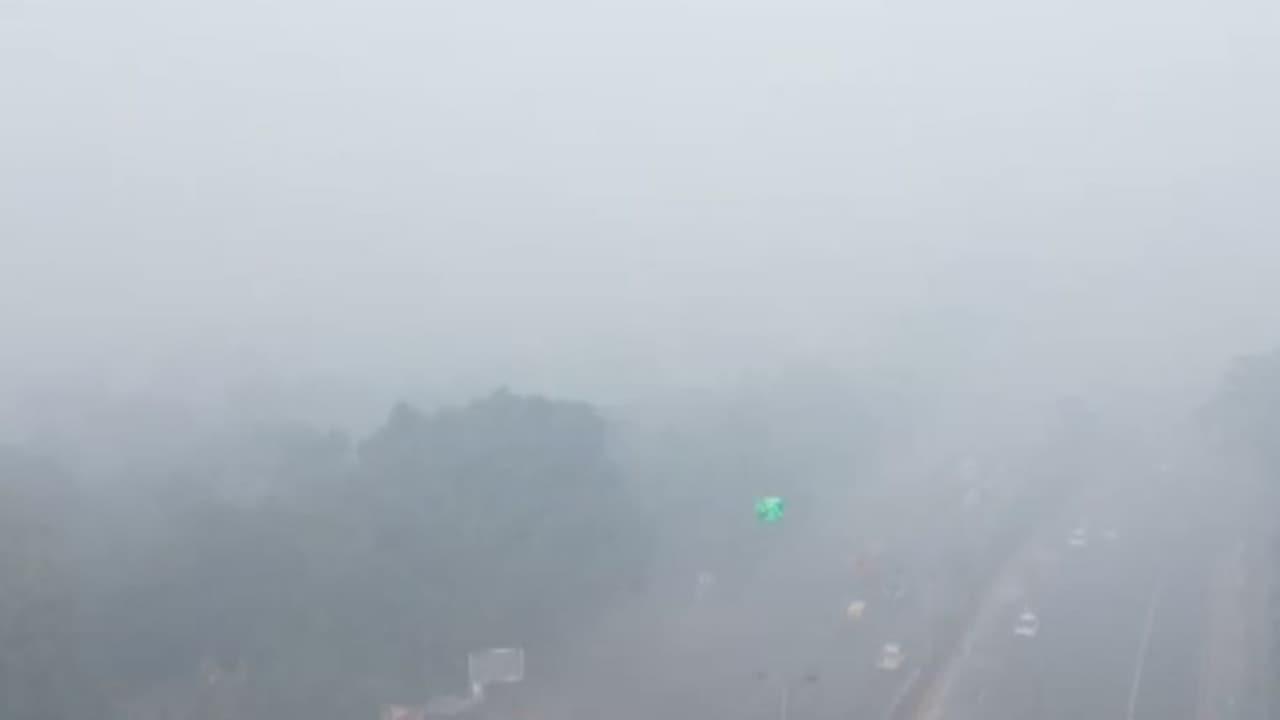
Meanwhile, a day after Diwali celebrations, Delhi's air quality deteriorated to the brink of the 'severe' category on Monday morning, with the Air Quality Index (AQI) touching the 400 mark, as thick smog engulfed several parts of the national capital and reduced visibility during the early morning hours.
A thick blanket of smog was particularly visible around the Inderlok area, while several other parts of the city woke up to hazy conditions, with deteriorating air quality and poor visibility adding to concerns among residents. According to the Central Pollution Control Board (CPCB), the AQI around Ghazipur stood at 418, categorised as 'severe', while the reading around Akshardham was 337, falling in the 'very poor' category. (ANI)
(Except for the headline, this story has not been edited by Asianetnews Editorial staff and is published from a syndicated feed.)

Legal Disclaimer:
MENAFN provides the
information “as is” without warranty of any kind. We do not accept any
responsibility or liability for the accuracy, content, images, videos,
licenses, completeness, legality, or reliability of the information
contained in this article. If you have any complaints or copyright issues
related to this article, kindly contact the provider above.


Comments
No comment