


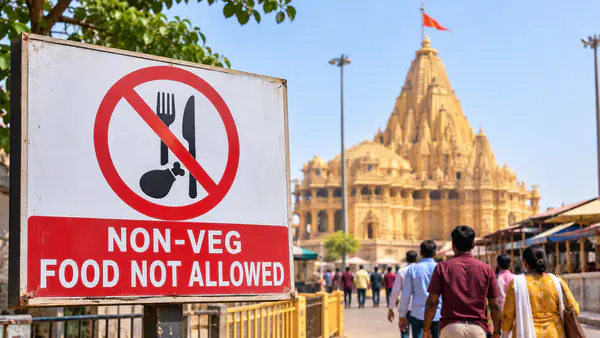
Somnath Temple Non-Veg Food Ban: Why Supreme Court Refused To Lift Restrictions And What The Judges Said


A bench of Justices MM Sundresh and PB Varale heard a petition filed by restaurant owners challenging the restrictions imposed by the Gir Somnath district administration.
During the November 6 hearing, the owners argued that the ban was affecting their businesses and livelihoods. The Supreme Court, however, refused to grant immediate relief and asked the Gujarat High Court to decide the pending appeals preferably within two months.
"We need to maintain a balance. We don't say anything," the bench observed.
Why was the ban imposed?The dispute began with a notification issued by the Gir Somnath District Magistrate on 10 August, 2026.
Also Read | Somnath non-veg food ban continues: What is Gujarat HC's latest orderIt prohibits the preparation, sale and storage of non-vegetarian food, including meat, fish and eggs, at restaurants, hotels, shops and roadside stalls in specified areas around the Somnath Temple.
The restrictions cover designated routes in Prabhas Patan and areas within 500 metres of the temple.
Six restaurant owners challenged the notification in the Gujarat High Court. They argued that it affected their right to carry on a lawful business and threatened the livelihoods of people working at their establishments. Some of the restaurants had reportedly been operating in the area for 35 to 40 years.
On October 30, a single-judge bench of the Gujarat High Court set aside the notification, holding that the restrictions went beyond the powers available under the Gujarat Police Act, 1951, and affected the owners' fundamental right to carry on a trade under Article 19(1)(g) of the Constitution.
However, the Gujarat government challenged the decision, following which a division bench stayed the single judge's order. This brought the restrictions back into force.
What did the Supreme Court say?During the hearing, senior advocate Huzefa Ahmadi, representing the restaurant owners, argued that the restrictions would affect businesses, particularly during the festive season. He also questioned the need to regulate people's food choices.
Solicitor General Tushar Mehta, appearing for the Gujarat government, defended the restrictions by referring to the religious significance of the Somnath Temple. He argued that restaurants could continue selling non-vegetarian food outside the restricted areas.
The Supreme Court chose not to interfere with the High Court's interim arrangement. It did not deliver a final ruling on whether the ban was legally valid.
Also Read | Swabhiman Parv: PM Modi witnesses drone show, fireworks outside Somnath temple What happens next?The Supreme Court has asked the Gujarat High Court to decide the pending appeals preferably within two months. The matter is scheduled to come up before the High Court on 25 November, 2026.
Until then, the restrictions will remain in force. Restaurant owners will have to wait for the High Court's decision before they can resume preparing and selling non-vegetarian food in the notified areas.
The Supreme Court's refusal to lift the ban does not mean it has finally upheld the restrictions. Their legality is still being examined by the Gujarat High Court.

Legal Disclaimer:
MENAFN provides the
information “as is” without warranty of any kind. We do not accept any
responsibility or liability for the accuracy, content, images, videos,
licenses, completeness, legality, or reliability of the information
contained in this article. If you have any complaints or copyright issues
related to this article, kindly contact the provider above.


Comments
No comment