


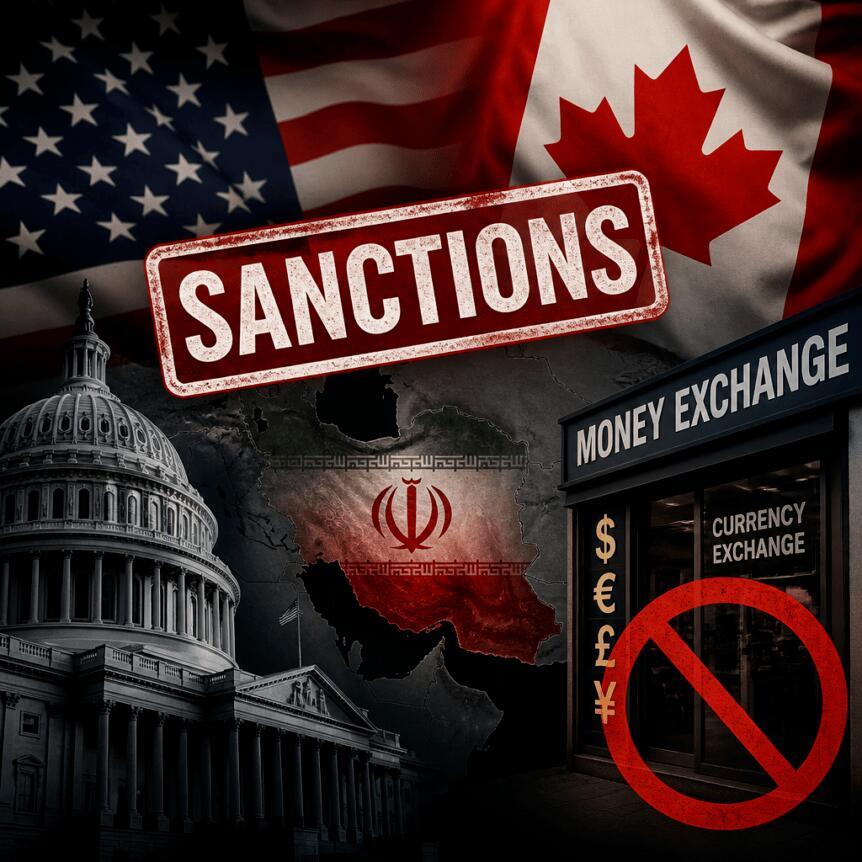
US Sanctions Canadian Money-Exchange Firms Linked To Iran


Treasury said the designations are intended to further cut these companies off from the dollar-based financial system and to disrupt what it describes as Iran's use of digital assets for illicit finance. The action also reflects an expanding pattern of U.S. efforts aimed at non-U.S. actors involved in sanctions evasion tied to Iran.
Key takeaways- The U.S. Treasury sanctioned eight Canadian money-service companies accused of facilitating rial and currency swaps into digital assets for sanctioned Iranian counterparties. Treasury frames the move as isolating intermediaries from the U.S. financial system to reduce sanctions-evasion pathways. Some targets are alleged to have changed names and addresses to avoid detection, according to the Treasury statement. The Treasury action was coordinated with FINTRAC, Canada's financial intelligence unit. Separately on Friday, the U.S. offered up to $20 million through the Rewards for Justice program for information related to Iran's nuclear program.
In its statement, the Treasury Department said the designated companies have facilitated transactions involving sanctioned Iranian digital-asset exchanges, as well as crypto-related addresses associated with Iran's Islamic Revolutionary Guard Corps (IRGC). Treasury linked the alleged activity to the conversion of Iranian rials and other currencies into digital assets, which can be used to transfer value across borders while potentially obscuring underlying sources and destinations.
The Treasury's core argument is that these services function as sanctions-evasion infrastructure. By restricting the designated firms, the U.S. seeks to limit the ability of intermediaries to operate within channels that would connect Iran-linked entities to broader global markets.
Treasury Secretary warns Canada cannot be a“safe haven”Scott Bessent, the U.S. Secretary of the Treasury, said the U.S. will continue pursuing and disrupting financial channels used by the Iranian regime and its proxies. In remarks included with the Treasury statement, he argued that“Canada cannot be a safe haven for illicit financial facilitators” offering sanctions-evasion services.
The message aligns with earlier U.S. policy posture toward Iran-focused financial networks that Treasury has repeatedly described as operating through“dollars, rials, or crypto.” Earlier coverage from Cointelegraph noted that Treasury's Office of Foreign Assets Control (OFAC) had been targeting crypto exchanges and related systems facilitating transfers of funds toward the IRGC, with an explicit goal of increasing economic pressure on Iran by focusing on the networks that move money.
While sanctions announcements often emphasize compliance risk, Friday's action underscores a broader enforcement direction: intermediaries that bridge fiat currencies and digital assets can become primary targets, even if the underlying digital-asset transfers occur outside U.S. jurisdiction.
Coordination with Canadian financial intelligenceTreasury said the sanctions were coordinated with FINTRAC, Canada's financial intelligence unit. That point matters for market participants because it signals cross-border cooperation between regulators and intelligence bodies, potentially tightening scrutiny on entities that handle currency exchanges or other money-service functions that could intersect with crypto-related flows.
Treasury also stated that some of the sanctioned entities have changed names and addresses to evade detection. That detail highlights a recurring challenge in sanctions enforcement: adversaries and intermediaries may adapt quickly, and enforcement actions may need to be followed by additional monitoring and subsequent designations if evasive behavior continues.
Additional U.S. action: Rewards for Justice tied to Iran's nuclear programBeyond crypto-related sanctions, the U.S. also announced a separate initiative on Friday through the Rewards for Justice program. The program offered up to $20 million and possible relocation for information related to Iran's nuclear program, including facilities, equipment, and personnel.
In its description of the underlying rationale, the U.S. cited Iran's lack of compliance with the International Atomic Energy Agency (IAEA) on safeguards, which Treasury said has contributed to the IAEA losing“continuity of knowledge” about Iran's production of enriched uranium and related components such as centrifuges.
Although this second action is not directly connected to digital assets, it fits a larger pattern of U.S. strategy toward Iran that spans both financial enforcement and national security-related information gathering.
For readers tracking crypto compliance and sanctions risk, the key question now is how intermediaries and exchanges will adjust their controls in response to Treasury's focus on fiat-to-crypto conversion services. Watch for further enforcement updates, especially if additional firms are designated or if reporting and onboarding practices tighten around currency exchange pathways linked to sanctioned jurisdictions.
Risk & affiliate notice: Crypto assets are volatile and capital is at risk. This article may contain affiliate links.
Legal Disclaimer:
MENAFN provides the
information “as is” without warranty of any kind. We do not accept
any responsibility or liability for the accuracy, content, images,
videos, licenses, completeness, legality, or reliability of the information
contained in this article. If you have any complaints or copyright
issues related to this article, kindly contact the provider above.


Comments
No comment