


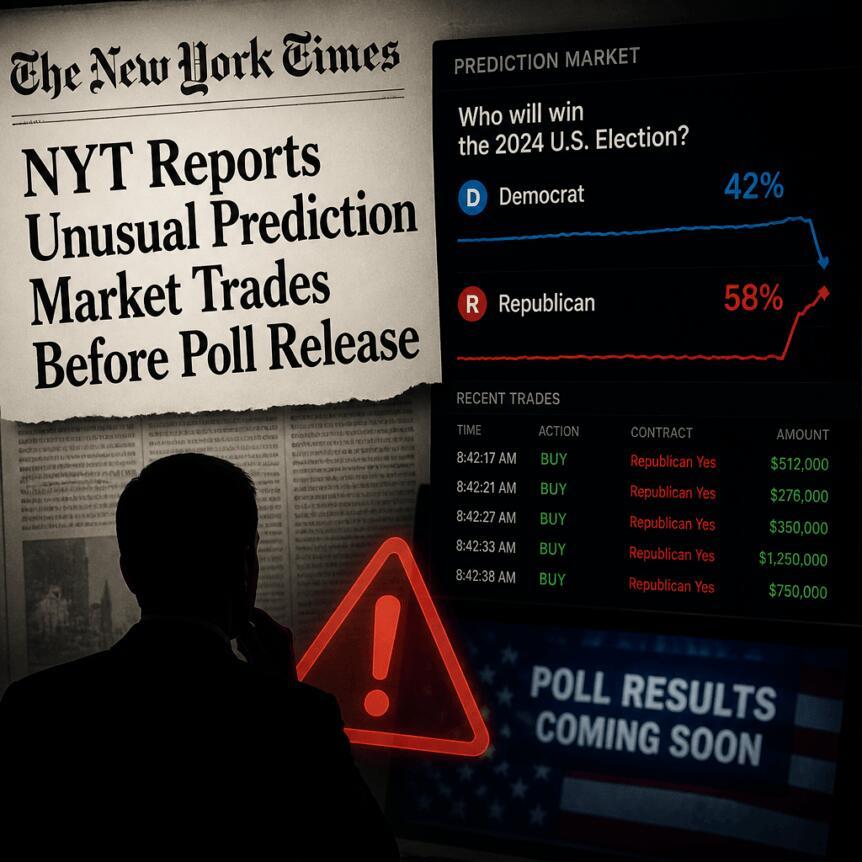
NYT Reports Unusual Prediction Market Trades Before Poll Release


According to the report, a Polymarket user placed a near $200,000 bet on Oct. 31 that Ricketts would be re-elected. Within an hour, a Times/Siena poll was released showing Ricketts in the lead. A later New York Times article also described additional wins-over $77,000-connected to the same polling coverage, while noting that it was not established whether the trader had access to nonpublic information.
Key takeaways- Vanderbilt researchers reported a nearly $200,000 Polymarket bet on Ricketts placed shortly before a New York Times/Siena poll was published. Timing alignment does not prove inside information, but the researchers said the pattern warrants further investigation. The subsequent New York Times report described additional profitable bets by the same user, including more than $77,000. Polymarket said it detected the trades and is investigating; Kalshi reportedly declined comment.
The core allegation involves the proximity between large prediction market orders and the publication of poll results. As described by Vanderbilt University researchers, a Polymarket participant wagered almost $200,000 on Oct. 31 that Nebraska Senator Pete Ricketts would secure re-election. An hour later, a New York Times/Siena poll-linked to that specific race-was published showing Ricketts ahead.
While markets often react quickly to new information, this case raised questions because of the size of the bet and how closely the trade preceded the poll's release. The report frames the sequence as unusual enough that investigators should examine whether there was any improper information flow or whether the timing could be coincidental.
The New York Times subsequently published additional coverage of the episode, including the trader's later outcomes. Earlier coverage by Cointelegraph also highlighted a separate criminal case involving allegations that prediction market trading was informed by nonpublic U.S. operational details.
Why researchers say the pattern can't be dismissedBrett Goldstein of the Vanderbilt Institute of National Security, as quoted in the report, argued that the circumstances are difficult to characterize as mere chance.“There's a series of circumstances here that it's hard to write it off as a random occurrence,” he said, adding that the matter“requires further investigation.”
For investors and market participants, the practical takeaway is that prediction markets depend on open, publicly available signals. When trades line up with major disclosures in a way that appears too tight, it can undermine confidence in fairness-even if definitive proof of wrongdoing has not been established.
At the same time, this is not automatically evidence of insider trading. Polling outcomes can move quickly, and traders routinely place bets in anticipation of likely results. The uncertainty is central to the story: the report described the timing correlation, but it did not present conclusive evidence that the trader had access to nonpublic information.
Polymarket response and the broader prediction-market controversyPolymarket said it spotted the trades and is investigating. The same report noted that Kalshi declined comment when asked about similar activity in markets it hosts.
Polymarket's stance matters because platform investigations are one of the few mechanisms available to verify whether trades were executed using information not meant for the public. Yet platform reviews can be limited by jurisdiction, the availability of user data, and the legal standards required to take enforcement action.
Importantly, this incident lands in a larger context of regulatory and legal attention directed at prediction markets. In April, Cointelegraph reported on a case in which a U.S. Army soldier was charged for allegedly using nonpublic information tied to a U.S. operation involving then-Venezuelan President Nicolás Maduro to profit from prediction market bets.
In that separate matter, the U.S. Department of Justice alleged that Master Sergeant Gannon Ken Van Dyke was involved in planning and execution of“Operation Absolute Resolve,” which led to Maduro's capture at a residence in Caracas, Venezuela, in January. The DOJ alleged Van Dyke used that information to buy“yes” shares in related Polymarket contracts, including“Maduro out by January 31” and“Trump invokes War Powers against Venezuela by January 31,” according to the DOJ statement.
While the Vanderbilt/Times-Siena episode is not described in the source as a criminal case, the juxtaposition is telling: both involve the central question of whether prediction markets can be kept insulated from informational advantages that do not come from publicly available data.
What market participants should watch nextFor traders, the most immediate question is whether the investigations by Polymarket-and any additional reporting or legal scrutiny-will clarify what, if anything, the user knew before the poll release. For builders and regulators, the broader issue is how prediction-market platforms monitor for anomalous activity without making markets less liquid or more fragile.
Readers should watch for follow-up reporting that goes beyond timing correlations-such as transaction-level explanations, compliance findings, or formal determinations about whether any inside information was accessed. Until then, the episode remains a warning about how quickly large bets can align with public events, and how crucial it is for platforms to maintain robust monitoring and enforcement standards.
Risk & affiliate notice: Crypto assets are volatile and capital is at risk. This article may contain affiliate links.
Legal Disclaimer:
MENAFN provides the
information “as is” without warranty of any kind. We do not accept
any responsibility or liability for the accuracy, content, images,
videos, licenses, completeness, legality, or reliability of the information
contained in this article. If you have any complaints or copyright
issues related to this article, kindly contact the provider above.


Comments
No comment