


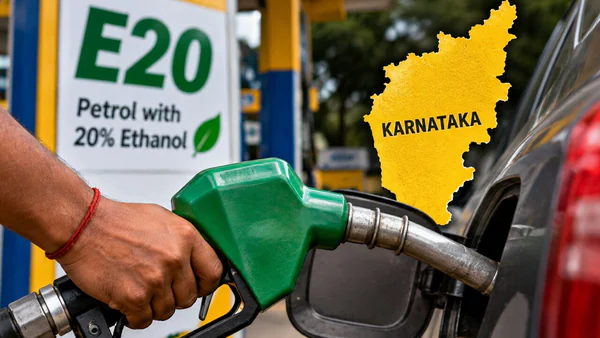
Explained: What Is The Ethanol Issue In Karnataka And Why Have Omcs Rejected The State Govt's Excess Blending Claims?


The companies questioned the sampling and testing procedures adopted by the state government, saying the reported findings could not be independently verified against the prescribed technical standards.
In a joint statement on Friday, the three OMCs said the claims that petrol sold at certain outlets contained between 26% and 31% ethanol were not supported by tests conducted in accordance with statutory and technical procedures, ANI reported. They maintained that the E20 petrol supplied by them across the country, including Karnataka, complies with the Bureau of Indian Standards (BIS) specification IS 17021.
The companies raised concerns over the sampling exercise conducted in October 2026, alleging that samples were collected without the participation of OMC representatives. They also said they had not received the corresponding retention samples, complete outlet-wise details or laboratory reports, despite seeking these through the State Level Coordinator.
The dispute follows the Karnataka government's claim that tests of petrol samples collected from seven districts found ethanol concentrations above the E20 limit. According to a state government statement cited by Hindustan Times, 11 of 14 samples tested exceeded the 20% threshold.
The highest concentration, 31.2%, was recorded in a sample collected from an IOCL outlet. An HPCL Power sample contained 30.5% ethanol, while another HPCL sample recorded 27%. A BPCL Speed sample had an ethanol concentration of 26.5%.
The samples were collected from fuel stations in Bengaluru, Kolar, Chikkaballapura, Bengaluru Rural, Ramanagara, Mangaluru and Tumakuru. The state government said the testing was conducted at the Shriram Research Institute in Bengaluru using gas chromatography.
Why OMCs have questioned Karnataka's testing procedureThe oil companies said the October exercise did not follow the sampling, retention and testing procedures prescribed under the Motor Spirit and High Speed Diesel (Regulation of Supply, Distribution and Prevention of Malpractices) Order, 2005, read with the Marketing Discipline Guidelines (MDG) 2024.
Under the prescribed procedure, six one-litre samples must be collected. Two are to be handed over to the dealer against acknowledgement, two retained by the oil company or department, and two sent to a laboratory specified under the Control Order or notified in the Official Gazette. The sample labels must also be jointly signed, with test results communicated to the dealer and oil company within the prescribed timeframe.
The OMCs said samples collected during Karnataka's September 2026 exercise were routed through the State Level Coordinator to designated OMC laboratories and tested for the quality parameters required under the MDG 2024. However, they alleged that the subsequent October exercise was conducted without their representatives.
The companies also questioned the laboratory certificates cited by the state government, saying they did not specify the complete technical details needed to validate the reported ethanol concentrations.
According to the OMCs, IS 17021:2018, including Amendment No. 3 issued in August 2025, prescribes methods for determining ethanol content in E20 fuel. These include Fourier Transform Infrared Spectroscopy (FTIR) under ASTM D5845, water extraction under Annex C, or Gas Chromatography under ASTM D4815/D6839.
The companies said that when gas chromatography is used, the sample must first be diluted in a 1:1 ratio with oxygenate-free petrol, and the result corrected against an E10 certified reference material. They argued that the certificates cited by Karnataka merely mentioned ethanol percentage by gas chromatography without specifying the applicable standard, dilution procedure or reference material.
In the absence of these details and counterpart samples, the OMCs said, the reported ethanol levels of 26-31% could not be independently validated against the prescribed methodology.
OMCs cite tests of 893 samples across 27 states and UTsThe three companies also cited a joint quality-monitoring exercise conducted with the Centre for High Technology. They said all 893 E20 samples tested from their depots and retail outlets across 27 states and Union territories were within the prescribed ethanol range of 19-21%.
The exercise included 56 samples from Karnataka, which recorded ethanol concentrations between 19% and 20%, with an average of 19.30%, according to the OMCs.
They said ethanol blending at their refineries and depots is carried out through calibrated and controlled systems, with automatic calibration and proportioning arrangements governing the process.
The companies also argued that more than 30 crore two-wheelers and 4 crore four-wheelers have been running on E20 fuel for over three years. They said there had been no widespread reports of vehicle breakdowns that would indicate a systemic fuel-quality problem.
Karnataka flags potential impact on vehicle ownersThe Karnataka government has raised concerns about the impact of higher ethanol concentrations on vehicle performance and fuel efficiency, particularly in vehicles designed to operate with lower ethanol blends.
The state estimated that motorists could be losing around ₹62,000 crore annually due to lower mileage, assuming a 10% reduction in fuel efficiency across the vehicle population. It separately estimated annual vehicle-repair costs at ₹39,000 crore, taking the combined potential burden to approximately ₹1.01 lakh crore.
The OMCs rejected these estimates, saying that applying a blanket assumption of 10% mileage loss across the entire vehicle population does not constitute a scientifically established assessment. They also said the repair-cost estimate needed to be supported by actual vehicle-performance data, materials compatibility studies and documented repair costs.
Karnataka has sought an explanation from the Union government on the ethanol concentrations found in the samples and called for action against oil companies found selling petrol containing more than 20% ethanol. The state has also demanded that petrol stations disclose the ethanol content of the fuel they sell and allow consumers to choose between available blends.

Legal Disclaimer:
MENAFN provides the
information “as is” without warranty of any kind. We do not accept
any responsibility or liability for the accuracy, content, images,
videos, licenses, completeness, legality, or reliability of the information
contained in this article. If you have any complaints or copyright
issues related to this article, kindly contact the provider above.


Comments
No comment