


issuewire


(MENAFN- National News Agency of Uzbekistan) SAMARKAND, Uzbekistan — The first SCO Plus Expert Dialogue on Security Issues was held in Samarkand on November 5–6, 2026, bringing together representatives of 24 countries and five international organizations. More than 180 officials and specialists from security agencies took part in the meeting, which focused on countering terrorism and extremism amid rapid technological development and digital transformation.
Held under the theme “Security in the Era of Digital Transformation: Countering Terrorism and Extremism in the Context of Emerging Technologies,” the dialogue brought together representatives of Shanghai Cooperation Organization (SCO) member states, observer countries and dialogue partners. The meeting was chaired by Bahodir Kurbanov, Chairman of Uzbekistan’s State Security Service.
At the opening ceremony, participants heard an address by Uzbek President Shavkat Mirziyoyev, delivered by Viktor Makhmudov, Secretary of the Security Council under the President of Uzbekistan.
The presidential address highlighted the growing importance of international security cooperation amid geopolitical tensions, armed conflicts and transnational threats. It also emphasized the need to strengthen information security, protect critical infrastructure and improve the resilience of states in responding to emerging security challenges.
Particular attention was given to the dual impact of digital technologies, artificial intelligence and global communications networks. While these technologies create new opportunities for economic and social development, they can also be exploited for criminal and extremist purposes.
The address pointed to the use of cyberspace for cyberattacks, the manipulation of public opinion, the dissemination of disinformation and the promotion of radical ideologies. Online recruitment, fundraising and the coordination of extremist networks operating across national borders were also identified as growing concerns.
In his opening remarks, Bahodir Kurbanov noted that terrorist and extremist organizations increasingly use digital technologies to spread propaganda, recruit supporters, raise funds and coordinate illegal activities.
According to figures presented by the head of Uzbekistan’s State Security Service, 49,000 online resources containing extremist and terrorist material were identified in 2026, compared with approximately 43,000 in 2025, representing an increase of 14 percent.
Kurbanov also referred to the implementation of Uzbekistan’s National Strategy for Countering Extremism and Terrorism for 2021–2026. He highlighted the importance of improving interagency and international cooperation mechanisms, identifying new forms of extremist activity in the digital environment and preventing the misuse of artificial intelligence for terrorist purposes.
SCO Secretary-General Nurlan Yermekbayev also addressed the meeting, noting that the expert dialogue format had emerged from an initiative put forward by President Mirziyoyev at the SCO summit in Astana in 2024. At the 2025 meeting of the SCO Council of Heads of State in Tianjin, a proposal was subsequently made to hold the first expert dialogue on security issues in Samarkand.
Yermekbayev noted that, over its 25 years of activity, the SCO had developed into a transregional multilateral organization bringing together countries with different political systems, cultures and national priorities. He also described Central Asia as one of the key geographical and political centers of the organization's activities.
The SCO Secretary-General highlighted the importance of peace, stability and development in Afghanistan for regional security. He reiterated the organization's support for Afghanistan becoming an independent, neutral and peaceful state free from terrorism, war and drug trafficking.
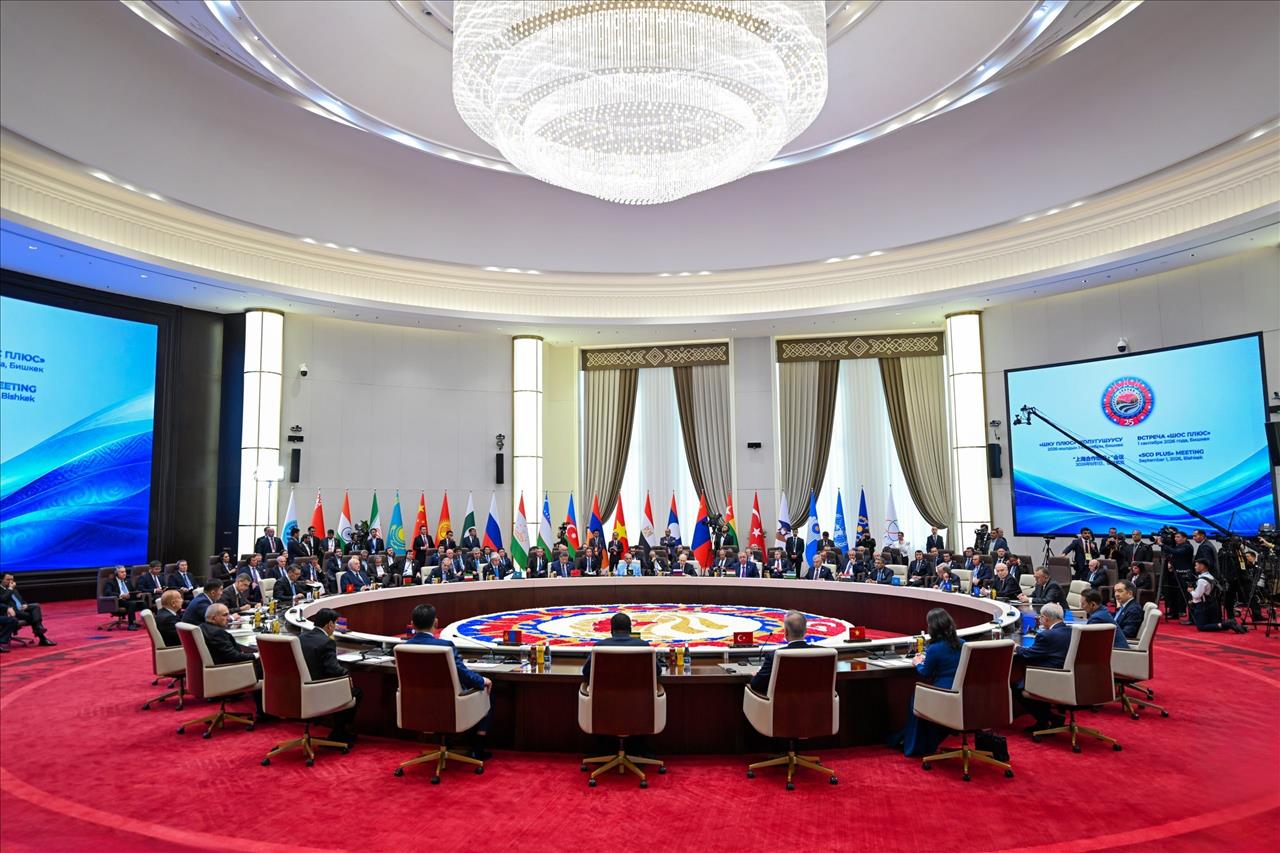
He also referred to decisions adopted at the SCO summit held in Bishkek in September 2026, including the approval of regulations concerning the Executive Committee of the SCO Universal Center for Countering Security Challenges and Threats and the SCO Anti-Drug Center. The summit also adopted programs through 2030 aimed at combating drug trafficking, synthetic narcotics and their precursors.
Alexander Zuev, Acting Head of the United Nations Office of Counter-Terrorism, also delivered an address. He noted that digital transformation was reshaping the global security environment, creating new opportunities for preventing threats and strengthening international cooperation, while also providing terrorist organizations with additional tools for their activities.
Zuev identified the Islamic State – Khorasan (ISIS-K) group as one of the significant security threats in Central and South Asia. He noted that the group was using artificial intelligence to translate and distribute propaganda materials into multiple languages, including languages spoken across Central Asia.
The UN representative also highlighted the growing links between terrorism, cybercrime and illicit financial flows, which are making security challenges increasingly complex. He emphasized the importance of early threat detection, information exchange between national agencies and international partners, data analysis and the development of practical preventive measures.
Zuev also referred to Uzbekistan's international initiatives in counterterrorism. In particular, he recalled President Mirziyoyev's proposal, put forward at the 80th session of the UN General Assembly in 2025, to establish a regional office of the UN Office of Counter-Terrorism in Uzbekistan.
During the plenary session, representatives of participating delegations and international organizations exchanged views on preventing terrorist activities in cyberspace, countering the spread of extremist and radical ideologies, sharing national experience and improving international cooperation mechanisms.
Discussions focused on the use of artificial intelligence, digital platforms and other emerging technologies for terrorist propaganda, recruitment and coordination of illegal activities. Participants also considered how these technologies could be used to identify potential threats, analyze information and strengthen preventive measures.
On the sidelines of the dialogue, SCO Secretary-General Nurlan Yermekbayev held meetings with Bahodir Kurbanov and representatives of the relevant agencies from participating countries.
The meeting concluded with the adoption of a joint communiqué by the heads of delegations. The document outlines several areas for further cooperation, including research into the impact of emerging technologies on terrorist threats, the preparation of analytical reviews of effective preventive practices, the organization of thematic seminars and the development of professional training programs for specialists.
The first SCO Plus Expert Dialogue on Security Issues in Samarkand provided a platform for discussing emerging security challenges associated with technological development, exchanging national experiences and identifying practical areas for international cooperation.
The joint communiqué is expected to serve as a basis for continuing expert-level discussions and advancing cooperation among participating countries in addressing terrorism, extremism and other security threats in the digital era.

Legal Disclaimer:
MENAFN provides the
information “as is” without warranty of any kind. We do not accept
any responsibility or liability for the accuracy, content, images,
videos, licenses, completeness, legality, or reliability of the information
contained in this article. If you have any complaints or copyright
issues related to this article, kindly contact the provider above.


Comments
No comment