


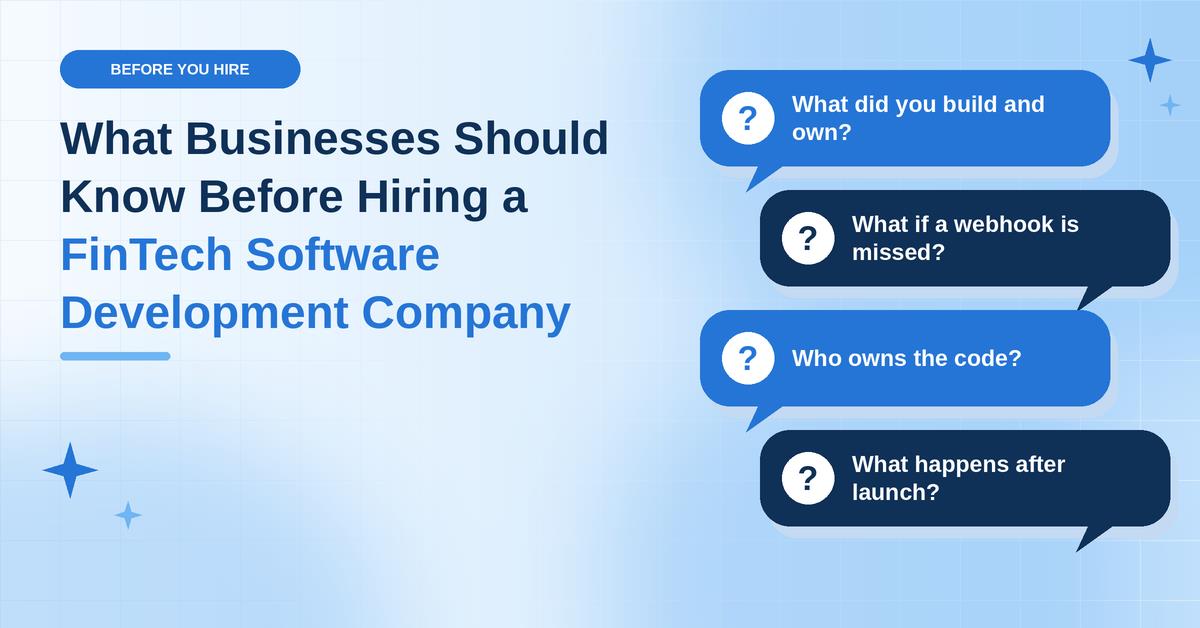
What Businesses Should Know Before Hiring a FinTech Software Development Company


(MENAFN- Bytexus Software Solutions Pvt. Ltd.™) Developing a financial product requires more than choosing the right technology stack or finding a team that can deliver within budget. Payment processing, financial data management, third-party integrations, and security all influence how well the product performs once it enters real-world use.
A development decision that looks cost-effective at the beginning can become expensive if the software cannot handle transaction failures, maintain accurate records, or adapt to changing business requirements. This makes the choice of a FinTech software development company an important business decision, not just a technical one.
Before starting a project, businesses should look beyond portfolios and pricing proposals to understand how a potential partner approaches financial workflows, engineering challenges, and long-term product maintenance.
Experience Matters More Than a General Software Portfolio
Experience in general software development does not automatically translate into an understanding of financial technology. FinTech products often involve transaction processing, settlement, reconciliation, payment integrations, and the handling of sensitive financial information.
When reviewing a company's previous work, businesses should look at the actual problems its team has addressed. What kind of financial workflows were involved? Which systems needed to be integrated? What technical responsibilities did the development team handle?
For instance, Bytexus developed FactorAvenue, an enterprise FinTech platform built around financial factoring operations. Relevant project experience can provide a better understanding of a company's capabilities than a portfolio filled with unrelated applications.
Businesses should also consider whether the development team can understand their specific financial workflows rather than simply adapting an existing template.
Technical Decisions Can Have Long-Term Consequences
Financial applications need to account for situations that do not always appear during a standard product demonstration.
A payment provider may respond slowly, a webhook may be delivered twice, or a network interruption may leave a transaction's final status uncertain. If the application cannot handle these situations correctly, businesses may face duplicate transactions, inconsistent records, and difficult reconciliation processes.
These possibilities should be discussed before development begins. Ask how the proposed architecture will handle failed requests, repeated events, transaction verification, and data inconsistencies. The development team should be able to explain its approach to testing these scenarios as well.
Integration capabilities deserve similar attention. Financial products frequently depend on payment gateways, banking services, accounting platforms, identity verification systems, and other third-party tools. Businesses should understand how these connections will be maintained and what happens when an external provider changes its API or becomes unavailable.
Security Should Be Part of the Development Process
Security cannot be treated as a final step before deployment. Financial applications handle information that requires careful protection, and weaknesses in authentication, access control, data handling, or third-party dependencies can expose businesses to serious risks.
Prospective development partners should be able to explain how they approach data encryption, authentication, authorization, secrets management, vulnerability testing, and production access.
Compliance requirements also need to be considered according to the product's functionality, operating regions, and data flows. Businesses should establish which standards apply and clarify the respective responsibilities of the development partner and their compliance or legal advisers.
Rather than accepting general assurances about security, it is worth understanding the actual controls and processes the team will implement.
Look Beyond the Initial Development Cost
Two development companies may submit very different estimates for what appears to be the same project. Often, the difference comes down to what each proposal includes.
One estimate might cover application development, integrations, testing, deployment, documentation, and maintenance. Another may account for only the initial development work, leaving several important expenses outside the quoted price.
Businesses should review project scope carefully and clarify responsibilities for infrastructure, third-party services, data migration, testing, future updates, and production support.
Ownership is another area that deserves attention. Source code, repositories, infrastructure accounts, technical documentation, and intellectual property should be addressed in the agreement. Clear ownership and handover terms help businesses retain control of their products even if the development relationship changes.
Choosing a Development Partner for the Long Term
The right development partner should understand the business behind the financial product, not just the technical requirements in a project brief. Relevant experience, sound engineering decisions, security practices, transparent communication, and dependable post-launch support all contribute to a successful working relationship.
Businesses evaluating potential vendors can also use a structured selection process to compare capabilities, ask technical questions, review previous projects, and identify potential risks before making a commitment.
A detailed discussion of these evaluation criteria is available here:
Bytexus works with businesses on financial technology products, custom software, and enterprise application development. Its FinTech software development services cover the technical needs involved in building and evolving financial applications.
Ultimately, selecting a development company should involve more than comparing proposals. Businesses need a partner capable of making sound technical decisions, understanding financial operations, and supporting the product as it grows.

Legal Disclaimer:
MENAFN provides the
information “as is” without warranty of any kind. We do not accept
any responsibility or liability for the accuracy, content, images,
videos, licenses, completeness, legality, or reliability of the information
contained in this article. If you have any complaints or copyright
issues related to this article, kindly contact the provider above.


Comments
No comment