


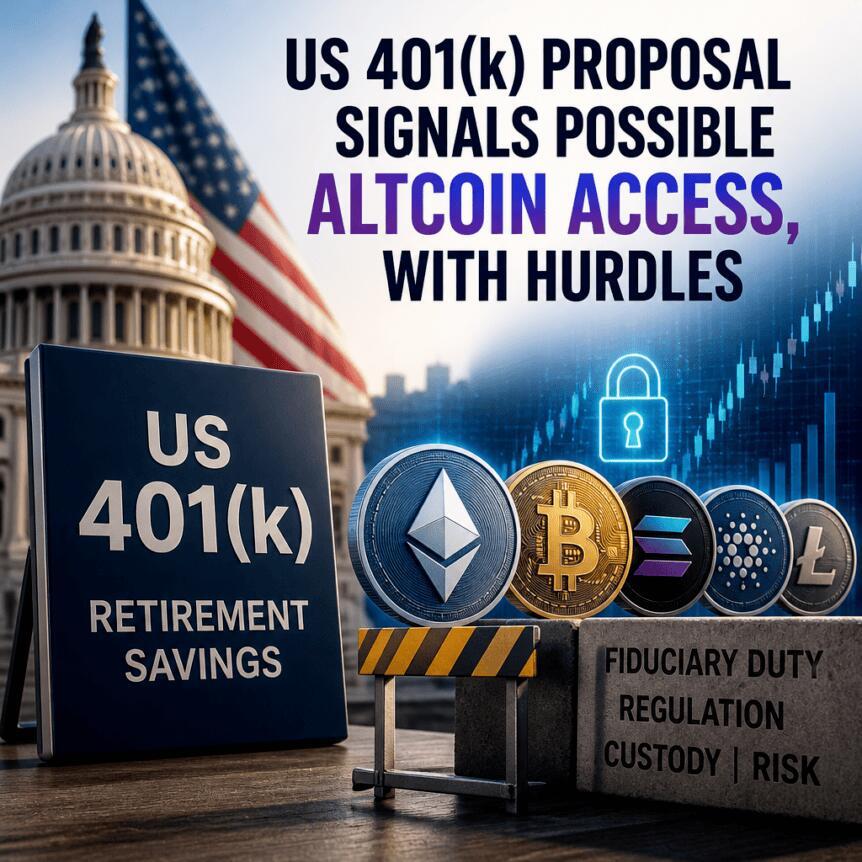
US 401(K) Proposal Signals Possible Altcoin Access, With Hurdles


Still, experts caution that the rule does not automatically mean broader access to a wide range of tokens-especially less established ones. Even if smaller cryptocurrencies become eligible in theory, plan committees will still need to demonstrate that each option meets the same prudence, liquidity, and investor-protection standards expected for any retirement investment.
Key takeaways- The Labor Department's proposal is now under White House review, with the goal of making crypto-like investments easier for 401(k) fiduciaries to consider. The March draft does not name specific cryptocurrencies or set a market-cap threshold, instead directing plans to evaluate six practical criteria. Experts expect the first options to center on Bitcoin and Ether due to liquidity, pricing reliability, and existing investment infrastructure. Smaller tokens may face tougher scrutiny because of shorter track records, less liquid markets, and harder-to-justify valuation benchmarks. Crypto exposure may arrive first through ETFs or managed funds rather than through direct holdings, since custody and pricing processes are more established.
According to the Office of Information and Regulatory Affairs, the Labor Department rule reached the White House for final review on Thursday. The proposal is designed to reduce legal uncertainty for employers and plan managers who want to add alternative investment options, including cryptocurrency-related products.
The March proposal does not specify which digital assets could be included and does not establish a minimum market capitalization requirement. Instead, it instructs retirement plan managers to consider six factors when selecting investments: performance, fees, liquidity, valuation, benchmarks, and complexity.
That framework matters because plan committees are not simply picking assets-they are documenting why an investment choice is consistent with fiduciary standards. As one expert put it, the crucial issue is not which tokens regulators might prefer, but whether each investment can be assessed under the same prudence and investor-protection expectations applied to other retirement options.
Why smaller cryptocurrencies may struggle despite the ruleTeresa Goody Guillén, managing partner at Bellementis PLLC, argued that Bitcoin and Ether are likely to be offered first because their markets are the most established and they have more mature investment products. She pointed to CoinGecko data as of 20:01 UTC on Nov. 6, citing Bitcoin at approximately $1.5 trillion and Ether at roughly $273 billion by market capitalization.
Guillén emphasized that larger market value does not automatically make an asset suitable, but it can be relevant to demonstrating liquidity and valuation reliability. In her view, managers must show that a digital asset meets the same standards of prudence, liquidity, valuation, and investor protection expected of any retirement option.
Rather than treating market capitalization as a strict gate, she suggested that“big doesn't mean suitable, and small doesn't mean disqualified.” Different technologies should not automatically disqualify an asset-however, plan committees must still be able to make a defensible case under the rule's evaluation criteria.
Bernardo Brites, co-founder and CEO of Trace Finance, framed the issue as more operational than theoretical. He said that running assets through the required evaluation list typically yields a limited set that can clear the track record and benchmark hurdles needed for fiduciaries to justify an investment. In his view, market capitalization matters only indirectly.
Brites also highlighted a practical constraint: plan committees need the ability to document a daily, reliable price using systems that fit the“regulated wrapper” fiduciaries require. If that pricing and documentation is not workable, he said, the token likely will not make the cut.
ETFs and managed funds could arrive before direct crypto holdingsWhile the proposal does not limit crypto exposure to ETFs or managed funds, experts expect those structures to be the first to gain traction inside retirement plans. Guillén said ETFs and managed funds would likely come earlier because they align with existing custody and recordkeeping processes.
Direct crypto holdings introduce additional concerns-such as storage, cybersecurity, and pricing mechanics-according to Guillén. At the same time, she stressed that these concerns should not automatically eliminate the possibility of direct holdings; rather, they raise the bar for how plan committees demonstrate compliance and risk controls.
Brites expects adoption to be gradual. He described a sequence where existing brokerage access could appear first, followed by standalone ETFs and funds that include smaller amounts of crypto. He also suggested a possible timeline: some crypto investment options could be available in 2027, with ETFs at larger employers later that year. Broader crypto availability in retirement funds could expand further by 2028, he said.
Underlying these expectations is an idea Brites summarized as legal progress outpacing operational readiness. In his view, the rule reduces legal risk, but the“plumbing” required for integration takes longer. He also noted that administrative steps-White House review, publication, and then an effective date that typically follows afterward-can extend timelines, mentioning that White House review can take up to ninety days.
Legal protections may help, but uncertainty remainsThe proposal offers potential protection from some lawsuits by giving fiduciaries a clearer path for evaluating crypto-related investments. However, experts caution that it does not eliminate litigation risk entirely-plan managers could still face claims related to their specific investment decisions.
Brites further warned that the regulatory landscape could shift again under future administrations. He pointed to how guidance issued in 2022 was reversed in 2025, and argued that the same possibility applies to the new rule. For employers considering long-term retirement plan changes, the prospect that rules could be reversed-and that courts may vary in how much they defer to agency safe harbors-could slow adoption.
In other words, the rule may lower the immediate barrier to considering crypto, but it does not remove the longer-term policy risk that employers must weigh when making decisions that affect plan participants for years.
As the proposal moves through the final White House review and subsequent publication and effective-date steps, investors and plan participants should watch how plan committees translate the rule's six evaluation factors into real-world documentation, and whether early products focus on widely liquid assets and ETF-style wrappers before broader token inclusion becomes practical.
Risk & affiliate notice: Crypto assets are volatile and capital is at risk. This article may contain affiliate links.
Legal Disclaimer:
MENAFN provides the
information “as is” without warranty of any kind. We do not accept
any responsibility or liability for the accuracy, content, images,
videos, licenses, completeness, legality, or reliability of the information
contained in this article. If you have any complaints or copyright
issues related to this article, kindly contact the provider above.


Comments
No comment