


Is Mars Still Volcanically Active? Scientists Discover New Clues Beneath Its Surface


The findings, published in the journal Science Advances on November 4, could change how scientists understand the planet's interior and where they might look for signs of life.
Recommended For YouThe discovery was made using the ExoMars Trace Gas Orbiter, a spacecraft operated through a collaboration between the European Space Agency and Russia's space agency, Roscosmos.
Stay up to date with the latest news. Follow KT on WhatsApp Channels. What did scientists discover?
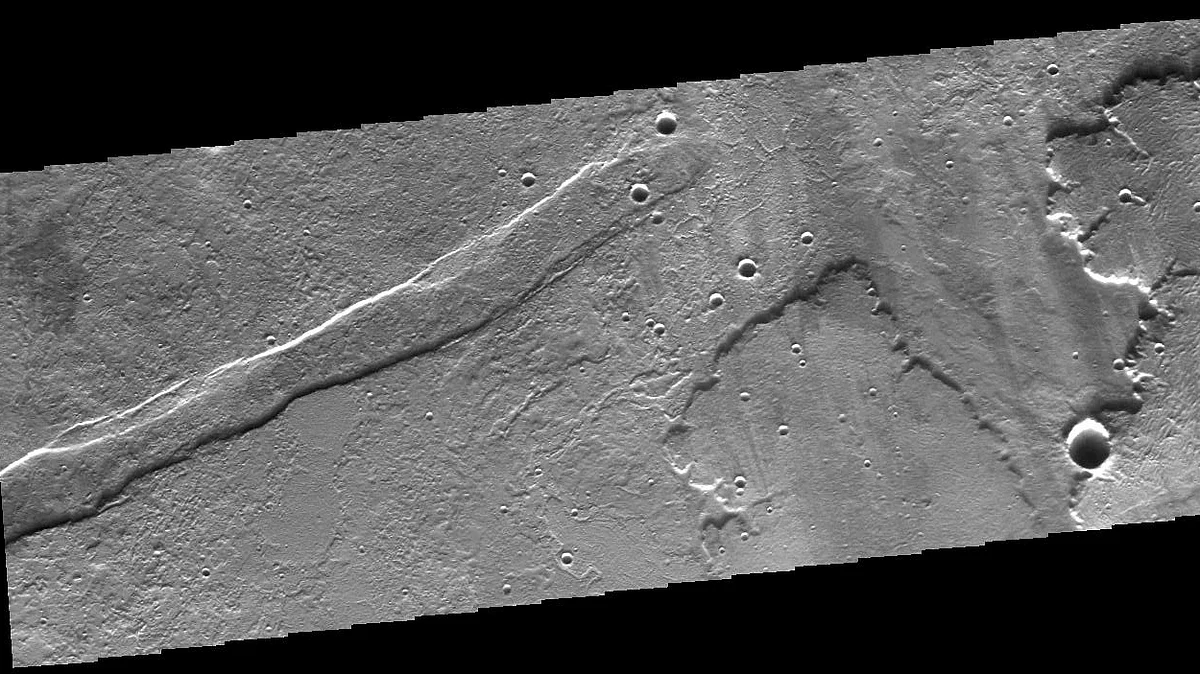
The spacecraft detected hydrogen chloride, a gas that can be released by volcanic activity on Earth, above cracks in the Alba Mons region of Mars. Alba Mons is a huge ancient volcano in the planet's northern hemisphere and is the largest Martian volcano by surface area.
Scientists noticed that levels of the gas increased at an unusual time of year, during early summer in the northern hemisphere.
The gas also appeared repeatedly in the same area, close to cracks along the volcano's slopes. These patterns led researchers to investigate whether the gas could be coming from beneath the Martian surface rather than forming entirely through processes in the atmosphere.
Does this mean Mars has active volcanoes?Not necessarily. Scientists believe the gas may be escaping from underground volcanic material, possibly linked to a chamber containing hot or molten rock.
On Earth, similar gases can escape through cracks near volcanic systems without a major eruption taking place.
Researchers also examined images of the Alba Mons region and identified narrow cracks, some hundreds of metres long, along with changes in the colour of the surrounding surface.
These features could be linked to gases escaping from below. However, no new lava flows or volcanic eruptions have been directly observed on Mars. The findings therefore suggest possible ongoing activity beneath the surface, rather than confirming that a volcano is currently erupting.
Why is the discovery important?Mars is home to some of the largest volcanoes in the solar system, including Olympus Mons, the tallest known volcano on any planet, which is about 21.9 to 25 kms and 2.5 to 3 times taller than Earth's Mount Everest.
Scientists have long known that volcanic activity shaped much of the Martian surface billions of years ago. What remains uncertain is whether enough heat still exists inside the planet to support volcanic processes today.
Previous observations have suggested that some areas experienced volcanic activity relatively recently in geological terms.
NASA's InSight lander also detected marsquakes, showing that the planet continues to experience movement beneath its surface. The latest gas discovery provides another clue that Mars may not be completely inactive internally.
Could there be life beneath Mars?The discovery also raises questions about whether conditions suitable for microscopic life might exist underground. If hot volcanic material comes into contact with water beneath the surface, it could create warm environments similar to hydrothermal systems found on Earth.
Such environments can provide heat and chemical energy that certain microorganisms need to survive.
They may also offer protection from the extremely cold temperatures and harsh radiation at the Martian surface.
However, scientists have not discovered living organisms on Mars, and the latest findings do not prove that life exists there.
Instead, they suggest that areas around ancient volcanic systems could be worth investigating during future missions.
What happens next?Researchers will need further observations to establish where the hydrogen chloride is coming from and whether it is linked to hot magma beneath the surface.
Scientists will also continue studying seasonal changes in the gas and the cracks identified around Alba Mons.
If future evidence confirms that volcanic processes are still taking place, it could reshape scientists' understanding of how Mars has evolved. For now, the discovery offers an intriguing possibility: the Red Planet may be quiet on the surface, but still active deep underground.
ALSO READ- Six years after Hope, UAE engineers are leading a 5-billion-km asteroid mission UAE: New 3D exoplanet map reveals hidden weather, heat patterns, atmosphere layers Was there life on Mars? UAE scientists reveal new proof of water under planet's surface

Legal Disclaimer:
MENAFN provides the
information “as is” without warranty of any kind. We do not accept
any responsibility or liability for the accuracy, content, images,
videos, licenses, completeness, legality, or reliability of the information
contained in this article. If you have any complaints or copyright
issues related to this article, kindly contact the provider above.


Comments
No comment