


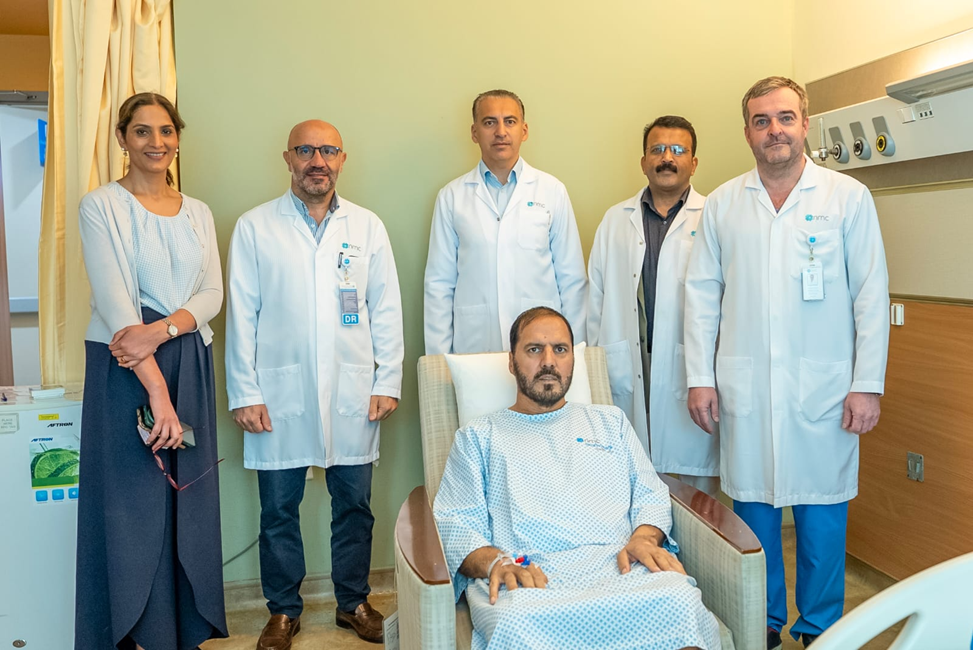
Multidisciplinary Team At NMC Royal Hospital, Khalifa City, Removes A Massive 36Cm Tumour Extending From The Patient's 12Th Rib Into The Abdominal Cavity.


(MENAFN- Mid-East Info) – Multidisciplinary team at NMC Royal Hospital, Khalifa City, removes a massive 36cm tumour extending from the patient's 12th rib into the abdominal cavity.
– The rare cancer reportedly affects approximately one person in every two million annually, with only a handful of comparable abdominal cases documented worldwide over the past 30 years.
– Complex surgery involved the removal of the affected kidney and surrounding tissues, with minimal blood loss and no blood transfusion required.
– Patient discharged after approximately one week and makes a remarkable recovery, travelling to Pakistan to reunite with his family six weeks after surgery.
ABU DHABI, 6 November 2026
– A multidisciplinary surgical team at NMC Royal Hospital, Khalifa City, Abu Dhabi, has successfully removed an exceptionally rare cancerous tumour weighing 4.4 kilograms and measuring 36 centimetres in length from a 49-year-old patient, during a complex six-hour operation that involved several vital organs and presented significant surgical challenges.
The successful procedure represents a notable medical achievement due to the extraordinary size, unusual location and rarity of the tumour, which originated from the patient's 12th rib and extended into the abdominal cavity.
According to the treating medical team, this rare form of cancer affects approximately one person in every two million annually. While such tumours typically develop in the chest, the growth into the abdominal cavity observed in this case is exceptionally uncommon, with only a handful of comparable cases reportedly documented worldwide over the past three decades.
Measuring 36 by 17 centimetres and weighing more than the average newborn baby, the tumour occupied most of the right side of the patient's abdomen, extending from the diaphragm to the pelvis. Its enormous size had displaced several major abdominal organs, including the liver, stomach, intestines and kidney, from their normal positions.
The patient, a Pakistani national who has lived in the UAE since 2014 and works as a driver, initially experienced pain on the right side of his abdomen approximately five months before seeking medical attention.
As the discomfort progressively worsened, he noticed a growing abdominal lump and experienced an unexplained weight loss of approximately eight kilograms, prompting him to undergo medical investigations.
Diagnostic imaging revealed the massive tumour, which doctors believe may have been developing gradually over several years before producing noticeable symptoms.
Following a comprehensive evaluation by the hospital's multidisciplinary tumour board, medical investigations found no evidence of the cancer spreading to distant organs. Surgical removal was therefore recommended as the most appropriate treatment option.
Given the size and location of the tumour, the surgical team developed a detailed operative plan to address the significant risks associated with its proximity to major abdominal blood vessels and vital organs, including the liver, kidney, diaphragm and intestines.
The operation was led by Dr Hassan Elberm, Consultant General and Hepatopancreatobiliary (HPB) Surgeon, alongside Dr Sharath Krishnan, Consultant Surgical Oncologist; Dr Haitham Gibbawi, Consultant Vascular Surgeon; Dr Juan Tova, Consultant Urologist; and Dr Ahmad Kamal, Consultant Anaesthetist.
During the six-hour procedure, surgeons carefully separated the tumour from surrounding structures while protecting major blood vessels and other vital organs.
As the cancer had invaded the right kidney, diaphragm and surrounding abdominal wall tissues, the surgical team removed the affected kidney, adrenal gland, part of the diaphragm and the right 12th rib together with the tumour to achieve complete removal with appropriate surgical margins.
Despite the considerable risk of major bleeding and injury to surrounding organs, the team successfully completed the procedure with minimal blood loss and without requiring a blood transfusion, although multiple units of blood had been prepared as a precaution.
Dr Hassan Elberm said the operation presented exceptional challenges because of the tumour's size and its close relationship with several vital organs and major blood vessels.
“The greatest challenge was not simply the size of the tumour, but its location and proximity to critical abdominal structures. The mass occupied a substantial part of the abdominal cavity, leaving very limited space for surgical manoeuvring. Any injury to the surrounding organs or major blood vessels could have resulted in serious, potentially life-threatening complications,” he said.
Dr Elberm explained that extensive preoperative planning and close coordination between specialists from different surgical disciplines were essential to the successful outcome.
“Our team carefully planned every stage of the operation and prepared for possible complications, particularly major bleeding. We were able to remove the entire tumour with minimal blood loss and without the need for a blood transfusion, which was a particularly encouraging result given the complexity of the case,” he added.
He noted that removing the affected organs and surrounding tissues was necessary to achieve appropriate surgical margins and reduce the risk of leaving cancerous tissue behind, giving the patient the best possible chance of long-term survival.
He added that the removal of the right kidney and affected tissues was not expected to significantly affect the patient's long-term quality of life, provided the remaining kidney continued to function normally and appropriate medical follow-up was maintained.
Following the procedure, the patient was transferred to the intensive care unit for close monitoring under the supervision of Dr Kalpana Reddy and Dr Hossam Elshekh Ali.
His condition remained stable, allowing him to be transferred to the general ward two days later. Within four days of surgery, he was able to walk and eat independently, and he was discharged from hospital after approximately one week without significant postoperative complications.
Subsequent microscopic examination confirmed that the tumour had originated from the 12th rib and had been completely removed.
Six weeks after the operation, the patient had recovered well and was able to travel to Pakistan to reunite with his family.
He will continue to undergo regular outpatient follow-up and surveillance imaging, with any additional treatment to be determined according to his clinical progress and the multidisciplinary oncology team's recommendations.
The successful operation highlights the importance of multidisciplinary collaboration, advanced surgical planning and coordinated specialist care in managing rare and complex cancers.
It also reflects the capabilities of NMC Royal Hospital, Khalifa City, in performing highly complex surgical procedures and providing specialised healthcare services to patients in Abu Dhabi and across the UAE.
– Ends – Borderless Finance. AI-Native.
Your digital companion for smarter everyday choices. Built for how you live, earn, and grow. Move money at your pace with AI-powered finance, all in one tap.
Join the waiting list. Earn
Legal Disclaimer:
MENAFN provides the
information “as is” without warranty of any kind. We do not accept
any responsibility or liability for the accuracy, content, images,
videos, licenses, completeness, legality, or reliability of the information
contained in this article. If you have any complaints or copyright
issues related to this article, kindly contact the provider above.


Comments
No comment