


A Collector's 'Mystical' Connection To Art Benefits A Swiss Museum


Jean Planque, scout for the Basel-based Galerie Beyeler, had a gift – an eye for art. Standing in front of a painting, he would sometimes start to cry.
“It was mystical, it was religious,” says Florian Rodari, the conservator of his collection, now held by the Jean and Suzanne Planque Foundation.“He questioned a painting; he asked it to give him a response.”
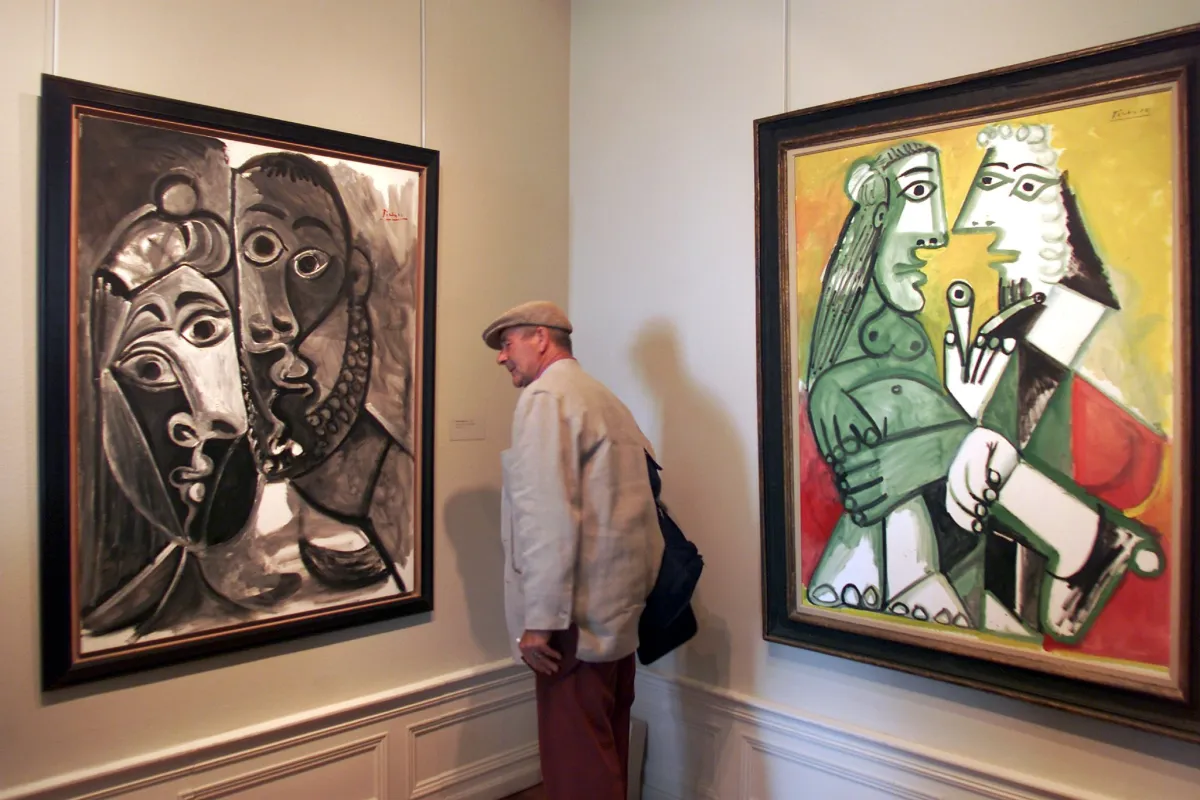
Based in Paris for two decades in the mid-20th century, Planque became friends with artists including Jean Dubuffet, Pablo Picasso and Alberto Giacometti. His personal collection of more than 300 artworks – among them, works by Picasso, Paul Cézanne, Vincent van Gogh, Claude Monet, Paul Klee and Georges Braque – has recently returned to Switzerland after about two decades abroad.
It will go on show in an exhibition at the Musée JenischExternal link in Vevey from November 6 to April 18, 2027. For this relatively small museum, securing the collection is a major coup.“It further consolidates the Jenisch Museum Vevey's position as a leading institution in French-speaking Switzerland,” the museum says, and it will“encourage exhibitions, cultural education research and collaboration”.
Nomadic fateThe collection has moved around since Planque's death in 1998. It was initially intended for the Cantonal Museum of Fine Arts in Lausanne, which planned to build a lakeside site. While the site was still in the planning, the collection went on tour to Winterthur, Zurich, Marseilles, Paris, Brussels and locations in Germany, Italy and Spain.
But in 2008, canton Vaud voters rejected the construction of the new museum. A broad coalition of opponents – an alliance of environmentalists, lakeshore protection groups (such as Helvetia Nostra), downtown museum advocates, and cultural figures – argued that the massive modern building would block or ruin the lakeshore and that cultural landmarks should remain in the city centre rather than be built by the water's edge.
So the Planque foundation, created a year before his death, had to find an alternative location. It decided to loan the collection for 15 years to the Musée Granet in Aix-en-Provence, France, where Planque had lived for four years to better understand his hero, the Aix native Cézanne.
This was a major loss for Lausanne. Silvia Zamora, the director of culture in Lausanne at that time, told the municipal parliament in 2010 that it was“a serious blow” to the city's artistic scene.“Not just for the Museum of Fine Arts, but for art in this country. It's really a pity that a collection this important is leaving.”
After the 15 years in Aix-en-Provence were up, it was no longer possible to house the collection at the Musée Granet, Rodari says. The foundation decided to return it to Switzerland.“That's how we settled on the Musée Jenisch,” he says.“I had visited it with Jean Planque once and he liked it very much.”
>> Some of the gems from Jean Planque's collection:
Planque was born in Ferreyres, a remote rural village at the foot of the Jura mountains, in 1910. With little in the way of formal education, he went to business school in Lausanne. He started working in Basel and began to paint and visit museums there.
When the pipe manufacturer he worked for in Basel went bankrupt, he returned to the Jura and took care of his sisters after the death of his mother. A successful venture to produce an efficient livestock-feeding system for farmers earned him the capital to begin collecting art in the early 1940s.
In 1954, he met the prominent art dealer Ernst Beyeler, who saw his talent for identifying and speaking about art, and who hired Planque to scout works in Paris for his gallery; he held the job until 1972.
“He was an extraordinary kind of autodidact with a passion for painting,” Rodari says.“Jean Dubuffet, Pablo Picasso, Alberto Giacometti phoned him in moments where they were in doubt. He had something innate.”
He told people he was himself“a failed painter,” Rodari says.“He said he practised every day, but he was bad. I went into his studio once and he was treading on his watercolours. He was an honest painter, but he always had someone watching over his shoulder. There was Picasso, there was Dubuffet, and he could never find his own language. He would say – 'you have to find your own language, your own style'.”
Planque thus described his experience of looking at art:“The painting imposes itself on me with a kind of brutality, in its entirety, and I have a premonition. I sense the mystery, that which can be expressed neither through music nor through words. Immediate apprehension. An emotional experience. Possession of my whole being. I am in them and they are in me. Paintings!”
His talent for spotting great paintings became known in Parisian art circles, Rodari says.“I can tell you that when he stopped in front of a painting for several minutes and the tears would well, certain Parisian galleries would wait until he had gone and quickly increase the price,” he says.
Falling out with the marketHis mandate at Galerie Beyeler, according to Franz Meyer, a former director of the Kunsthalle Bern, was“to buy expensive paintings in Paris in order to sell them even more expensively in Basel.” In an interview in a 2007 documentary about Beyeler, Meyer described Planque as having been“essential to the Galerie Beyeler's operations”. Beyeler, with whom Planque was close friends, trusted his advice, Rodari says.
In 1960 – on the day of his 50th birthday – Planque went to visit Pablo Picasso with a painting by Cézanne that had been very badly restored. He knew Picasso wouldn't buy it. They commiserated about the terrible restoration, and it was the beginning of a friendship. Planque used to take his wife's homemade jam when he visited. Picasso agreed to sell 20 paintings via Galerie Beyeler and explained to the gallery that the reason was his regard for Planque. Through his friendships with artists, he“got discounts for Beyeler”, Rodari says.
Perhaps part of the reason Planque resigned from Beyeler in 1972 was disillusionment with the direction of the art market, Rodari says. Art Basel was founded in 1970.“Art started to become an object for speculation, and he really didn't like that at all.”
Among the works that will go on show at the Musée Jenisch are some by lesser-known artists whose work Planque admired, such as the American Earl Kerkam, the Spanish painter Fermín Aguayo and the French artist Roger Bissière.
“It's not the collection of an art historian at all,” Rodari says.“It's the collection of a man who saw paintings and fell in love with them.”
There is also a painting of a bouquet of flowers Planque discovered in 1959 in a Paris apartment, covered in dirt at the end of a dark corridor and hung from a piece of string. He was convinced he had found something remarkable and, together with Beyeler, set about trying to identify it. A few months later, it was added to the official catalogue of Van Gogh's work. Planque bought it.
Edited by Virginie Mangin/ts
Prefer Swissinfo on GoogleSee more Swissinfo articles in your Google results. Learn
In compliance with the JTI standards
More: SWI swissinfo certified by the Journalism Trust Initiati
You can find an overview of ongoing debates with our journalists here. Please join us!
If you want to start a conversation about a topic raised in this article or want to report factual errors, email us at ....
Read more
Legal Disclaimer:
MENAFN provides the
information “as is” without warranty of any kind. We do not accept
any responsibility or liability for the accuracy, content, images,
videos, licenses, completeness, legality, or reliability of the information
contained in this article. If you have any complaints or copyright
issues related to this article, kindly contact the provider above.


Comments
No comment