


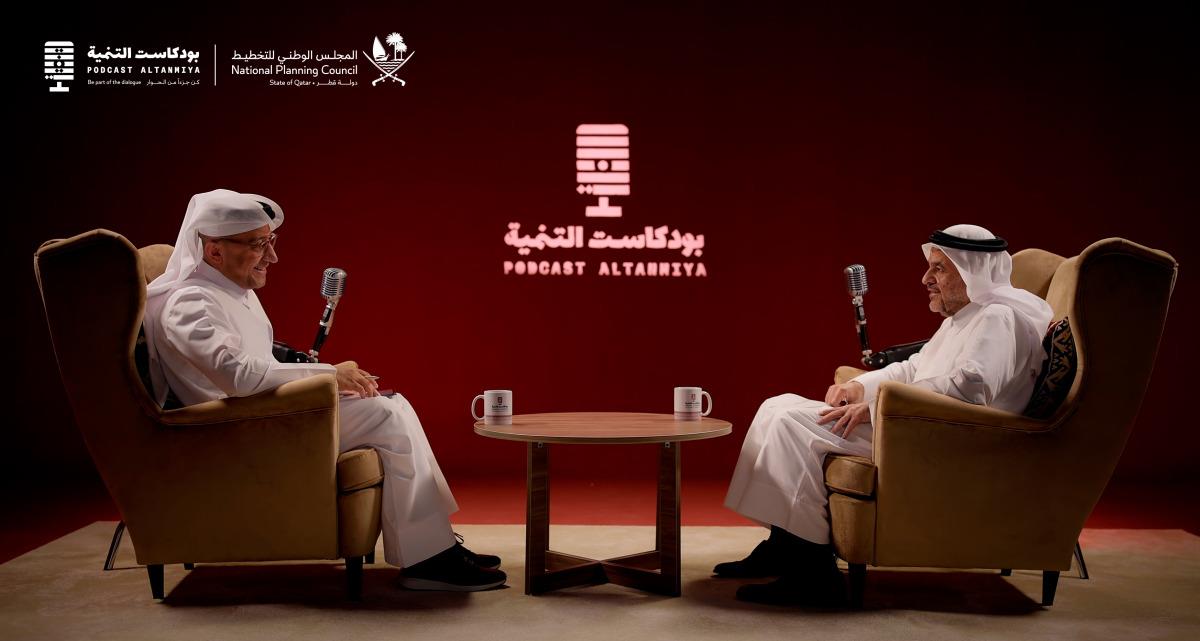
NPC Hosts QU President To Discuss Building National Talent And Future Of Higher Education In Age Of AI


DOHA: The National Planning Council (NPC) hosts President of Qatar University (QU),Dr Omar Mohamed Al-Ansari, in the sixth episode of Podcast AlTanmiya.
The episode discussed the university's role in preparing a future ready workforce for the labour market, its efforts to update its academic programmes to keep pace with rapid developments in artificial intelligence (AI), the introduction of new admission standards, and mechanisms to increase the Qatarisation rate of its academic staff.
The episode also explored the university's approach to aligning its research with national priorities and turning its outputs into practical applications, contributing to the achievement of the targets of the Third National Development Strategy (NDS3) and Qatar National Vision 2030.
Dr Omar Al-Ansari affirmed that Qatar University, alongside the country's other higher education institutions, contributes to supplying the labour market with qualified national talent, noting that employers are keen to recruit its graduates for their academic preparation, which is aligned with labour market needs.
In this context, Al-Ansari said:“The most distinctive and clearest thing about Qatar University is the word 'Qatar'. It is the country's first and largest national university, and for decades it was the cradle of higher education. Today, it's hard to find a home or family without a connection to QU; more than three generations now have ties to the university.”“Over time, I believe any student we graduate who doesn't know how to use AI in their field will fall short, and may even face difficulties finding a job,” Al-Ansari said. He added:“Students are not prohibited from using AI; what matters is how they use it to raise the quality of their work.” Al-Ansari also outlined the university's efforts to enhance the skills and knowledge of its faculty, explaining that it is close to finalising a framework that defines the skills, knowledge and abilities required of any faculty member it recruits, so they add real value to the learning process and raise students' standards, alongside the continuous development of current faculty through a dedicated centre that offers workshops and training programmes.
“Faculty members are, first and foremost, teachers before they are specialists in any field, whether engineering, law or education,” he said.
On the Qatarisation of academic staff, Al-Ansari explained that Qatari faculty make up around 30% of the university's total faculty and said he aspires for this to reach 60 to 70% in the future.
On research and innovation, Al-Ansari affirmed that Qatar University is the country's largest contributor to scientific research, with more than 4,000 research publications a year, noting that the university directs its research grants towards the country's development priorities and provides researchers with an incubation environment that supports their ideas from incubation through to technology readiness and intellectual property protection.

Legal Disclaimer:
MENAFN provides the
information “as is” without warranty of any kind. We do not accept
any responsibility or liability for the accuracy, content, images,
videos, licenses, completeness, legality, or reliability of the information
contained in this article. If you have any complaints or copyright
issues related to this article, kindly contact the provider above.


Comments
No comment