


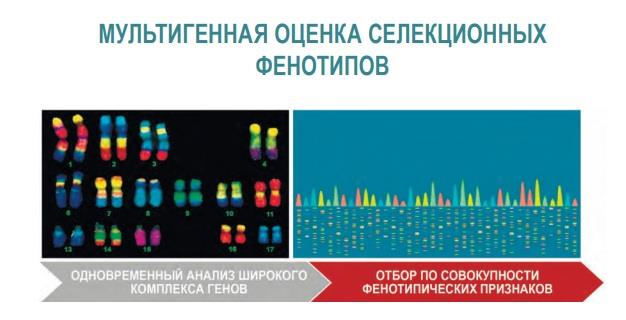
Multigene Assessment Of Breeding Phenotypes


(MENAFN- RCTT)
The Institute of Genetics and Cytology offers the Method (Technology) of multigene assessment of breeding phenotypes in the field of agricultural breeding to predict the breeding value of plants and animals under a commercial agreement with technical assistance and/or a license agreement and is looking for partners interested in the further development and implementation of this Method (Technology) under a technical cooperation agreement.
Description
The method of multigene assessment of breeding phenotypes is a modern approach in agricultural breeding that enables the prediction of the breeding value of plants and animals based on the analysis of multiple genetic markers.
Importance of the multigene assessment method:
1. Predicting breeding value:
- The method allows for the assessment of the genetic potential of plants and animals before they reach full maturity, which accelerates the breeding process.
- This is particularly significant for perennial crops and animals with long reproductive cycles.
2. Increasing breeding accuracy:
- Multigene analysis accounts for a multitude of genetic factors linked to productivity, disease resistance, stress tolerance, and other essential traits.
- This reduces the likelihood of errors when selecting breeding lines.
3. Accelerating the breeding process:
- The method shortens the time required to develop new plant varieties or animal breeds by enabling the prediction of desired phenotypes in advance.
4. Preserving genetic diversity:
- Multigene assessment helps to consider not only productive traits but also the preservation of genetic diversity within populations, which is crucial for resilience against changing environmental conditions.
5. Economic efficiency:
- It lowers costs associated with long-term field trials and animal testing by providing accurate predictions based on genetic data.
Relevance for Belarus:
1. Significance of agriculture to the economy:
- Agriculture is a key sector of the Belarusian economy. The multigene assessment method can enhance the productivity of crops and livestock, which is vital for ensuring food security and supporting exports.
2. Development of breeding centers:
- Belarus is home to various scientific centers and institutes dedicated to plant and animal breeding, such as those under the National Academy of Sciences of Belarus (NASB). The implementation of multigene assessment will enhance their competitiveness at the international level.
3. Climate change:
- Resilience to stressful conditions (drought, frost, diseases) is becoming an increasingly important factor in the context of climate change. Multigene assessment enables the development of plant varieties and animal breeds adapted to new conditions.
4. Export potential:
- Highly productive and resilient plant varieties and animal breeds, developed using multigene analysis, possess significant export potential, thereby strengthening Belarus's position in the global market.
5. Integration with modern technologies:
- Belarus is actively developing biotechnology and genetics. Multigene assessment can be integrated into existing genomic selection programs, which will increase research efficiency.
Multigene assessment (genomic selection) is a method in agricultural breeding developed at the Institute of Genetics and Cytology that utilizes genomic information to predict the breeding value of plants and animals. By employing genetic markers identified through high-throughput sequencing and bioinformatic analysis of genomic data, it is possible to precisely identify individuals that carry desired traits.
This approach allows breeders to significantly shorten the time required to develop new varieties, breeds, and hybrids. It enables a faster and more accurate selection of individuals with desired characteristics for further breeding, compared to traditional breeding methods, which often require many years to evaluate phenotypic traits and their transmission to subsequent generations. Genomic selection serves as a powerful tool for advancing agricultural science and practice, contributing to food security and sustainable development.
This information is featured in the 2024 catalog "Advanced Developments of the National Academy of Sciences of Belarus, pp. 202–203. (in Russian) Advantages and Innovations Benefits of implementing the technology in Belarus:
- Increased productivity of agricultural crops and livestock.
- Accelerated development of new varieties and breeds.
- Reduced costs for breeding programs.
- Enhanced resistance to biotic and abiotic stresses.
- Development of scientific potential and training of qualified personnel.
Accelerated breeding processes, improved selection accuracy, preservation of genetic diversity, and cost reduction.
A world-class development.
In the Republic of Belarus, traditional breeding methods are predominantly used; therefore, this development is unique. It is based on the analysis of large volumes of genomic data, the use of computer algorithms to process and interpret this information, and the application of modern biotechnological approaches for the selection and breeding of agricultural plants and animals with desired traits.
This development establishes the scientific foundation for creating biotechnologies of the sixth technological paradigm for agriculture (enabling the creation of promising new forms and lines of plants and animals characterized by high resilience, productivity, and quality). Stage of development Already on the market Comments regarding stage of development Areas of application.
Plant breeding (development of new plant varieties to improve yield, product quality, resistance to diseases and pests, and adaptation to various environmental conditions).
Animal breeding (improvement of productive traits, including milk and meat yield, health, and reproductive capabilities).
Aquaculture (improvement of economically valuable traits in fish and other aquatic organisms).
Conservation of biodiversity (identification and preservation of gene variants that are critical for the survival of a species). Funding source State budged
Internal
IPR status Exclusive rights
Secret know-how
Comments regarding IPS status At the Institute of Genetics and Cytology, a R&D project was carried out titled:
"Identification of polymorphisms in signal transducer and activator of transcription (STAT) and myostatin (MSTN) genes to enhance fertility and productivity in Belarusian-bred cattle."
The results of this research were used in the implementation of the Method. Sector group BioChemTech
Healthcare
ICT Industry & Services
Client information Type R&D institution Year established 1965 NACE keywords A.01.61 - Support activities for crop production
A.01.62 - Support activities for animal production
M.72.11 - Research and experimental development on biotechnology
M.74.90 - Other professional, scientific and technical activities n.e.c.
Q.86.90 - Other human health activities
Turnover (in EUR) 10-20M Already engaged in transnational cooperation Yes Additional comments The Institute of Genetics and Cytology of the National Academy of Sciences of Belarus is one of the leading research centers in the field of genetics and cytology, providing a wide range of professional services to clients and partners and specializing in high‐quality genetic and cytological research based on modern technologies and advanced methods.
Main areas of research:
– Studying the structural and functional organization of genomes of plants, animals, humans, and microorganisms;
– Studying issues in genetic and cellular engineering;
– Developing the genetic foundations for the selection of plants, animals, and microorganisms.
– Development of genomic technologies for agriculture, healthcare, sports, and environmental protection;
– Study of biosecurity issues;
– Providing services for DNA marking and DNA profiling of plants, animals, humans, and microorganisms;
– Study of the interaction between the genome and the microbiome;
– Bioinformatics;
– Collection and preservation of unique DNA samples as sources of valuable genetic information;
– Monitoring of the genetic resources of the Republic of Belarus, promoting access to genetic resources and the joint use of benefits.
– Provision of services for determining the content of genetically modified ingredients in food raw materials and foodstuffs.
International scientific partnership agreements have been concluded with the Medical Genetic Research Center (Russia), the Estonian Biocenter (Estonia), the Institute of Genetics and Animal Breeding of the Polish Academy of Sciences (Poland), the National Institute of Biology of the Republic of Slovenia (Slovenia, Institute of Plant Genetic Resources“K", Sadovo of Agricultural Academy (Bulgaria), The Center for Experimental Biomedicine named after Ivane Beritashvili (Georgia), the Institute of Molecular and Cellular Biology of the Siberian Branch of the Russian Academy of Sciences (Russia), and others.
Official website of the Institute of Genetics and Cytology. Languages spoken English
Russian
Information about partnership Type of partnership considered Commercial agreement with technical assistance
License agreement
Technical cooperation agreement
Type and role of partner sought Consumers interested in purchasing the Methods (Technologies) for multigene assessment of breeding phenotypes in the field of agricultural breeding, used to predict the breeding value of plants and animalsunder a commercial agreement with technical assistance and/or a license agreement.
Partners interested in the development and implementation of the Methods (Technologies) for multigene assessment of breeding phenotypes in the field of agricultural breeding, used to predict the breeding value of plants and animals under a technical cooperation agreement. Type and size of partner sought > 500
251-500
SME 51-250
SME 11-50
SME <= 10
R&D Institution
University
Sole proprietor

Legal Disclaimer:
MENAFN provides the
information “as is” without warranty of any kind. We do not accept
any responsibility or liability for the accuracy, content, images,
videos, licenses, completeness, legality, or reliability of the information
contained in this article. If you have any complaints or copyright
issues related to this article, kindly contact the provider above.


Comments
No comment