


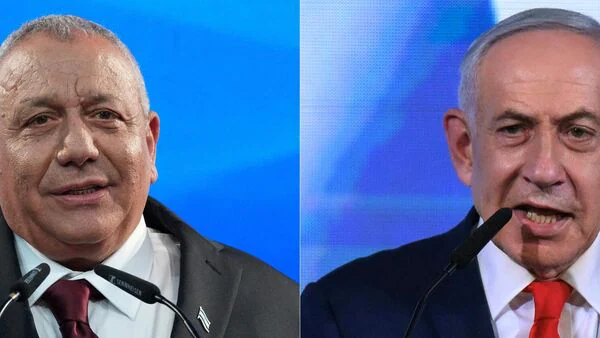
Netanyahu Out? Arab-Led Parties Back Gadi Eisenkot To Form Israel's Next Govt- What Next?


Benjamin Netanyahu's chances of retaining power have weakened after the country's largest Arab political alliance, the Joint List, backed opposition leader Gadi Eisenkot to form the next government.
Also Read | Netanyahu's election fraud claims rejected: Coalition talks beginThe development came on Thursday, as President Isaac Herzog continued consultations with political parties to decide who should receive the mandate to form the next Israeli government. The Joint List's endorsement, coupled with a decision by Netanyahu's long-time ally United Torah Judaism (UTJ) not to recommend any candidate, has strengthened Eisenkot's position.
“The Joint List announced today, Thursday, that it will inform the President of the State, Isaac Herzog, this evening of its decision to recommend that Gadi Eisenkot be tasked with forming the government,” the alliance said in a statement.
Arab-led parties secured a record 19 of the 120 seats in Israel's parliament in the October 27 election, giving them considerable influence over the government formation process. The Joint List holds 11 seats, while Mansour Abbas-led Ra'am has eight.
Netanyahu's Likud emerged as the largest party with 27 seats, but his right-wing and religious bloc initially secured only 53 seats, falling short of the 61 required for a parliamentary majority.
Eisenkot's opposition bloc, meanwhile, holds 48 seats.
Why has Netanyahu's position weakened?A setback for Netanyahu came on Thursday when United Torah Judaism, an ultra-Orthodox party that has traditionally supported him, declined to recommend any candidate for prime minister during its meeting with Herzog.
The party, which has seven seats in the Knesset, said it would not endorse either Netanyahu or Eisenkot. Its decision reportedly stems from frustration over the failure to pass legislation protecting military service exemptions for ultra-Orthodox students.
Also Read | Trump says US will stop $4 billion annual funding to Israel by year-endWith UTJ withholding its support, Netanyahu's recommendations have fallen from 53 to 46 lawmakers.
Eisenkot, meanwhile, has received backing from opposition parties and the Arab-led Ra'am alliance. Together with the Joint List's seats, his potential support could rise to 67 lawmakers, giving him a clear advantage in the presidential consultations.
What is the significance of Arab parties backing Eisenkot?The Arab-led parties' electoral gains have made them important players in Israel's political landscape.
Their record 19 seats could help Eisenkot secure the parliamentary numbers needed to replace Netanyahu. However, their endorsement does not automatically guarantee their participation in an Eisenkot-led coalition.
Also Read | Israel elections 2026: Joint List backs anti-Netanyahu bloc, supports EisenkotSome of Eisenkot's potential partners, particularly Avigdor Liberman's Yisrael Beiteinu, have expressed opposition to a government dependent on Arab parties.
Netanyahu has also repeatedly criticised the opposition over the possibility of relying on Arab lawmakers to form a government
What happens next in Israel?The next crucial step rests with President Isaac Herzog, who must decide which lawmaker has the best chance of forming a functioning Israeli government.
The presidential consultations are expected to conclude on Thursday, with representatives of the two largest parties, Eisenkot's Yashar and Netanyahu's Likud, scheduled to meet Herzog towards the end of the process.
Although the number of recommendations is an important factor, Herzog is not legally required to appoint the candidate with the most endorsements. He must assess who is best positioned to assemble a governing coalition.
Also Read | Netanyahu, Israel's divisive political Houdini, still at the centre of the showUnder Israeli law, the lawmaker chosen by Herzog will have 28 days to form a government. The Israeli president can grant an extension of up to 14 additional days, taking the total period to 42 days.
If the candidate fails, Herzog can give another lawmaker an opportunity to form a government. If subsequent attempts also fail, the process could eventually lead to parliament being dissolved and fresh elections being called.
Is Netanyahu out as Israel's prime minister?Not yet. Despite the growing advantage for Eisenkot, Netanyahu remains Israel's prime minister in a caretaker capacity until a new government is formed.
Also Read | Israel election latest: Who will form govt as Netanyahu, Eisenkot fall short?Eisenkot's immediate challenge will be to turn the recommendations he has secured into a workable coalition. Opposition within his camp to relying on Arab parties could complicate negotiations, even if Herzog gives him the first opportunity to form a government.
For Netanyahu, the loss of support from UTJ marks a massive political setback. However, the final outcome will depend on Herzog's decision and whether either candidate can secure the backing of at least 61 lawmakers.

Legal Disclaimer:
MENAFN provides the
information “as is” without warranty of any kind. We do not accept
any responsibility or liability for the accuracy, content, images,
videos, licenses, completeness, legality, or reliability of the information
contained in this article. If you have any complaints or copyright
issues related to this article, kindly contact the provider above.


Comments
No comment