


A Giant Desert Mouse, A Bee Museum: Abu Dhabi Park Turns Into A Playground For Imagination


That would be the scene at one outdoor exhibition kicking off this weekend in Abu Dhabi. Children are not only invited to look at artworks, they are also encouraged to touch them, change them, contribute to them and, perhaps most importantly, let their imaginations run wild.
Recommended For You Iran says in 'intensive' negotiations with US to avert war via mediatorsThe Children's Biennale, opening on November 6 and running until December 6, transforms parts of the park into an interactive exhibition featuring eight installations, seven newly commissioned works by UAE-based artists and an immersive installation by Indonesian artist Eko Nugroho.
Stay up to date with the latest news. Follow KT on WhatsApp Channels.
Titled How the World Feels, the exhibition explores how children make sense of their surroundings through sound, touch, movement, repetition and curiosity.
Curator Dana Al Mazrouei said the idea was to put children at the centre of the artistic experience, rather than treat them as visitors who simply walk around looking at exhibits.
"Children are not visitors here. They're not just simply welcomed by these artists," she explained during a preview tour.
"The artists that were commissioned were really commissioned to think about how do you position children in the centre and how do you make children part of your work and not just passive visitors?"
And that philosophy becomes apparent as soon as visitors begin walking through the park.
One installation invites families to leave something of themselves behind. Titled Where Wishes Grow, the three-part work by Nada Al Mosa, in collaboration with UT-R Studio, takes visitors on a journey through the past, present and future.
At one end, visitors are encouraged to write or draw their favourite memories of public parks and place them among flowers. In another section, a shrub-like structure displays artworks created by children in response to different prompts. At the other end stands a wishing tree, where visitors can write down their hopes for the parks they would like future generations to enjoy.
The idea is for the installation to grow throughout the month, with contributions from children and families becoming part of the artwork.
"We invite visitors to write down their favourite memories of public parks and to plant it into the flower," Al Mosa explained, describing the section dedicated to the past.
The future-facing section, meanwhile, encourages visitors to write down their wishes and tie them to the tree.
A few steps away, another installation challenges children to decide for themselves what they are looking at.
Egyptian artist Hana El-Sagini's Common Thread, Common Ground features large, organic sculptural forms surrounded by ropes that children can braid and rearrange. Depending on who is looking, the shapes could resemble coral, bones, dates or something entirely different.
El-Sagini deliberately avoids giving children an explanation of what the sculptures represent.
"I wanted to create very ambiguous forms, organic forms that the children wouldn't really know what they are, and each child can make their own idea of what these pieces are," she said.
The ropes are equally important to the concept. Children can braid them together, changing the appearance of the sculptures as they play.
"One very fragile element with braiding becomes much stronger," she explained, adding that she wanted children to explore that idea while working together.
The sculptures were originally modelled in ceramics before being recreated in fibreglass and resin to withstand outdoor use. Children can even sit on them, making the installation as much a shared family space as an artwork.
For El-Sagini, braiding is also a familiar childhood motif connected to care, family and the ways people look after one another.
Elsewhere, an installation offers a rather different sensory experience: listening to the park.
Created by Meera and Moza Al Mazrouei, the interactive sound installation takes inspiration from the familiar tin-can telephone.
Its different channels offer different listening experiences. Some allow sound to travel from one end to the other, while another introduces a delay between speaking and hearing a response. Other pipes encourage children to imagine listening to the sky and the soil.
The idea is to draw attention to sounds and surroundings that people often overlook, while allowing children to experiment with how they communicate and listen.
A different kind of exploration awaits at Pollinators Play Museum, by Moza Al Matrooshi, which invites children to get closer to bees and other pollinators, creatures that many people instinctively avoid for fear of being stung.
The installation brings together pollinator plants found around the park, wild honeycombs, traditional beehives and other objects used in beekeeping.
Children can crawl through large hexagonal structures designed to make them imagine themselves as bees. The colours used throughout the installation also introduce them to the idea that bees perceive the world differently from humans.
Al Matrooshi said the project was partly about breaking down the barriers between people and pollinators.
"We're always afraid to be stung or we're afraid of insects, but maybe bees are super scared because of their stingers,” she explained.
The honeycombs on display were collected after wild bees had abandoned them, while the materials used in the structure were selected to be recyclable or capable of returning to the earth, the beekeeper or the park.
"It was really important for me to not generate waste while I was creating this installation.”
Not far away, colourful woven structures bring another interpretation of nature to life.
Three textile-based works by Sarah Afaneh, titled The Patient Land, The Gracious Sun and The Enchanting Sea, explore elements of nature through colour, texture and weaving.
The land represents nourishment and abundance, the sun is imagined as a patient giver, while the sea represents the vast unknown.
"The sea is this vast unknown, right? Like when you ask kids something about the water, you know the surface, but the dark sea, you don't know," said the Palestinian artist.
Interactive weaving nets allow children and adults to add their own threads to the installation, which will continue evolving during the biennale.
For Afaneh, weaving also became a way of reconnecting with her own childhood and creative instincts.
"When I got on a loom, I kind of just stopped thinking. And I can follow intuition," she said, describing how the process allowed her to create without planning every detail.
But perhaps one of the most intriguing installations is also one of the smallest creatures made enormous.
Artist Alia Al Shamsi has taken inspiration from the UAE's jerboa, a tiny desert rodent with unusually long legs, and turned it into a much larger sculptural presence in the park.
Titled Where Wonder Hides, the playful creature looks almost like a cross between a mouse and a kangaroo.
"It's quite unique in the way it looks. It looks like a cross between a mouse and a kangaroo.”
The idea, she explained, is to reverse the animal's actual scale and encourage children to imagine things differently.
For Al Shamsi, the installation is also deeply personal, bringing back memories of playing outdoors as a child, collecting sticks and flowers and inventing imaginary worlds.
"I was probably one of the last that really played with nature and this idea of imagination and creating an imaginary world.” While Al Shamsi hadn't encountered a jerboa growing up, she recalled an incident where the remarkable animal crawled into their tent while camping in the desert; her son managed to catch it.“We let it return into the wild after it bit my son.”
She hopes the artwork will encourage families to reconnect with nature through play, particularly at a time when so much of children's attention is drawn towards screens and technology.
"That's great. But it's also really important to reconnect back. I think offline is very important,” she concluded.
Another work, Cosmic Connate by Palestinian artist Aya Afaneh, draws inspiration from the fish and other creatures found around the park's fountains. Its sculptural forms encourage children to think about what kinds of unusual creatures might inhabit the water, using familiar natural features to invent something new.
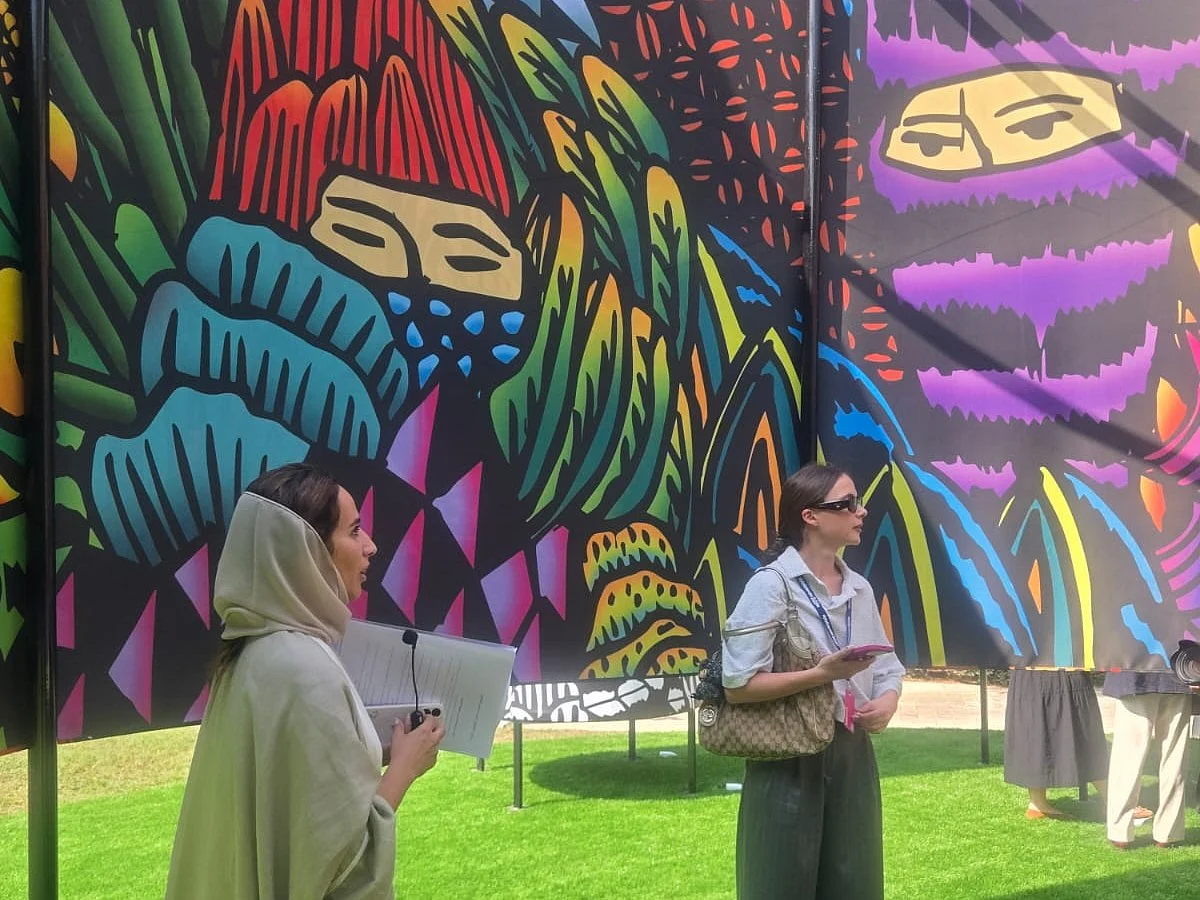
The final stop brings visitors beneath a large illuminated lantern-like structure by Indonesian artist Eko Nugroho, titled Kenangan Kunang-Kunang (Memories of Fireflies).
Originally commissioned by National Gallery Singapore for its 2019 Children's Biennale, the installation draws inspiration from traditional East Javanese lanterns and explores ideas of peace, equality and kindness.
Reimagined for its outdoor setting in Abu Dhabi, visitors can walk underneath the structure and experience it from within. Its lighting makes it particularly striking after sunset.
Beyond the installations, the biennale will also feature workshops and activities with artists, allowing children and their families to experiment with some of the ideas behind the artworks and contribute to their development.
Public workshops will take place on November 6 and 7, and November 13 and 14, from 6.30pm, with activities including drawing, weaving, lantern-making, sound exploration and collective art-making. Morning guided tours will also be organised for schools throughout the exhibition.
For Al Mazrouei, the park itself is an important part of the experience. Unlike conventional exhibitions held inside galleries or museums, the outdoor setting offers children a familiar environment in which to encounter art.
The challenge, she said, is to encourage them to stop and notice things they might otherwise walk past.
Some artists have explored mythical creatures and imagined animals emerging from water, while others have focused on sounds in the park that people rarely stop to notice.
Ultimately, the exhibition asks a simple question: what if children were given the freedom to experience the world without being told exactly what to see?
ALSO READ- Dubai: This free children's theatre festival is giving kids a break from screens Look: 130-year-old kerosene fan, radio designed in Braille; rare items at Sharjah festival

Legal Disclaimer:
MENAFN provides the
information “as is” without warranty of any kind. We do not accept
any responsibility or liability for the accuracy, content, images,
videos, licenses, completeness, legality, or reliability of the information
contained in this article. If you have any complaints or copyright
issues related to this article, kindly contact the provider above.


Comments
No comment