


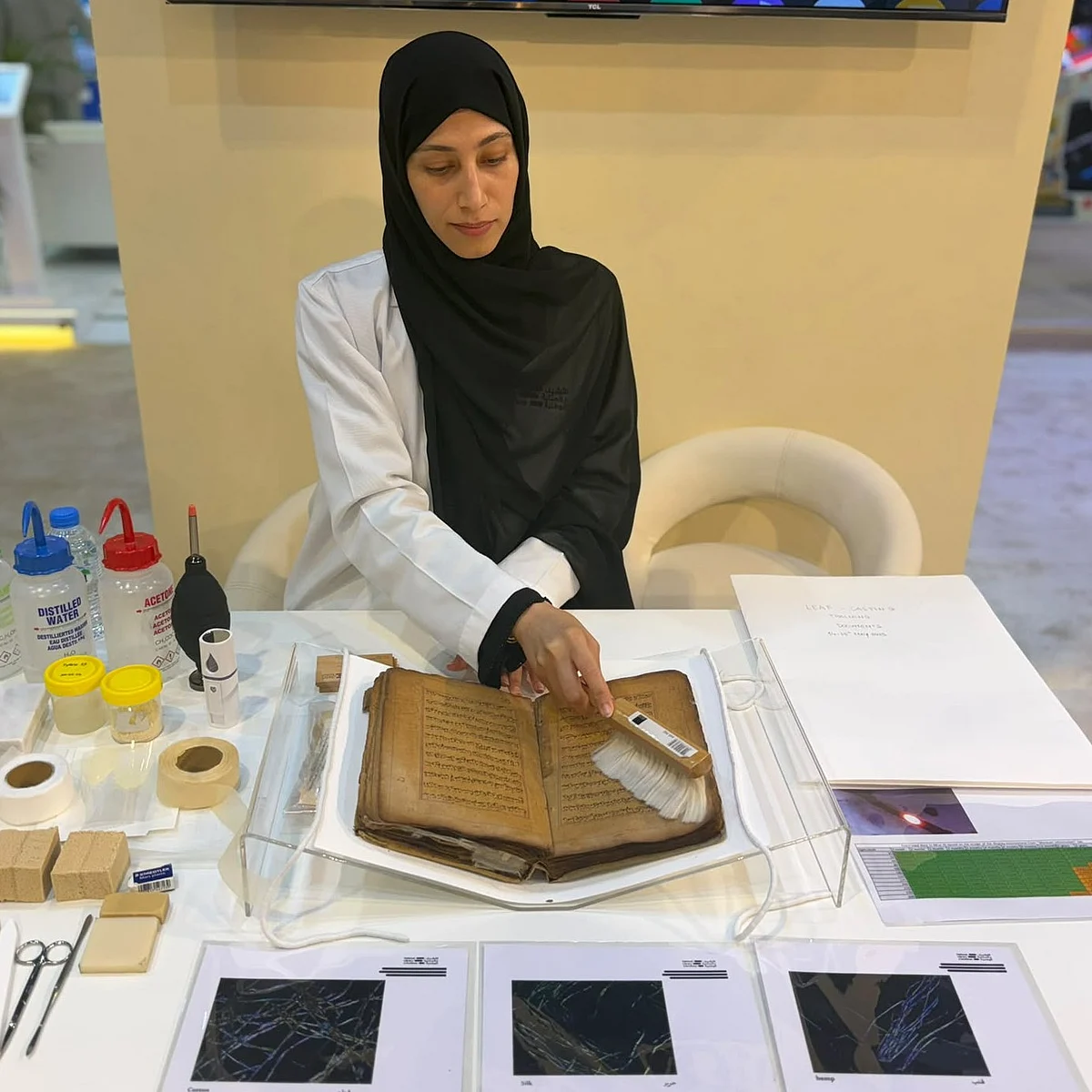
How UAE Expert Uses Tech To Detect Forged Manuscripts, Reveal Hidden Writing


- By: Arwa Almazrouei
Historical manuscripts may contain hidden writing, watermarks and clues about their origins that cannot be seen with the naked eye. At the Sharjah International Book Fair 2026, held at Expo Center Sharjah, a restoration specialist explained how advanced scientific equipment is being used to examine centuries-old documents, identify possible forgeries and protect fragile manuscripts from deterioration.
Speaking to Khaleej Times, Sheikha Al Sawafi, a restoration specialist, explained that examining historical manuscripts involves more than simply reading their contents. Specialists study the materials, ink, and physical characteristics of each document to estimate its age and assess whether it is genuine.
Recommended For You Iran says in 'intensive' negotiations with US to avert war via mediators"In the conservation and restoration department, we conduct studies on manuscripts to determine their approximate age and whether they are original or forged," she said.
Stay up to date with the latest news. Follow KT on WhatsApp Channels.
One technique involves taking a small sample from a document and examining it under a microscope to identify the materials used in its production.
"We examine whether the paper is made from cotton, linen, or silk. This helps us determine the historical period in which the paper may have been produced," she explained.
The paper's composition can provide important clues about its origins, helping specialists understand the techniques and materials used during different historical periods.
Revealing hidden writingAnother key technology in manuscript examination is multispectral imaging, which lets specialists detect details that may be invisible under normal lighting.
According to Sheikha, the device uses visible, ultraviolet, and infrared light to examine documents more accurately, particularly when identifying watermarks and hidden writing.
"The device helps us examine manuscripts in greater detail and reveal things that we cannot see with the naked eye, including watermarks and other hidden features," she said.
The technology is particularly useful when historical writing has faded or become difficult to read.
She explained that while the equipment cannot physically restore ink that has disappeared, it can sometimes produce images that make faded writing visible again.
"If the ink has faded or become partially erased, we may be able to use multispectral imaging to capture an image that reveals the writing. However, we cannot physically reverse the damage," she said.
How light can damage historical manuscriptsOne of the biggest challenges in preserving historical documents is protecting their ink from deterioration caused by prolonged light exposure.
Sheikha explained that specialists use a light-fading testing device to determine how sensitive different inks are to lighting conditions and estimate how long they can remain stable before changes begin to appear.
Using an example from an ink examination, she explained that exposure to different light intensities could significantly affect how long the writing remains preserved.
"If the ink is exposed to 35 lux, it may remain stable for approximately five years before it begins to change. However, if the same ink is exposed to 300 lux, it may begin changing after just nine months," she said.
Lux is a unit used to measure light intensity on a surface.
The testing device also helps specialists predict the type of deterioration that may occur, including changes in ink color or the gradual fading of written text.
Specialists then use these findings to recommend appropriate lighting conditions for storing or displaying manuscripts.
How specialists determine whether manuscript is original or forgedIdentifying whether a manuscript is authentic requires a combination of scientific examinations rather than relying solely on its appearance.
Sheikha explained that specialists use three main methods: microscopic examination, multispectral imaging and light-fading testing.
The microscope helps identify the paper's composition, while multispectral imaging reveals hidden characteristics such as watermarks and faded writing. Light-fading tests provide additional information about the ink's behavior and sensitivity.
By examining the results together, specialists can assess whether a document's materials and characteristics match its claimed historical origins.
Preserving manuscripts for future generationsBeyond identifying the age and authenticity of manuscripts, the department also focuses on ensuring that restored documents remain protected for as long as possible.
Sheikha explained that specialists prepare detailed conservation instructions based on the results of their examinations, including recommendations for lighting, storage and handling.
"We conduct these examinations and provide instructions on how the manuscript should be preserved so that it can last longer," she said.
She emphasised that restoration alone is not enough to protect historical documents, as improper storage or exposure to unsuitable environmental conditions can cause further damage.
"Preservation after restoration is just as important. We need to make sure the manuscript is kept under suitable conditions so it can survive for a longer period," she explained.
The demonstration at Sharjah International Book Fair 2026 highlighted how modern scientific techniques are helping conservation specialists better understand historical manuscripts while protecting the cultural and historical information they contain.
ALSO READ- Sharjah launches registration service for private museums; here's how to apply Dubai launches digital archive project to preserve its history, cultural heritage Look: 130-year-old kerosene fan, radio designed in Braille; rare items at Sharjah festival

Legal Disclaimer:
MENAFN provides the
information “as is” without warranty of any kind. We do not accept
any responsibility or liability for the accuracy, content, images,
videos, licenses, completeness, legality, or reliability of the information
contained in this article. If you have any complaints or copyright
issues related to this article, kindly contact the provider above.


Comments
No comment