


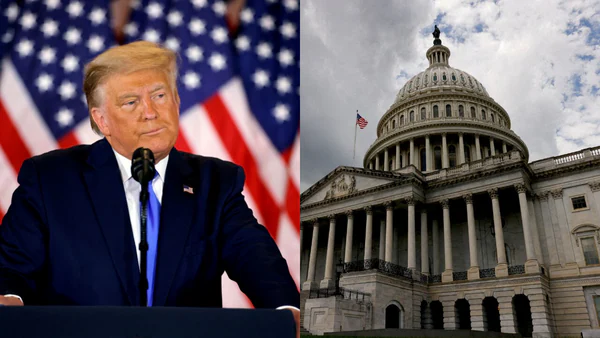
Trump Wants To Work With Democrats After Election Defeat: Can Bipartisan Cooperation Survive?


Democrats not only retained their seats in the Senate and House of Representatives but also made inroads into Republican strongholds such as Texas and Kansas, flipping both states after decades of Republican dominance.
In an interview with The New York Times, Trump said he was willing to accept the results of the midterm elections. "We'll work with the Democrats, and we'll, you know, look forward to working with them. We'll probably work something out," he told the newspaper.
Quick answers to key questions
.5 QUESTIONS1What does Democrats taking control of both chambers of Congress mean for Trump?⌵Trump remains president and retains executive powers, but Democrats can scrutinise his administration, challenge his legislative agenda and make it harder to pass legislation.
2Why could bipartisan cooperation remain difficult after the midterm elections?⌵Deep divisions between Republicans and Democrats could make it harder to agree on legislation. Divisions within the Democratic Party could also complicate efforts to form a united position.
3Can Trump veto bills passed by a Democratic-controlled Congress?⌵Yes. Most bills need the president's signature to become law, and Trump can veto them. Congress can override a veto only with a two-thirds majority in both chambers.
4What powers does a Democratic-controlled Congress have to scrutinise Trump's administration?⌵Democrats can control congressional committees and investigate the administration, including by issuing subpoenas. The Senate can also block or confirm Trump's Cabinet and federal judiciary nominees.
5Can Democrats remove Trump through impeachment?⌵The House can impeach the president, but removing him requires a two-thirds majority in the Senate-67 votes. The article says Democrats' current numbers make securing his removal difficult.
According to the latest projections, Democrats are expected to win at least 250 seats in the House and 54 in the Senate. Republicans, meanwhile, are projected to be reduced to 160 seats in the House and at least 42 in the Senate.
Several races remain too close to call, including two Senate contests in Alaska and Mississippi.
Also Read | What Trump's loss mean for Sensex, Nifty, gold, silver rates? What does the US Constitution say?The US federal government operates on the principle of checks and balances, under which no single branch of government can exercise unchecked power.
Although Trump's Republican Party has lost its majorities in both chambers of Congress, he remains President and retains his executive powers. Democrats, however, will now have greater authority to scrutinise his administration and challenge his legislative agenda.
The shift in control of Congress could lead to legislative gridlock in Washington for the remainder of Trump's two-year term, making it harder for him to push his agenda through Congress.
Experts have warned that deep political divisions between Republicans and Democrats could further complicate the passage of legislation.
What Democrats can and cannot doWith majorities in both chambers, Democrats will control congressional committees and gain greater powers to investigate the Trump administration, including the ability to issue subpoenas.
A Democrat-controlled Senate can also block or confirm Trump's nominations to his Cabinet and the federal judiciary.
If a vacancy arises on the US Supreme Court during the remaining two years of Trump's presidency, Senate Democrats could block his nominee, potentially forcing the President to choose a candidate who can secure bipartisan support.
The House of Representatives also has the power to impeach the President. Democrats have already impeached Trump twice during his first term. However, removing him from office requires a two-thirds majority in the Senate, or 67 votes, making it difficult for Democrats to secure his removal with their current numbers.
Also Read | Trump says he 'would do it again' as Vance blames Iran war for Republican defeatDemocrats can pass legislation in both chambers, but getting it enacted into law will be considerably harder. Most bills must receive the President's signature to become law. Trump can veto legislation passed by Congress, although lawmakers can override his veto with a two-thirds majority in both chambers.
Trump and the 'veto' powerDuring the run-up to the midterm elections, Trump had indicated that he was prepared to use his veto power more frequently. He even posted a picture on his social media platform, Truth Social, of a hat emblazoned with the word "VETO".
According to a BBC report, several lawmakers have acknowledged that although Democrats have won majorities in both chambers, their numbers may not be sufficient to override presidential vetoes.
Democrats could also face internal divisions, particularly over contentious issues such as the war in the Middle East and US support for Israel, potentially complicating efforts to present a united legislative front.
Also Read | 'Trump could face impeachment': Republican Senator warns The prospect of gridlockWith Democrats now controlling both chambers of Congress, Trump's ability to push his legislative agenda through Washington will face significant hurdles. While the President retains executive powers, Democrats can use their control of Congress to scrutinise his administration, block nominations and challenge his policies.
Trump's willingness to work with the opposition will therefore be tested against the deep political divisions in Washington, with the possibility of legislative gridlock looming over the remainder of his term.

Legal Disclaimer:
MENAFN provides the
information “as is” without warranty of any kind. We do not accept
any responsibility or liability for the accuracy, content, images,
videos, licenses, completeness, legality, or reliability of the information
contained in this article. If you have any complaints or copyright
issues related to this article, kindly contact the provider above.


Comments
No comment