


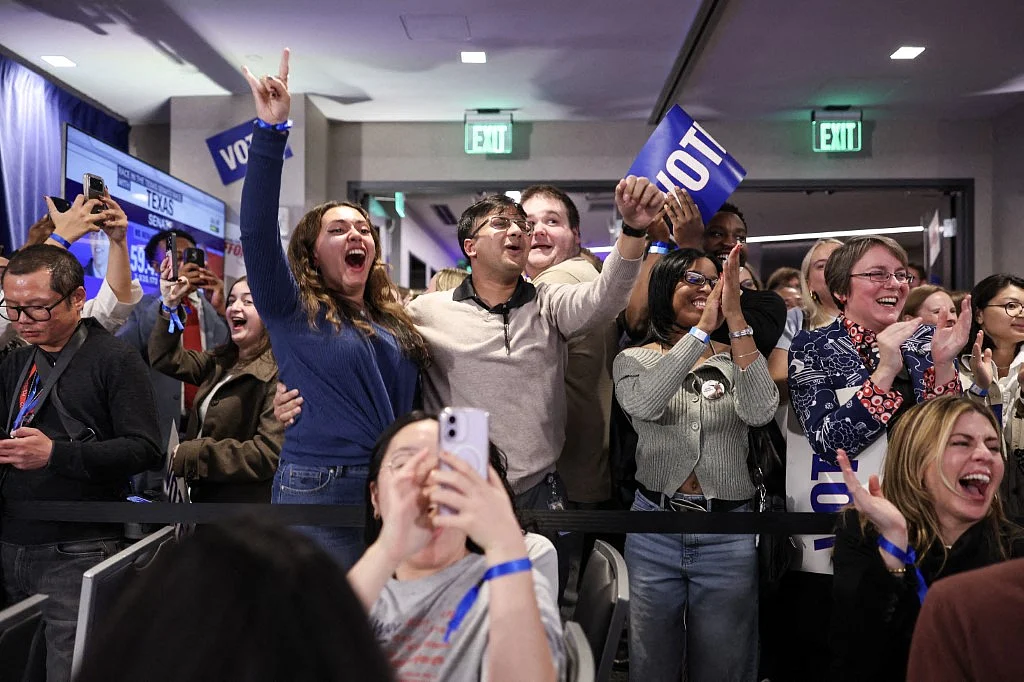
US Midterm Elections: What Democratic Gains Mean For India-US Ties, Trade And H-1B Visas


Relations between New Delhi and Washington have come under strain since President Donald Trump returned to the White House over trade, geopolitics and tightened work visas.
Recommended For You Iran says in 'intensive' negotiations with US to avert war via mediatorsThe results suggest voter discontent with Trump's hardline approach to trade and geopolitics, while Democratic gains in Congress could have tangible implications for India-US relations, particularly on trade and immigration.
Stay up to date with the latest news. Follow KT on WhatsApp Channels.
Leaders of India's main opposition Congress party have hailed the outcome as a restoration of constitutional democracy, accusing Prime Minister Narendra Modi of yielding to Trump's hardline policies while criticising the Hindu nationalist leader for what they describe as subverting democratic institutions at home.
“The US midterm elections have delivered a stunning verdict and decisively rejected President Trump...the results demonstrate the power of mid-term polls to enforce accountability...They have also restored institutional balance that is at the very core of a constitutional democracy. That balance has been dangerously disturbed in India since 2014,” Jairam Ramesh, a parliamentarian from the Congress party, wrote on X.
Noting the victory of a Democrat in Kansas for the first time since 1932, Shama Mohamed, the Congress spokesperson, said that“the corrupt, who lie about the economy, who subvert democracy” would be removed from office.
“Kansas has never elected a Democrat since 1932, but it has today! Hence the impossible can be made possible when a tyrant subverts democracy. India will soon follow!,” she wrote.
Defeat of Trump-backed candidatesAnish Gawande of the Nationalist Congress Party said he was“thrilled” with the defeat in Ohio of Trump-backed Indian-American Vivek Ramaswamy.
He noted his“distaste” over Ramaswamy's campaign, which ran a political attack ad featuring Democrat Amy Acton's estranged mother, Donna Arthur, calling her daughter a liar and disputing accounts of her childhood after she had spoken about poverty, abuse and homelessness during her childhood. The American physician, public health expert and Democratic politician defeated Ramaswamy.
“As an Indian, I am thrilled that Vivek Ramaswamy (once hailed as 'good representation') has lost. His distasteful, disgusting ad on Amy Acton-going after her estranged mother-was like the personal attacks made by the BJP IT Cell. Hopefully, they will meet the same fate soon,” Gawande said.
Saurav Das, leader of the satirical Cockroach Janata Party movement, which has gained prominence in recent months after calling for Education Minister Dharmendra Pradhan to resign over paper leaks, called Trump a“dictatorial” leader.
“Dictatorial Trump's party loses control of both the US House and Senate! Seems like wanna-be dictators are having a very tough time worldwide?” Das said on X.
India's ruling Bharatiya Janata Party (BJP) and the Modi government have yet to officially comment on the results, which also saw several Indian Americans elected to Congress.
Democrat Suhas Subramanyam won re-election to Virginia's 10th congressional district, while Indian-American Aruna Miller retained her position as Maryland's lieutenant governor.
Democrat Pia Dandiya was also declared the winner in Florida, while Indian-American Democrats Ro Khanna from California and Pramila Jayapal from Washington were re-elected to the House.
Vote against Trump's policiesIndia and US-the two democracies-share a strategic, trade and defence partnership, and Washington sees New Delhi as a key partner in countering China's growing influence in the Asia Pacific region.
But relations between New Delhi and Washington have come under strain since Trump began his second term in January 2025, marked by a series of trade wars with countries across the globe, including India.
The biggest sticking point has remained a proposed trade deal, Trump's tariff threats and shifting foreign policy.
New Delhi and Washington have struggled to clinch a new trade deal for months after Trump scrapped India's special trading status, triggering a tit-for-tat tariff war, despite bilateral trade having grown to over US$140 billion in 2018.
Trade tensions escalated last year when Trump imposed punitive additional tariffs of 50 per cent on Indian goods over Delhi's continued purchase of Russian oil. Washington has accused New Delhi of helping fund Moscow's war in Ukraine. The rate on most Indian goods was later brought down to 18 per cent.
There have been other friction points, with Trump repeatedly claiming credit for brokering a ceasefire between India and Pakistan, the arch-rivals who nearly went to war in May last year.
Besides, the Trump administration has tightened H-1B visa rules that have caused concern in India, given the large number of Indian professionals working in the US.
Ambassador Anil Trigunayat, a former Indian diplomat, said the midterm election results were quite“predictable” and an“endorsement against Trump's policies”.
“The way one witnessed the stress factors among the Americans with regard to the result or reaction to certain policies that President Trump followed, especially due to the Iran war, which has been impacting them, then the extensive tariffs that eventually did impact ordinary people and small businesses, all amounted to some kind of endorsement against Trump's policies,” Trigunayat told Khaleej Times.
The former diplomat said that India has traditionally enjoyed support across party lines in Washington, but it has been bearing the brunt of Trump's unilateral decisions in his second term.
While the Democratic victory would not automatically reverse Trump's tariffs, H-1B curbs or foreign policy decisions, a Democrat-controlled Congress could use investigations, budgetary powers, hearings and oversight powers to raise the political cost for Trump of making controversial decisions.
Restore bipartisan consensusTrigunaya said the US midterm elections should bring some checks on the President's unilateral decisions and help restore the bipartisan consensus on India's strategic importance.
“In one year of President Trump's second term, one has witnessed that things have not gone down well. India, which has been a comprehensive global strategic partner for the US, has taken the brunt of his unilateralism with regard to critical areas like energy security, and we hope that there would be some kind of check on that,” Trigunayat said.
Trade analysts were cautious about the midterm election outcome, saying that it could prompt Trump to change course on trade to demonstrate strength, while underlining that both Democrats and Republicans are protectionists.
“A midterm setback won't shift Washington's protectionist direction-both parties favour economic nationalism, domestic manufacturing, and strong supply chains. But needing a quick win to demonstrate strength, Trump may intensify pressure on India for a rapid trade deal. Here is why it matters for India,” noted Ajay Srivastava, founder of Global Trade Research Initiative, a Delhi-based trade policy think tank.
ALSO READ- US midterms may reshape Congress, but uncertainty remains for global markets: Analysts What is holding up the US-India trade deal for months? An emboldened India holds out for better terms in US trade talks

Legal Disclaimer:
MENAFN provides the
information “as is” without warranty of any kind. We do not accept
any responsibility or liability for the accuracy, content, images,
videos, licenses, completeness, legality, or reliability of the information
contained in this article. If you have any complaints or copyright
issues related to this article, kindly contact the provider above.


Comments
No comment