


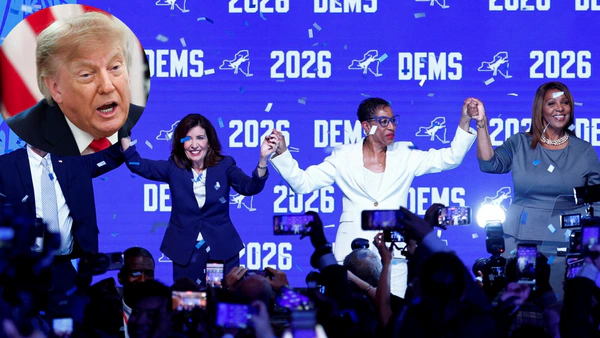
Trump Chants 'Veto' As Democrats Win Congress: 'They Obviously Want To Talk, But...' - What Can He Actually Block?


As per the Associated Press' latest count, the Dems are winning the US Senate by a 54-44 margin and the House of Representatives with a strong 228-139 margin. Counting is still underway in several states.
Now with the US Congress going against him, the only power Trump has to reject bills they send to him is the President's veto. This power is hard to overturn and it remains to be seen how intense the Dems-Trump clash gets once the changes in the Congress take effect starting 3 January. This will also end Trump's ability to pass laws based on votes of GOP members alone, as per a report by Bloomberg.
Quick answers to key questions
.5 QUESTIONS1What can the US president block with a veto?⌵The president can reject a bill passed by the House or Senate and return it to the chamber with objections for reconsideration. The president must accept or reject the bill as a whole.
2How can Congress override a presidential veto?⌵Congress can override a veto if two-thirds of both the House and the Senate vote to pass the bill. The articles note that only 112 of 2,599 presidential vetoes had been overturned since 1789.
3What is a pocket veto?⌵A pocket veto occurs when the president leaves a bill unsigned and Congress adjourns before the 10-day period, excluding Sundays, expires. In that case, the bill dies.
4Can a US president veto only part of a bill?⌵No. The president must approve or reject a bill as a whole. The Supreme Court ruled that using the Line Item Veto Act to cancel only some provisions violated the Constitution's Presentment Clause.
5Does a Democratic-controlled Congress take away the president's foreign policy powers?⌵No. The president retains considerable authority over diplomacy, military command and negotiations with foreign governments. Congress can increase scrutiny and make controversial policies harder to pursue.
Also Read | 'Trump could face impeachment': Republican Senator warnsIn a telephone interview with CBS, the US President said that he would be becoming 'Mr Veto'.
He also said the same thing in a New York Post podcast:“I guess I'll become Mr Veto... And then at some point, we'll probably make deals.”
How can the President affect the Congress' decisions?The US Constitution states that bills that are passed in the US Senate or the House of Representatives has to go to the president. If the president decides to approve the same, he signs it or if he has objections it sends it back to the respective chamber with his objections for reconsideration.
This power is bestowed on the President via the Article I, Section 7 of the Constitution, which, however, does not mention the word 'veto' specifically.
The US president also the option to leave a bill unsigned. If this happens when the Congress is in session, the bill becomes law after 10 days (excluding Sundays) even if the president refuses to sign the same.
However, if Congress adjourns before these 10 days are passed, the bill dies. This process is known as pocket veto.
Also Read | Gold, silver rates rebound with Trump loss: Can Sensex, Nifty hit new peak?The rule is for the US President to either accept or reject a bill as a whole. They cannot partially accept a bill. In 1996, a law was passed by the Congress and signed by then president Bill Clinton, wherein he used the Line Item Veto Act to cancel some of its provisions.
The matter reached the Supreme Court, which decided that the use of the Line Item Veto Act violated the Constitution's Presentment Clause, which is Article 1 Section 7.
What can the Dems do?The first thing a bill has to do in order to become law is to survive the filibuster, which is the power in the Senate minority to stall a bill by refusing to end debating on it.
In order to end a debate, 60 Senators out of the 100 have to agree, which is more than the projected seats the Dems are set to win.
However, there are three cases in which this hurdle can be bypassed. Firstly, in order to withdraw the armed forces of the US government from hostilities. Secondly, to put an end to a national emergency that the president has declared, and thirdly, to overturn a regulation of the federal government. All these cases need the president to sign on the legislation.
Also Read | US midterms: How a Democratic Congress could constrain Trump on Iran, UkraineA veto can also be overriden if two-thirds of the House as well as of the Senate vote to pass it.
However, these fights are generally won by the US President. Since 1789, only 112 out of 2,599 vetoes have been overturned by the US Congress.

Legal Disclaimer:
MENAFN provides the
information “as is” without warranty of any kind. We do not accept
any responsibility or liability for the accuracy, content, images,
videos, licenses, completeness, legality, or reliability of the information
contained in this article. If you have any complaints or copyright
issues related to this article, kindly contact the provider above.


Comments
No comment