


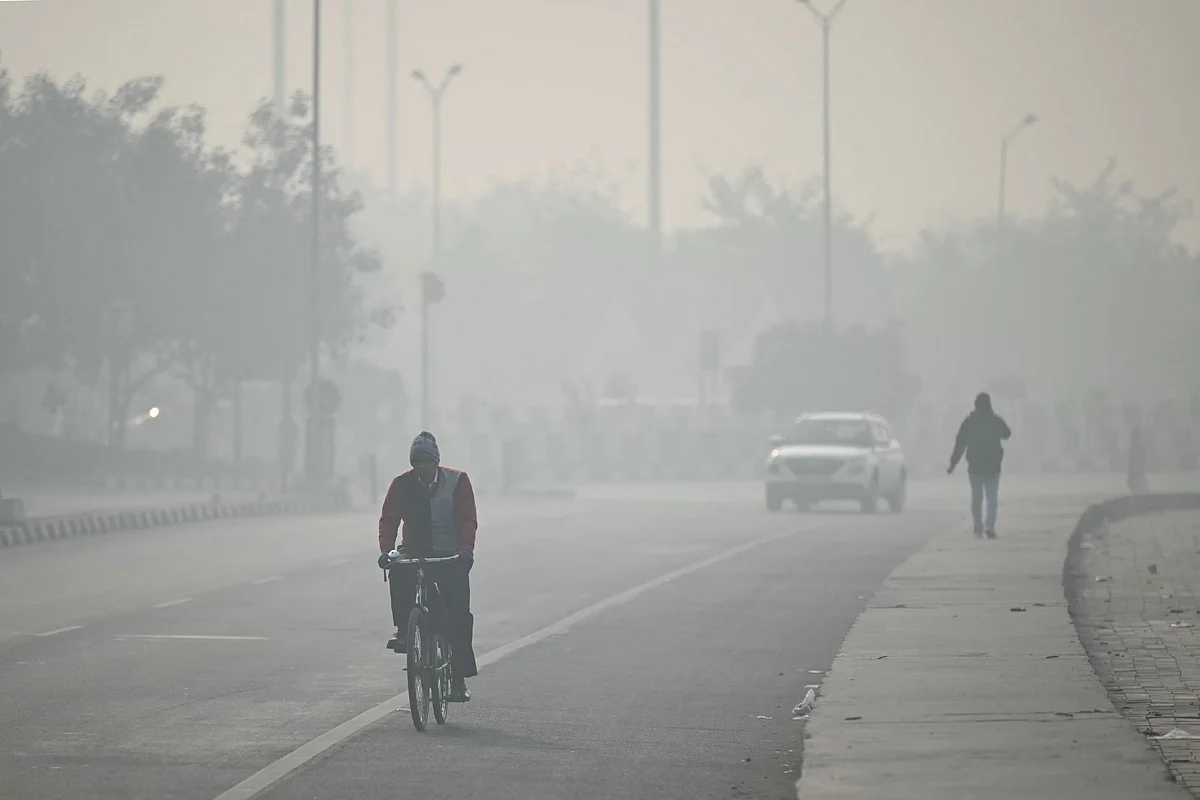
Toxic Smog Blankets Indian Capital As Diwali Firecracker Concerns Mount


The Central Pollution Control Board, a pollution watchdog under the environment ministry, found that the city's PM2.5 levels stood at 379 micrograms per cubic metre at 12pm (India time).
Recommended For You Iran says in 'intensive' negotiations with US to avert war via mediatorsParticulate matter, or PM2.5, consists of the finest dust and other harmful particles measuring less than 2.5 microns that penetrate deep into the lungs and enter the bloodstream, causing respiratory and cardiac diseases.
The World Health Organisation considers 5 micrograms per cubic metre to be the safe level of exposure to particulate pollution.
Stay up to date with the latest news. Follow KT on WhatsApp Channels.
People were complaining of headaches, burning eyes and nasal congestion. "I have been feeling uneasy since morning. My eyes are burning and my throat feels choked. This has become an annual issue," Aditi Singh, a city dweller, told Khaleej Times.
Delhi has been repeatedly named the world's most polluted capital. The city's average Air Quality Index (AQI) hovered around 545, according to AQI, a private air quality tracker. Several monitoring stations in the city reported high pollution levels, with Mandir Marg recording an AQI of 508, falling into the 'severe' category.
Any reading above 50 on the AQI scale is considered harmful, with a reading of 300 or above deemed a health hazard.
The city, home to 22 million people, suffers from the scourge of air pollution throughout the year, but toxic air levels spike in November and December - the winter months - as winds push smoke from stubble burning on farmlands into the city, shrouding it under a blanket of smog.
Diwali firecrackersOctober was unusually the cleanest month in eight years, but the city has been reeling under dangerous levels of pollution since November began. The situation is expected to worsen this week when the country of 1.3 billion people celebrates Diwali - the Hindu festival of lights - on Sunday by bursting firecrackers.
The sale and use of firecrackers are banned by India's top court, but residents regularly violate the prohibitions, despite **warnings** by authorities that such actions could lead to a deterioration in air quality.
The Supreme Court on Monday allowed the manufacture, sale and use of certified green firecrackers in Delhi and neighbouring areas for a limited period, citing a lack of data to determine whether a complete ban would be a solution to Delhi's annual pollution problem.
Slew of measuresAuthorities on Tuesday imposed a slew of measures, including barring diesel vehicles older than 10 years and petrol vehicles older than 15 years from entering the city.
They have also banned the use of coal and firewood in roadside eateries, restricted mechanical or vacuum sweeping of roads and increased parking fees to discourage the use of personal vehicles.
Authorities in Gurgaon, the satellite city outside Delhi, have ordered a complete halt to dust-generating construction and demolition activities for the next 15 days.
The Delhi government, led by Prime Minister Narendra Modi's Bharatiya Janata Party, has blamed the spurt in farm fires in northern Punjab and Haryana, the breadbaskets of India, for the pollution crisis.
Stubble burning is a practice in which farmers in vast farmlands burn paddy stubble to clear their fields for the next crop.
The Ministry of Earth Sciences has forecast that the contribution of farm fires will rise from 8.5 per cent on November 2 to 22.2 per cent on November 5. The forecast is based on climatological data on fire counts and emissions.
But the Punjab government, led by the opposition Aam Aadmi Party, has claimed a substantial decline in stubble-burning incidents in Punjab in recent years.
Experts have often pointed out that vehicular emissions contribute significantly to the city's toxic air quality. The city reportedly has 79 million vehicles.
ALSO READ- India rolls out new curbs to fight New Delhi's air pollution ahead of winter New restrictions come into force as Delhi battles pollution Delhi flights disrupted, as smog, dense fog lower AQI to 'very poor'

Legal Disclaimer:
MENAFN provides the
information “as is” without warranty of any kind. We do not accept
any responsibility or liability for the accuracy, content, images,
videos, licenses, completeness, legality, or reliability of the information
contained in this article. If you have any complaints or copyright
issues related to this article, kindly contact the provider above.


Comments
No comment