


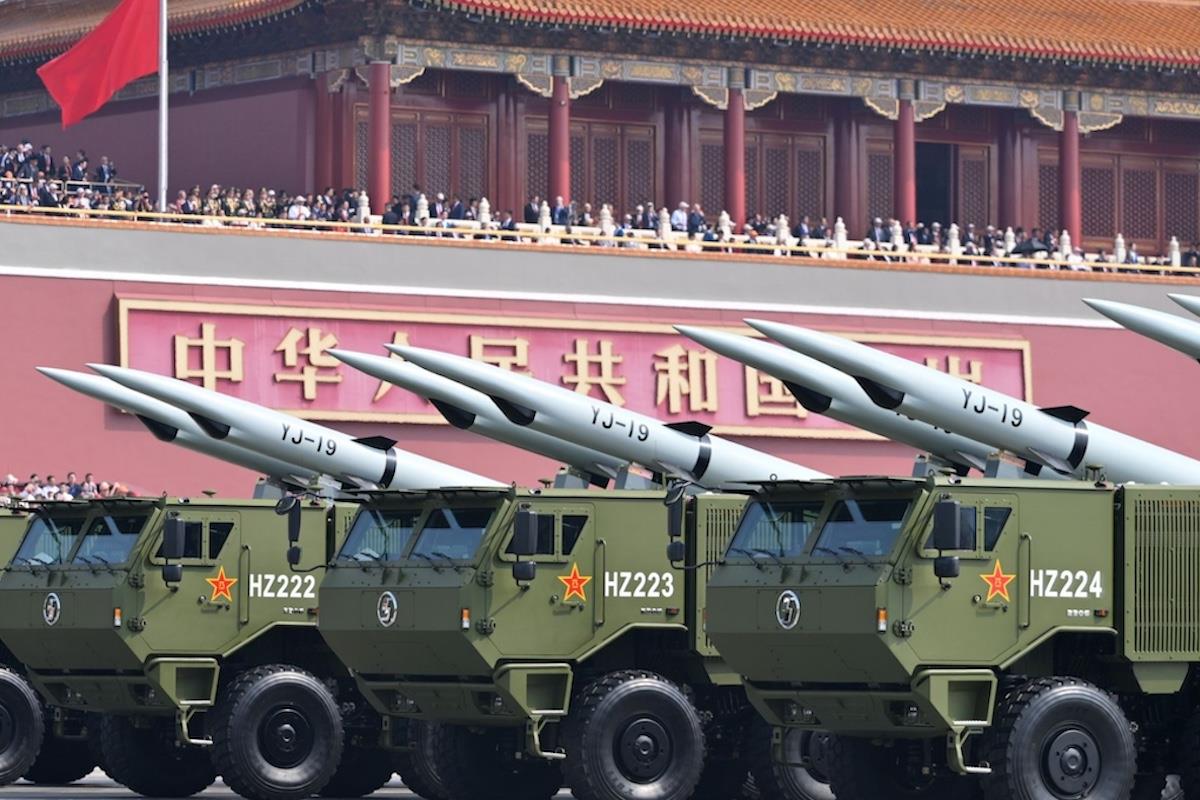
How China Accidentally Broke The West's Arms Trade Monopoly


The drones use hair-thin cables to maintain direct connections with operators, making them highly resistant to electronic jamming and essential to both sides on the front line. The Kremlin's use of these drones faced a major setback in 2025, when a long-range Ukrainian drone struck the country's only fiber optic plant, forcing it to shut down.
But Chinese manufacturers quickly filled the gap, helping sustain Russia's operations.
Fiber optic cables are one of many types of dual-use specialized Chinese equipment found in Russian drones. Beyond supplying finished commercial drones that can later be weaponized, Chinese manufacturers also provide many components in Russian-built drones, including microchips, engines, lithium-ion batteries, 5G tech, mesh modems used for communication, and other essential parts.
With global military spending continuing to rise, the US has further consolidated its dominance of the major arms market, as Ukraine and European allies increase purchases and Russia, its traditional rival, diverts more of its own weapons to the war.
According to the Stockholm International Peace Research Institute (SIPRI), the US accounted for 42% of global major-arms exports in 2021–2025, up from 36% in 2016–2020.
Together, the US and Western Europe accounted for 74% of global major arms exports between 2021 and 2025. Beyond finished products, Western influence extends to the technology used to manufacture high-performance military electronics.
A dvanced lithography equipment from the Netherlands-based ASML, the world's sole manufacturer of extreme ultraviolet (EUV) lithography machines, enables chipmakers to mass-produce the most sophisticated semiconductors that power cutting-edge military computing and artificial intelligence systems. American allies such as Taiwan, South Korea, and Japan also occupy important positions in international electronics and manufacturing supply chains.
This concentration of arms production and critical technology among US and Western companies gives them“significant economic and political power, which enables them to drive the strategic interests of states in exporting arms to conflict zones,” explains arms control expert Hiruni Alwishewa.
This provides them with considerable influence over access to advanced weapons and the ability to sustain military operations. China, while accounting for just 5.6% of global arms exports in 2021–2025, is nonetheless reshaping modern industrial warfare in ways that traditional measures of the arms trade struggle to fully capture.
The ease with which commercial products can be repurposed for military use is transforming the arms business, even if much of this is a byproduct of Beijing's drive to become a global manufacturing leader.
China's growing role in these supply chains challenges the dominant Western position in the global arms trade. By supplying the components and equipment other countries and armed groups need to wage war, Beijing is gaining greater influence over their military capabilities and campaigns. This, however, complicates China's stated neutrality in foreign conflicts.
From arms buyer to industrial lifelineThe war in Ukraine has transformed the Russia-China weapons relationship.

Legal Disclaimer:
MENAFN provides the
information “as is” without warranty of any kind. We do not accept
any responsibility or liability for the accuracy, content, images,
videos, licenses, completeness, legality, or reliability of the information
contained in this article. If you have any complaints or copyright
issues related to this article, kindly contact the provider above.


Comments
No comment