


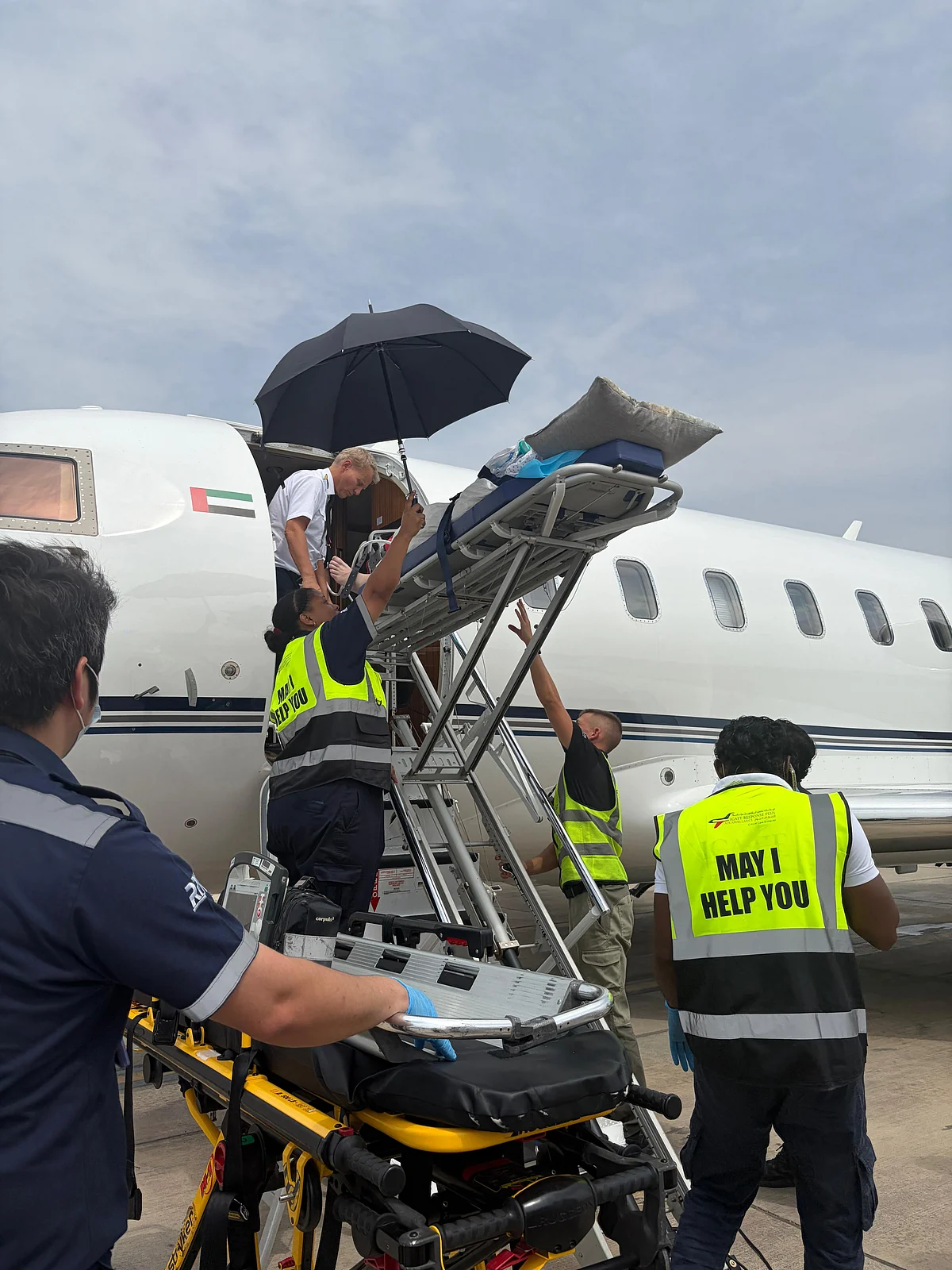
UAE Medical Evacuations Surge As Conflict Raises Demand For Emergency Response


That was the sequence in one operation described by Steven Wines, chief executive of Prometheus Medical International, during an interview with Khaleej Times on the sidelines of Adipec 2026 in Abu Dhabi. The firm, which provides medical evacuation, emergency medical support and specialist trauma training, is based in the UAE.
Recommended For You Iran says in 'intensive' negotiations with US to avert war via mediatorsWines described an evacuation in which a patient who needed to be evacuated from an area where aircraft could not fly. The team arranged ground transportation in an armoured vehicle, accompanied by a security team, and coordinated the patient's journey to a border where an aircraft could reach them.
Stay up to date with the latest news. Follow KT on WhatsApp Channels.
The team also helped arrange the necessary visas. Once the patient had crossed into the neighbouring country, an aircraft equipped with a mobile intensive care unit arrived with a doctor, specialist paramedic and nurse on board.“The patient was flown to the UAE, where arrangements were made for onward transfer to hospital.”
The operation was managed throughout the journey, with the medical and logistical arrangements adjusted as circumstances evolved.
Wines said the group's operations had involved approximately 1,000 hours of flying over the preceding three to four months, three times the number recorded during the same period last year, covering both security work and medical evacuations.
He described the ability to coordinate the different stages of an evacuation as critical, particularly when a mission involves several countries and changing security conditions.
“Everything that we do, from case management to medics, to land transportation, security, air evacuation, medics on the flight, receiving the patient in the home country, transfer to the hospital – all of that is one organisation,” he explained.
Wines said established local networks were important when working in areas affected by conflict. Teams need contacts on the ground who understand local conditions and can help navigate access and border arrangements.“If you've tried to mobilise after the event, it's impossible,” he said, stressing that these relationships and operational arrangements must be established before a crisis.
Preparing before an emergency
That approach also shapes the group's work with energy companies, where emergency planning begins well before an incident occurs.
Wines said Prometheus works with major oil and gas and renewable energy producers, conducting regular simulations and drills to test how teams would respond to different emergencies. The exercises are used to identify weaknesses and feed into revised training and operational plans.
One scenario involves a bus carrying 50 workers to a remote site crashing.“Responders must work out how to reach the location, get emergency teams to the site, triage casualties and arrange medical evacuations.”
Offshore operations present another set of challenges. Helicopters may not be able to fly during bad weather or when seas are too rough. Wines said experience with sea ambulances in Norway could help inform alternative evacuation arrangements in this region.
The emphasis is not only on getting professional medical teams to an incident, but also on ensuring that people already at the site can provide immediate assistance.
Wines highlighted the importance of the first minutes after a serious injury, when a trained colleague may be able to prevent a casualty from deteriorating before emergency responders arrive.
In the case of severe bleeding, for example, applying a tourniquet correctly can help stabilise an injured person. He said the company was also looking at community training in the UAE to give more people the confidence to respond to medical emergencies.
He cited an organisation that had automated external defibrillators (AEDs) installed in its offices, but whose employees did not know how to use them. Having emergency equipment available, he argued, is not enough if people have not been trained to operate it.
When medical help cannot arrive immediately
The need to stabilise patients for extended periods is particularly relevant in remote or insecure locations.
Wines described an emergency at an industrial plant in Africa, near an area affected by conflict. The location and security conditions made it difficult to fly directly to the patient, so a helicopter had to be mobilised to reach the area.
In the meantime, people on the ground had to provide care until the medical team could arrive. Wines said training in prolonged field care, which draws on techniques used in military medicine, can help workers manage casualties when professional medical support is delayed.
He said the same principle applies to civilian operations: people at a remote site need to know how to assess and stabilise an injured colleague while waiting for specialist assistance.
Prometheus runs training at client sites and at its own facilities, recreating scenarios specific to the locations and risks involved.
For Wines, the objective is to ensure that workers, company procedures and external emergency services can operate together when an incident occurs, rather than having to establish roles and responsibilities in the middle of a crisis.
ALSO READ- Inside air ambulance in UAE: How critically ill children are kept alive in transit Abu Dhabi unveils ambulances for newborns, critical cases, patients weighing up to 300kg Drone Box, AI analysis: Inside Dubai Police 999 emergency control room

Legal Disclaimer:
MENAFN provides the
information “as is” without warranty of any kind. We do not accept
any responsibility or liability for the accuracy, content, images,
videos, licenses, completeness, legality, or reliability of the information
contained in this article. If you have any complaints or copyright
issues related to this article, kindly contact the provider above.


Comments
No comment