


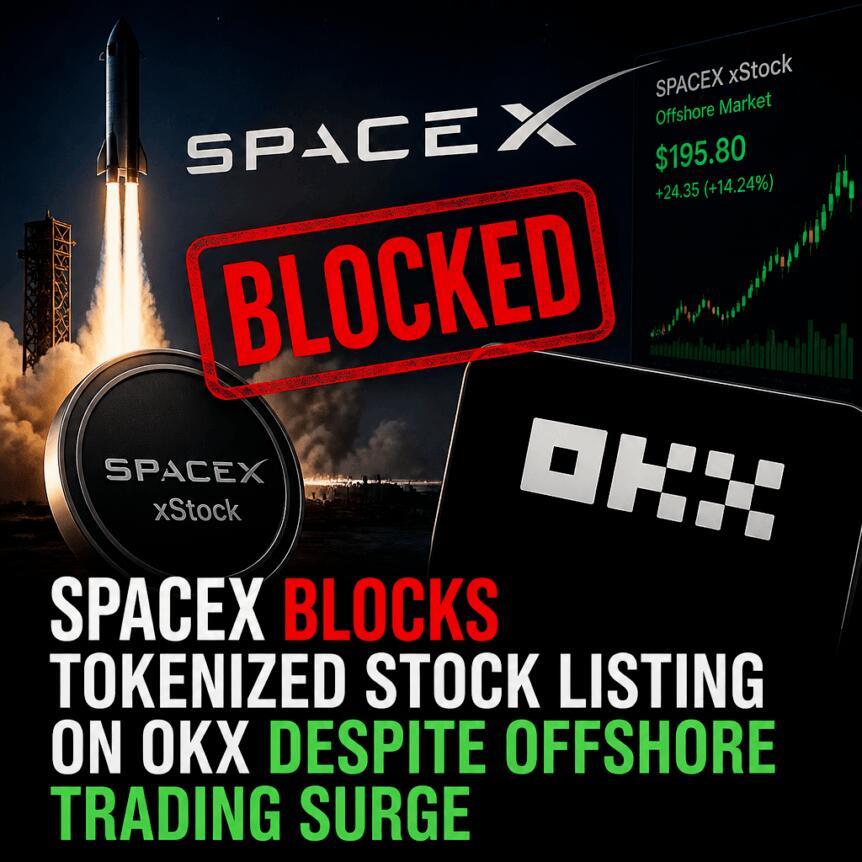
Spacex Blocks Tokenized Stock Listing On OKX Despite Offshore Trading Surge


OKXICE-a joint venture between crypto exchange OKX and Intercontinental Exchange (ICE), the owner of the New York Stock Exchange-had proposed making tokenized SpaceX shares available to investors through the venue. SpaceX's objection effectively signals that the company does not want those tokens trading on the platform, joining Tesla and Amazon among 56 companies that have objected to proposed tokenized stock listings.
Key takeaways- SpaceX has objected to the proposed listing of tokenized SpaceX shares on OKXICE, according to an Nov. 2 notice. OKXICE operates under the SEC Innovation Exemption, which allows tokenized US stock trading without full national securities exchange registration-if companies do not object. Companies get a veto window: they can object within 30 days to keep their tokenized shares off the venue. Tokenized SpaceX shares are already active offshore, with trading volume reported on other platforms since the company's June public offering. Regulatory and liquidity concerns remain central, with Nasdaq previously warning about potential liquidity fragmentation and impacts on shareholder value.
In the Nov. 2 public notice, OKXICE states that SpaceX objected to the proposed listing of tokenized versions of its shares. The notice matters because it highlights how the SEC's Innovation Exemption is not just a regulatory shortcut for trading platforms-it includes a built-in mechanism for issuers (the companies) to influence whether tokenized representations of their equity can trade on a given venue.
The SEC's five-year Innovation Exemption, introduced in September, permits platforms such as OKXICE to offer trading in tokenized US stocks without registering as national securities exchanges. However, the framework also grants companies an active role in the process: they can object to the proposed trading of their shares tokenized by third parties. If an objection is raised within the allowed timeframe, the tokens can be kept off the platform.
That issuer control helps explain why the OKXICE model has met resistance even as tokenized stocks continue to show up on trading platforms outside the United States.
How the SEC“innovation” window works for tokenized sharesTokenized stocks are blockchain-based representations of traditional company shares. In many structures, they are intended to provide onchain exposure to equities-often enabling more continuous trading compared with conventional market hours.
But those benefits come with structural complexity: depending on the design of the token and the legal arrangement behind it, the rights attached to tokenholders may not mirror exactly the rights of registered traditional shareholders. That distinction can become a pressure point for companies when deciding whether to permit tokenized trading tied to their corporate shares.
Under the Innovation Exemption, OKXICE (and similarly positioned platforms) are operating within a pathway that avoids full exchange registration. Still, the process is not automatic. The SEC's model gives companies a defined period-30 days-to object to specific proposed tokenized listings. SpaceX's objection indicates that at least some issuers are using that right as leverage to prevent tokenized trading on this particular US venue.
Tokenized SpaceX trading has already attracted activity offshoreSpaceX's move may be seen less as a rejection of tokenization outright and more as a targeted stance on where and how its shares should trade. The company's shares have already been tokenized and traded on platforms outside the US since its June public offering.
The article points to two major offshore efforts ahead of an eventual OKXICE push: Backpack Securities and Kraken 's xStocks offering. Both prepared tokenized versions of SpaceX's stock designed to be backed by actual shares. According to reported figures in the source, Backpack's SPCX token recorded $1.08 billion in onchain trading volume in June, while Kraken 's SPCXx token recorded $852 million.
Those volumes underscore that demand for onchain equity exposure exists. They also help clarify the core question investors should be watching: whether tokenized equity trading in the US can scale beyond limited issuer participation, or whether objections will continue to constrain available listings-even as offshore liquidity grows.
Opposition isn't isolated: Nasdaq's warning and a broader debateSpaceX's objection lands amid a wider debate over whether tokenized stock trading is beneficial for long-term shareholders and market structure. In September, Nasdaq warned issuers that they“must be cautious about their participation,” arguing tokenized stock trading could fragment liquidity and undermine long-term shareholder value.
That concern is relevant to OKXICE's ambitions. Bringing tokenized stocks to US investors could expand access and potentially attract new participants. But if trading shifts across venues-traditional markets, tokenized platforms operating under the exemption, and other offshore systems-liquidity can become distributed rather than concentrated. For some issuers, that outcome could conflict with how they think about shareholder experience and market quality.
OKXICE co-chair Andrew Cuomo, a former New York Governor, previously suggested that more companies might eventually participate as they see benefits. In an interview with Cointelegraph on Oct. 20, he indicated the venture expected additional objections, noting companies may be avoiding being first to test the model. A later press conference comment on Oct. 30 echoed that as tokenization proves its value, participation could broaden.
SpaceX joining the objections list provides a reminder that the“learning curve” for tokenized markets may be uneven: issuers can support tokenization indirectly through offshore token trading, while still refusing permission for US venue listing.
For traders, the practical implication is straightforward: even where tokenization infrastructure exists and demand shows up on-chain, access for US-based investors can be blocked by issuer objections on specific venues. For long-term investors and market participants, the key uncertainty is whether the next wave of objections will shrink the addressable set of issuers-or whether more companies will decide the benefits outweigh risks like liquidity fragmentation and token-rights complexity.
Risk & affiliate notice: Crypto assets are volatile and capital is at risk. This article may contain affiliate links.
Legal Disclaimer:
MENAFN provides the
information “as is” without warranty of any kind. We do not accept
any responsibility or liability for the accuracy, content, images,
videos, licenses, completeness, legality, or reliability of the information
contained in this article. If you have any complaints or copyright
issues related to this article, kindly contact the provider above.


Comments
No comment