


The Emerging Shape Of China's Military Reach In SE Asia


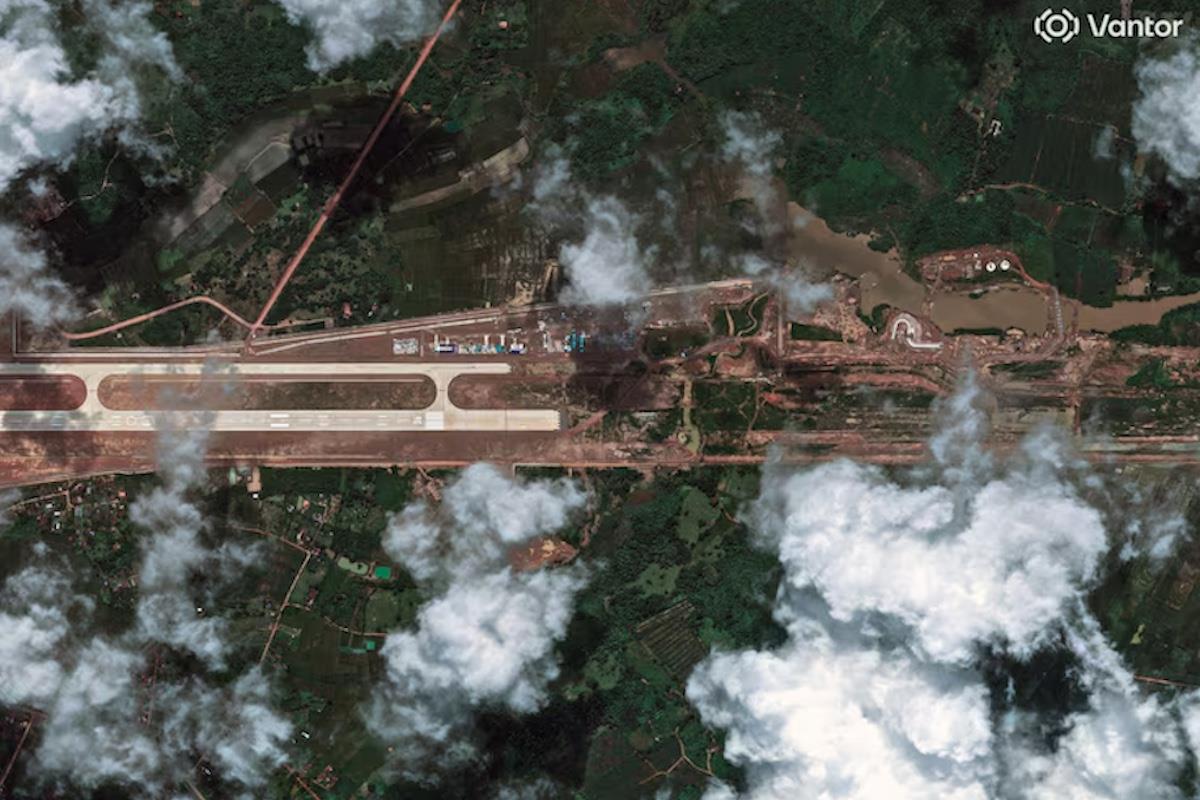
On September 29, China and Laos opened the China-Laos Joint Support and Training Center and the China-Laos Friendship Aviation Academy. Beijing says the facility is designed mainly to train Lao pilots and deepen military cooperation, and that it is not aimed at any third country.
Satellite imagery shows, however, that construction began in late 2025 and has since transformed agricultural land into a sizable aviation complex, complete with a runway, taxiway, apron and supporting buildings.
Ban Keun is not yet an American-style overseas air base, and there is no public evidence that China has stationed a large combat force there.
However, how many Chinese personnel, aircraft and weapons will eventually operate from the site remains unclear. What matters is what the facility could enable over time: persistent Chinese access.
China has spent years extending its economic and political reach across mainland Southeast Asia. Now, military access is emerging on top of that infrastructure. Ban Keun thus looks like an early node in a wider air-access network stretching from southwestern China into the strategic heart of Southeast Asia.
Power projectionChina does not need to replicate the American system of permanent overseas bases to project power abroad. The US built much of its military presence through formal alliances, defense treaties and large permanent installations.
Beijing has fewer treaty allies and faces stiffer political resistance to openly hosting Chinese forces. Its emerging model is therefore more incremental, characterized by joint facilities, military exercises, training centers, logistics arrangements and rotational access.
Ban Keun epitomizes this model. It gives China what a base in its southern province of Yunnan cannot: a physical presence inside mainland Southeast Asia.
Modern airpower depends not only on aircraft and missiles but on runways, maintenance, fuel, personnel, training areas and logistics. The facility need not host a large Chinese force to be strategically valuable.
It can familiarize Chinese forces with local operating conditions, build interoperability with a neighboring partner force and establish procedures that could later support more intensive activity.
China's overseas footprint is already developing along complementary lines. China's base in Djibouti provides a foothold in the western Indian Ocean along key trade routes.

Legal Disclaimer:
MENAFN provides the
information “as is” without warranty of any kind. We do not accept
any responsibility or liability for the accuracy, content, images,
videos, licenses, completeness, legality, or reliability of the information
contained in this article. If you have any complaints or copyright
issues related to this article, kindly contact the provider above.


Comments
No comment