


Innovative Method For Identifying Significant Molecular Markers Of The Immune System For The Diagnosis Of Mental Disorders


(MENAFN- RCTT)
The Institute of Biophysics and Cell Engineering offers an innovative method (technology) for identifying significant molecular markers of the immune system for the diagnosis of mental disorders under a commercial agrement with technical assistance and/or a license agreement and is looking for partners to conclude a technical cooperation agreement.
Description
The course of various mental disorders (MDs) is accompanied by immune system dysfunctions-specifically, an increase in the number of circulating monocytes/macrophages in patients' blood serum, plasma, and cerebrospinal fluid, as well as elevated levels of pro-inflammatory cytokines produced by these cells.
Methodological aspects.
1. Significance:
- Early diagnosis: Mental disorders such as depression, schizophrenia, and bipolar disorder often remain undiagnosed in their early stages. The use of molecular markers facilitates the detection of these conditions before clinical symptoms manifest.
- Personalized medicine: Molecular markers enable the development of tailored treatment approaches, thereby enhancing therapeutic efficacy.
- Objective diagnosis: Unlike subjective methods (such as questionnaires and interviews), molecular markers provide objective data regarding a patient's condition.
2. Relevance:
- Rising prevalence of mental disorders: According to the WHO, more than 970 million people worldwide suffer from mental disorders, making their diagnosis and treatment a matter of critical importance.
- The immune system and mental disorders: Research indicates that immune system dysfunctions-such as chronic inflammation-are linked to the development of mental illnesses. This underscores the importance of studying immune-related markers.
- Integration of technologies: Modern advancements in genomics, proteomics, and bioinformatics allow for the effective identification and analysis of molecular markers.
- Need for new approaches: Traditional diagnostic methods often fail to account for a patient's specific biological characteristics, highlighting the urgent need for innovative solutions.
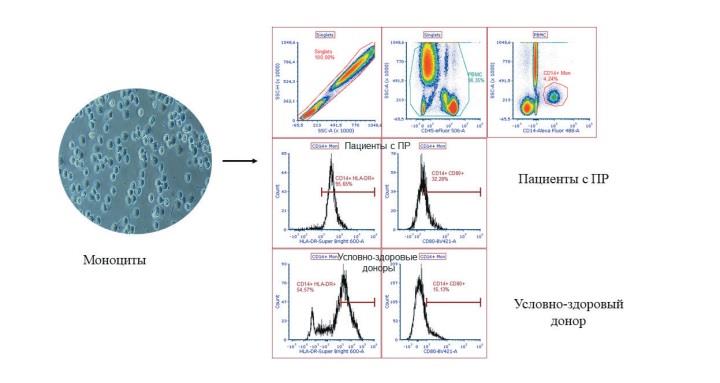
The Institute of Biophysics and Cell Engineering has developed an innovative method for determining the expression of the costimulatory molecule CD80 and the activation marker HLA-DR using flow cytometry. This technique makes it possible to detect inflammatory processes and immune system dysfunction in patients with mental disorders. The identified molecular markers may serve as therapeutic targets in the development of diagnostic and treatment methods for mental health conditions.
This information is featured in the catalog "100 Best Developments of the National Academy of Sciences of Belarus for the National Economy (2022–2023)," 2024, pp. 210–211. Advantages and Innovations Advantages of the method:
- High specificity and sensitivity.
- Ability to monitor treatment efficacy.
- Reduced time to diagnosis.
There are no domestic or foreign equivalents. Stage of development Field tested/evaluated (TRL8) Comments regarding stage of development A laboratory procedure has been developed. Funding source State budged
Internal
IPR status Exclusive rights
Secret know-how
Comments regarding IPS status At the Institute of Biophysics and Cell Engineering, a research project titled "Studying the status of cellular immunity in patients with mental disorders" was carried out.
The results were used in the development of a methodology. Sector group BioChemTech
Healthcare
Client information Type R&D institution Year established 1973 NACE keywords A.01.61 - Support activities for crop production
M.72.11 - Research and experimental development on biotechnology
M.74.90 - Other professional, scientific and technical activities n.e.c.
Q.86.90 - Other human health activities
Turnover (in EUR) 10-20M Already engaged in transnational cooperation Yes Additional comments The Institute of Biophysics and Cell Engineering is a leading scientific institution in the Republic of Belarus, specializing in genetic engineering, immunology and allergology, nanotheranostics and personalized nanomedicine, as well as experimental and applied virology.
The Institute's fundamental and applied research areas include:
In the field of medical biotechnologies:
- Genetic engineering: development of innovative biomedical cell products based on genetically modified cells.
- Immunology and allergology: development of new methods for the diagnosis and treatment of allergic diseases and immune dysfunctions.
- Innovative vaccines: development of prototypes for domestic DNA and RNA vaccines for the prevention of viral diseases.
- New diagnostic approaches: development of novel technologies for the early diagnosis of diseases and methods for personalized medicine aimed at improving human quality of life.
- Genome editing: editing of somatic and induced pluripotent stem cells, enabling the treatment of various diseases, including rare (orphan) and genetic disorders.
- Synthetic morphogenesis: including the engineering of tissues and organs.
In the field of bioinformatic technologies:
- Structure-based design of next-generation drugs, including the development of innovative targeted anti-tumor and antiviral agents using structural bioinformatics methods.
- Synthesis of targeted therapeutic agents and their *in vitro* testing.
In the field of nanotheranostics and personalized nanomedicine:
- Development of targeted delivery systems for next-generation therapeutic agents using nanomaterials.
- Development of biological biochips for disease diagnosis. - Research into a wide range of biocompatible nanomaterials for the development of biomedical cell products, artificial organs, and novel materials with antimicrobial, antiviral, and anti-inflammatory properties.
Activities of the Center for Experimental and Applied Virology:
- Cultivation of viruses and the development of new methods for culturing human viruses to create tools for the diagnosis, medical prevention, and treatment of viral diseases.
- Development of vaccine prototypes, including those for influenza (inactivated and recombinant), African swine fever (vector-based), and pulmonary tuberculosis (a therapeutic vaccine based on donor dendritic cells), as well as innovative anti-influenza agents.
In recent years, the Institute has carried out a number of international contracts and agreements within the framework of European Union programs, as well as in collaboration with leading scientific centers, foundations, and organizations.
Official website of the Institute of Biophysics and Cell Engineering. Languages spoken English
Russian
Information about partnership Type of partnership considered Commercial agreement with technical assistance
License agreement
Technical cooperation agreement
Type and role of partner sought Consumers interested in purchasing an innovative method (technology) for identifying significant molecular markers of the immune system for the diagnosis of mental disorders under a commercial agreement with technical assistance and/or a license agreement.
Partners interested in the development and implementation of an innovative method (technology) for identifying significant molecular markers of the immune system for the diagnosis of mental disorders under a technical cooperation agreement. Type and size of partner sought > 500 MNE
> 500
251-500
SME 51-250
SME 11-50
SME <= 10
R&D Institution
University

Legal Disclaimer:
MENAFN provides the
information “as is” without warranty of any kind. We do not accept
any responsibility or liability for the accuracy, content, images,
videos, licenses, completeness, legality, or reliability of the information
contained in this article. If you have any complaints or copyright
issues related to this article, kindly contact the provider above.


Comments
No comment