


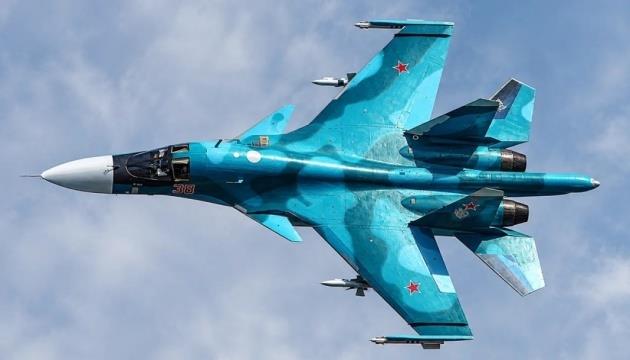
Intelligence Data: How Many Su-34 Fighter-Bombers Has Russia Lost, And How Many Remain In Service?


As the agency notes, such losses are quite significant for the aggressor country's aircraft fleet, as its restoration requires a lengthy production cycle, substantial financial resources, and specialized industrial cooperation. By way of comparison: the number of Su-34s destroyed is equivalent to approximately 2.5–3 years of their production, based on an estimated production capacity of 14–18 aircraft per year.
As of October 22, according to intelligence data, the Russian Federation's Aerospace Forces had approximately 140 Su-34s of various modifications in service, including the upgraded Su-34M (Su-34NVO).
It is emphasized that the sheer numbers of the Russian Su-34 fleet do not fully reflect its actual combat capability. Such an assessment must take into account a range of factors: the technical condition of the aircraft, the number of trained crews, the intensity of operation, maintenance capabilities, and the ability to replace losses.
According to the Main Intelligence Directorate (GUR), the Su-34s deployed in the war against Ukraine are one of the key components of the enemy's strike aviation. The use of these aircraft as carriers of guided aerial bombs has enabled the aggressor country to expand its capabilities for striking ground targets, particularly in areas of active combat operations and in settlements near the front lines.
Despite significant combat losses, Russia continues to produce and modernize the Su-34, seeking to maintain the size of its air fleet and sustain the intensity of its missile and bomb strikes. The potential for further expansion of this capability depends on production capacity, the availability of technological components, and the ability of the aggressor country's military-industrial complex to compensate for losses.
Serial production of the Su-34 is concentrated at the V.P. Chkalov Novosibirsk Aviation Plant, which is part of the United Aircraft Corporation of the Russian Federation. The production capacity of this facility allows for the manufacture of approximately 14–18 aircraft of this type per year.
The priority is the production of modernized Su-34Ms, which feature improved onboard equipment and expanded capabilities for the use of airborne weapons. The modernization is intended to enhance the aircraft's effectiveness, taking into account combat experience gained during the war against Ukraine.
At the same time, production resources are divided between the needs of the Russian military and export orders. In particular, part of the production capacity is dedicated to fulfilling a contract to supply Su-34ME aircraft to Algeria. This places an additional strain on the production system, forcing Russia to balance replenishing its own air fleet with fulfilling international contractual obligations.
“However, between October 22, 2025, and October 22, 2026, 22 new Su-34s were delivered to the Russian Aerospace Forces. This figure exceeds the estimated annual production volume by 14–18 aircraft,” the Main Intelligence Directorate reports.
Intelligence data indicates that during the initial phase of the full-scale invasion, the Russians used the Su-34 primarily to bomb ground targets with unguided aerial bombs, including the FAB-250, FAB-500 M-62, and the concrete-piercing BetAB-500. The use of such weapons required the aircraft to fly close to their targets, which increased their vulnerability to Ukraine's air defense systems.
At the same time, the enemy began using the Su-34 as a platform for the Kh-31 and Kh-59 guided air-to-air missiles, as well as, in some cases, the Kh-35U anti-ship missiles to strike ground targets.
As noted by the Main Intelligence Directorate, fundamental changes in Russian aviation tactics occurred with the widespread introduction of aerial bombs equipped with a standardized guidance and correction module. The combination of the Su-34 with relatively inexpensive UMPC kits became one of the key factors in the aggressor country's buildup of its strike aviation capabilities.
These guidance and correction modules enable Russian invaders to convert significant stockpiles of conventional aerial bombs into guided munitions suitable for use from a distance, thereby reducing risks to the carrier aircraft, as the Su-34s can remain outside the engagement ranges of certain Ukrainian air defense systems.
The use of Su-34s in Russia's“scorched earth” tactics leads to large-scale destruction of infrastructure, civilian casualties, and the forced displacement of survivors from frontline communities.
According to intelligence data, the Russian aircraft manufacturing industry remains dependent on a complex supply chain for electronic components, high-tech equipment, and specialized materials. Of particular importance are components for avionics, navigation systems, communications equipment, and electronic warfare systems, as well as industrial and measuring equipment necessary for the manufacture of modern aircraft.
Read also: DIU fighters clear 600 hectares of forest in Sumy region, thwart Russian offensivInternational sanctions are hindering Russian manufacturers' access to certain critically important technologies. Under these conditions, the aggressor country continues to use schemes involving intermediary entities, third countries, and alternative import channels to meet the needs of its military-industrial complex.
“In this regard, intensifying sanctions pressure on Russia remains a pressing issue. Specifically, this involves the ability to block mechanisms for circumventing sanctions, strengthen export controls, and restrict Russian companies' access to critical production technologies for the Russian aircraft manufacturing industry-technologies that allow Moscow to continue its genocidal war against Ukraine,” the Main Intelligence Directorate states.
As reported by Ukrinform, in October, the Russian army suffered record casualties on the front lines.
Photo: Main Intelligence Directorate

Legal Disclaimer:
MENAFN provides the
information “as is” without warranty of any kind. We do not accept
any responsibility or liability for the accuracy, content, images,
videos, licenses, completeness, legality, or reliability of the information
contained in this article. If you have any complaints or copyright
issues related to this article, kindly contact the provider above.


Comments
No comment