


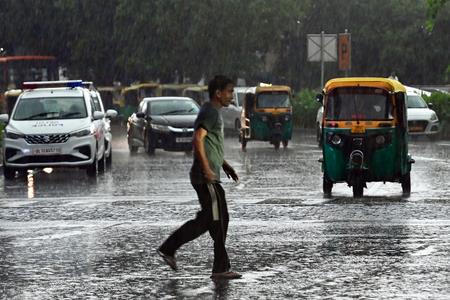
Overnight Rain Brings Chilly Weather To Delhi-NCR AQI Improves


Several parts of the national capital witnessed steady showers late Thursday night, with visuals from Delhi's Hazrat Nizamuddin railway station and the Jamia Millia Islamia area showing rain-soaked roads and overcast skies.
According to the Central Pollution Control Board (CPCB), Delhi's overall AQI stood at 76 on Friday morning, placing it in the satisfactory category. However, monitoring stations across the city recorded varying pollution levels.
Burari recorded an AQI of 71, while Badarpur registered 142, Uttam Nagar 144, Pusa 138, Sirifort 127, Dwarka Sector 8 126, and Jahangirpuri and Rohini 128 each. Other areas, including Jharoda Kalan, R.K. Puram, IIT Delhi, Narela, Najafgarh, Bawana and the Commonwealth Sports Complex, also recorded AQI levels ranging from 104 to 142.
The improvement in air quality came after pollution levels remained above 200 on Wednesday and Thursday.
The India Meteorological Department (IMD) had issued a yellow alert for Delhi and neighbouring National Capital Region districts on October 29, forecasting rainfall and thunderstorms over the following 24 to 48 hours.
On Thursday, Delhi experienced its coldest October day in four years, with temperatures dropping 5.6 degrees Celsius below normal amid the weakening Cyclone Arnab.
According to the Regional Meteorological Centre in New Delhi, Delhi, Noida, Ghaziabad, Gurugram, and Faridabad are likely to experience generally cloudy skies, with one or two spells of light to moderate rainfall accompanied by thunderstorms and lightning.
Light to moderate showers are forecast for Friday, with isolated heavy rainfall possible during the night.
Weather conditions are expected to improve on October 31, when partly cloudy skies are likely across the region. No weather warnings have been issued for Saturday.
From November 1, Delhi-NCR is expected to experience mainly clear skies and more stable weather conditions.
Meanwhile, a low-to-moderate flash flood risk has been flagged until October 30 in vulnerable watersheds across several districts of Chhattisgarh, Odisha, Jharkhand, Bihar and eastern Uttar Pradesh.

Legal Disclaimer:
MENAFN provides the
information “as is” without warranty of any kind. We do not accept
any responsibility or liability for the accuracy, content, images,
videos, licenses, completeness, legality, or reliability of the information
contained in this article. If you have any complaints or copyright
issues related to this article, kindly contact the provider above.


Comments
No comment