


Spain Train Crash: What Caused The Collision? Which Safety Systems Failed? Here's What Drone Footage Reveals


Also Read | Spain train accident: 64 dead after two high-speed trains collide
The train crash in Spain occurred on Wednesday morning in Castilla-La Mancha, south of Madrid, as two trains travelled towards Seville.
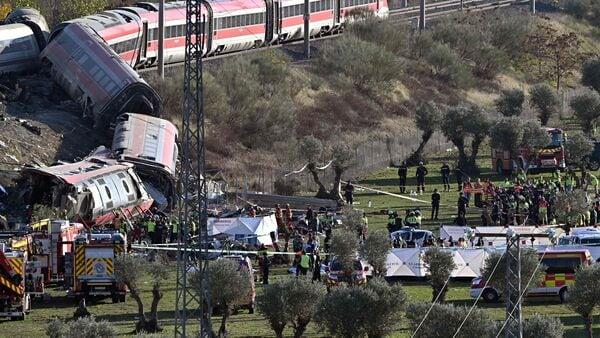
The impact derailed carriages from both trains, leaving wreckage scattered across the tracks and a nearby embankment. Investigators are examining the sequence of decisions that allowed one train to move towards another that remained stationary.
The disaster, Spain's second major high-speed rail collision this year, has put the Pedro Sanchez's railway infrastructure and operational safeguards under scrutiny.
Spain Train Crash: How Did the High-Speed Trains Collide?According to Transport Minister Óscar Puente, an automatic security system malfunctioned at around 8.30 am, forcing trains operating along an affected stretch of track to stop. The disruption covered approximately 63 to 69 kilometres, according to differing initial accounts.
Spain's central railway control centre subsequently authorised a Renfe train to resume its journey, even though the safety system had not been restored. The service travelled about 25 kilometres before colliding with the stationary Iryo train at approximately 8.53 am.
Also Read | On this day: Key events on June 6The Renfe train may have been travelling at speeds of up to 200 kilometres per hour, Puente said, although its precise speed at the time of impact remained under investigation.
The minister described the decision to restart traffic as inexplicable, adding that the train should not have been allowed to proceed while a stop signal remained active. If movement had been authorised, he said, it should at least have been subject to reduced speed restrictions.
What Safety Systems Failed Before the Spain Train Collision?The initial account points to two critical failures for Spain train crahes: the malfunction of the automatic control system and the subsequent decision to resume services without restoring normal safeguards.
When the system stopped working, trains were halted and the control centre assumed responsibility for managing movements. However, according to Puente, the Renfe service was permitted to restart despite the continuing safety restriction.
The incident has raised questions about how railway staff handled the disruption, whether they knew the Iryo train had stopped on the tracks, and why the Renfe train continued towards it despite a signal telling it to stop.
Puente said the train's drivers were not to blame, but the investigation will need to establish precisely how the malfunction and the restart authorisation combined to cause the collision. The available information does not yet establish whether additional signalling, communication or procedural failures contributed.
What Did Drone Footage and Images From the Crash Site Show?Aerial footage from Spain's Civil Guard showed the extent of the destruction near Urda, in the province of Toledo, where several carriages derailed after a Renfe high-speed train struck a stationary Iryo service.
Some carriages plunged down an embankment, leaving twisted metal and wreckage scattered across the surrounding fields.
Spanish emergency services deployed firefighters, Civil Guard officers, medical teams and Civil Protection personnel to search the wreckage and assist passengers.
Also Read | Train hits school van in West Bengal's Murshidabad, 3 killed, several injured
Ambulances and medical helicopters were among the emergency vehicles sent to the scene, while cranes were used to help rescuers reach damaged carriages and search for victims.
Spanish authorities also established an advanced medical post to treat the injured, and the regional government requested assistance from Spain's Military Emergency Unit.
Passengers described a violent impact that sent luggage, mobile phones and people flying through the carriages. Survivors were evacuated as emergency crews and nearby residents helped those trapped in the wreckage.
Spain Train Crash Raises Fresh Questions About Rail SafetyThe collision comes months after a January crash involving Renfe and Iryo trains killed 46 people in southern Spain. Before this year, the country's dedicated high-speed network had not experienced a fatal crash since its opening in 1992.
Spain has built one of the world's largest high-speed rail networks, with about 3,900 kilometres of track. But railway workers' representatives have questioned whether infrastructure maintenance has kept pace with increased passenger traffic and competition following the entry of private operators.
The latest disaster has prompted calls for accountability and renewed assurances on safety. Prime Minister Pedro Sánchez announced three days of national mourning and pledged an investigation into the causes.
The central question remains whether the collision could have been prevented had the automatic system failure been handled differently.

Legal Disclaimer:
MENAFN provides the
information “as is” without warranty of any kind. We do not accept
any responsibility or liability for the accuracy, content, images,
videos, licenses, completeness, legality, or reliability of the information
contained in this article. If you have any complaints or copyright
issues related to this article, kindly contact the provider above.


Comments
No comment