


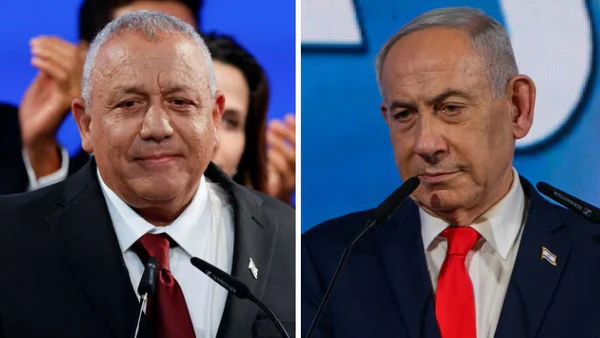
Israel Election Latest Update: Who Will Form The Next Government As Netanyahu, Eisenkot Fall Short?


Netanyahu's right-wing coalition is expected to fall short of a majority in the 120-member Knesset, while Eisenkot also faces a struggle to gather enough support to replace him.
Also Read | Israel's voters deny Binyamin Netanyahu a majorityThe final results of Israeli elections are expected by Thursday evening, but it could take weeks of talks before Israel knows who will lead its next government.
Latest Israeli election results: How many seats have Netanyahu and Eisenkot won?Quick answers to key questions
.5 QUESTIONS1How many seats do Netanyahu and Eisenkot need to form Israel's next government?⌵A majority in the 120-seat Knesset requires 61 seats. Early results put Netanyahu's bloc at about 53–54 seats and Eisenkot's bloc at around 49, so either would need support from other parties.
2Does the largest party automatically get to choose Israel's next prime minister?⌵No. Likud is projected to be the largest single party, but its leader does not automatically become prime minister. The key is securing enough Knesset support to form a government.
3Could Arab parties decide who forms Israel's next government?⌵Yes. Their seats could be crucial because neither main bloc appears to have a majority. The Joint List has said it wants to remove Netanyahu, but Eisenkot has also opposed working with Arab parties.
4How is Israel's next prime minister chosen after the election?⌵After the final results, President Isaac Herzog consults party representatives and gives one political leader the first chance to form a government. That leader must negotiate with other parties to secure sufficient support in the Knesset.
5What happens if Netanyahu and Eisenkot cannot form a coalition?⌵The parties could continue negotiating, but talks may end in a stalemate. If they cannot agree on a government, Israel could hold another election.
Early results suggest Netanyahu's coalition could win around 54 seats, down from the 64 it secured in the 2022 election. Eisenkot's bloc is expected to win about 49 seats, while two Arab parties could together secure as many as 19. Some estimates put Netanyahu's coalition at 53 seats.
The figures could change as the remaining votes are counted.
Netanyahu's Likud party remains the largest single party, with an estimated 26 seats. But that has not been enough to keep his wider coalition on track for a majority.
Record Arab turnout surprises Israeli pollstersArab citizens of Israel turned out to vote in record numbers, something the pre-election polls failed to predict. The polls also underestimated how many votes Likud would win from supporters who might otherwise have backed Netanyahu's right-wing and ultra-Orthodox allies.
The Joint List, an alliance of Arab parties, could now play an important role in deciding who forms the next government. It said it would“do everything in its power” to remove Netanyahu from office.
Also Read | Israel Exit Polls 2026: Netanyahu ahead, but can he secure majority? Know hereThe statement leaves open the possibility that the alliance could support an effort by Eisenkot to replace Netanyahu. However, most Jewish parties have been reluctant to work with Arab parties, and their lawmakers have not been invited to join an opposition-led government.
Why Eisenkot is struggling to challenge NetanyahuEisenkot, a former chief of staff of the Israel Defence Forces, went into the election with two clear goals. He wanted the Jewish opposition parties to win enough seats to form a government, or come close to doing so. He also wanted his party, Yashar, to win more votes than any other party.
The early results suggest he has fallen short on both counts.
Eisenkot's next move will not be easy.
Eisenkot has said Netanyahu is unfit to lead Israel, but he has also opposed working with Arab parties. On Wednesday, he said he wanted a government that was both Zionist and committed to universal military conscription.
That position leaves him with fewer options. Working with Arab parties would go against his stated position, while bringing ultra-Orthodox Jewish parties into the government would also be difficult given his stance on military service.
Could a unity government help Netanyahu stay in power?One possibility being discussed by Netanyahu's allies is a broad government involving Netanyahu, Eisenkot and other centrist leaders. Such an arrangement could allow Netanyahu to remain prime minister despite his coalition's losses.
Also Read | Israel elections 2026: Can Netanyahu lose polls but stay in power? ExplainedNetanyahu has survived political setbacks throughout his career of more than three decades, and the latest results do not yet spell the end of his time in office. Although his opponents have an opportunity to replace him, they must first find a way to work together and secure enough support in Parliament.
What happens next in Israel's election?Once the final results are announced, President Isaac Herzog will decide which political leader gets the first chance to form a government.
The chosen leader will then have to negotiate with other Israeli parties to secure enough support in the Knesset. Those talks could take weeks, and there is no guarantee they will succeed.
Also Read | Who is Gadi Eisenkot? The man challenging Netanyahu's grip on power in IsraelThe Knesset is due to open on November 10. Even if a new government has not been formed by then, Netanyahu's opponents could gain greater influence over parliamentary proceedings.
If the parties fail to reach an agreement, Israel could face another election.

Legal Disclaimer:
MENAFN provides the
information “as is” without warranty of any kind. We do not accept
any responsibility or liability for the accuracy, content, images,
videos, licenses, completeness, legality, or reliability of the information
contained in this article. If you have any complaints or copyright
issues related to this article, kindly contact the provider above.


Comments
No comment