


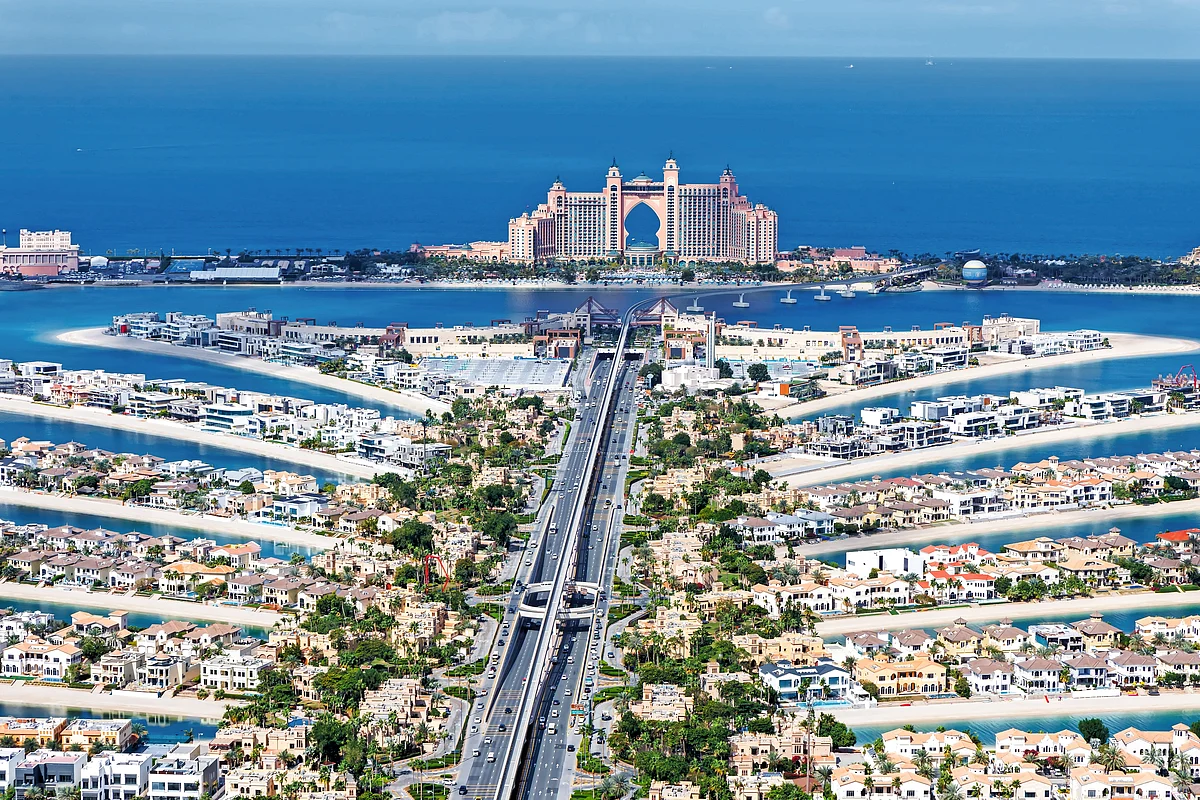
Dubai's $10 Million Property Market Is Spreading Beyond The Palm


New luxury developments, branded residences and emerging villa communities are reshaping the market, while buyers are becoming more selective about what they purchase and how much they are willing to pay.
Recommended For YouDubai recorded 335 sales of homes valued at $10 million (Dh36.7 million) and above in the first eight months of 2026, underlining the city's position among the world's leading luxury residential markets.
An analysis of Dubai Land Department data by fäm Properties found that 206 high-end villas were sold for a combined Dh11.7 billion between January and August, while 129 luxury apartments accounted for Dh8.67 billion.
Palm Jumeirah remained a leading destination for ultra-luxury buyers, ranking among the top three locations for both villa and apartment sales by volume and value. The island recorded 35 apartment sales worth Dh2.18 billion, ranking first by apartment value, alongside 28 villa sales worth Dh1.85 billion. The average transaction value was Dh62.2 million for apartments and Dh66.2 million for villas.
Firas Al Msaddi, CEO of fäm Properties, highlighted the continued movement of wealth through the market's highest price brackets.“There is still a great deal of money moving through the very top of Dubai's property market, reinforcing the city's position among the leading global investment hubs for high-net-worth individuals.”
He added:“More and more investors are making serious commitments because they regard Dubai as one of the most desirable places in the world to live, work and raise families, something which has also been highlighted by high volumes of new and renewed rental contracts in recent months.”
The Palm's enduring appeal
Prathyusha Gurrapu, Head of Research and Consultancy at Cushman & Wakefield Core, identified Palm Jumeirah as the leading location for Dubai's $10 million-plus residential market in 2026 year to date, accounting for around 21% of transactions. Dubai Hills Estate followed with 15%, while Palm Jebel Ali accounted for 11%.
“Palm Jumeirah remains the leading location for Dubai's $10 million-plus residential market in 2026 year to date, accounting for around 21% of transactions. This compares with 15% in Dubai Hills Estate and 11% in Palm Jebel Ali, with the remaining activity increasingly spread across a wider range of established and emerging prime locations.
“Palm Jumeirah also continues to command some of the highest transaction values in the market, reflecting its combination of high-value villas and branded and luxury apartments.”
The island's performance reflects its ability to attract buyers across both property types, unlike locations that are more heavily associated with either villas or apartments.
Qurat Ul Ain, CLO at Drehomes, described this consistency as one of Palm Jumeirah's defining strengths.
“Roughly one in every five $10 million-plus homes sold in Dubai this year has been on the Palm, and that's on an island that's been fully built out for years. No other location appears in the top three for both apartments and villas. Other areas do beat it in specific categories. Jumeirah Second has higher ticket prices on apartments, and Hadaeq Sheikh Mohammed Bin Rashid has more villa deals. But the Palm is the most consistent performer across both.”
Villas, branded towers and changing tastes
Palm Jumeirah's appeal is evolving alongside the preferences of wealthy buyers. Villas continue to attract those seeking established waterfront homes, while branded apartment developments appeal to buyers looking for contemporary design and hospitality-style services.
Gurrapu explained how the two segments are developing differently.
“Palm Jumeirah's ultra-prime market has broadened considerably, with demand spanning both villas and apartments. Villas continue to underpin the ready market, while new high-end apartment launches have expanded the off-plan segment. This is particularly evident above Dh100 million, where 70 of the 79 apartment transactions since 2022 were off plan, compared with 89 of 129 villa transactions taking place in the ready market.”
Qurat pointed to a growing distinction between buyers seeking completed villas and those drawn to newer apartment towers.
“What's interesting is that the Palm now has two quite different buyer pools. On the villa side, people want a finished home on the fronds, and they're willing to buy resale stock at very high prices because supply is fixed. On the apartment side, demand has moved towards new branded towers, where the buyer is paying for hotel-style services and a newer product. The fact that apartments now outnumber villas at this price level tells you luxury buyers are much more comfortable with vertical living than they were five years ago.”
Maaz Jamshed Khan, Founder and Partner at Global Homes, also highlighted the island's performance across both segments. In the first eight months of 2026, Palm Jumeirah recorded 63 ultra-luxury transactions worth more than Dh4 billion, accounting for nearly 19% of sales in the segment.
“Palm Jumeirah continues to be one of Dubai's leading ultra-luxury destinations. In the first eight months of 2026, it recorded 63 ultra-luxury transactions worth over Dh4 billion, accounting for nearly 19% of sales in this segment. While Jumeirah Second led apartment sales by total value at Dh2.77 billion, Palm Jumeirah ranked first in apartment values and third for villas, underlining its continued appeal to high-end buyers.”
Khan argued that lifestyle is becoming as important as investment potential.
“What stands out is that buyers are increasingly looking at Palm Jumeirah as a long-term lifestyle choice, rather than simply an investment opportunity. Luxury apartments generated Dh2.18 billion in sales, compared with Dh1.85 billion for villas. With limited scope for new development, buyers are also willing to pay over Dh11,000 per sqft for properties with uninterrupted ocean views.”
Dubai's luxury map is expanding
Palm Jumeirah remains a major destination, but it is increasingly part of a wider network of luxury residential locations. Dubai Hills Estate has strengthened its position in the villa market, while Palm Jebel Ali is attracting buyers seeking alternatives to the more developed Palm Jumeirah. Jumeirah Second, meanwhile, is gaining attention for high-value apartment sales.
Khan observed that this expansion is changing the geography of the city's most expensive property market.
“Dubai's luxury market is expanding beyond its traditional coastal hotspots. Dubai Hills Estate recorded 51 sales above $10 million, while Palm Jebel Ali attracted 40 major off-plan deals as buyers explored alternatives to the largely developed Palm Jumeirah. Jumeirah Second is also gaining attention, highlighted by a landmark Dh422 million penthouse sale. This shows how luxury demand is spreading across different parts of the city.”
Qurat similarly noted that the market is expanding beyond its traditional prime postcodes.“Luxury in Dubai used to mean a handful of postcodes: the Palm, Emirates Hills and Downtown. That map has expanded. Some of the busiest $10 million-plus villa locations this year are newer master-planned communities and Palm Jebel Ali, which barely featured a few years ago. At the same time, the Jumeirah coastline has become the trophy-apartment strip. So the geography is spreading out on volume while concentrating on the very highest price points.”
The shift does not mean every location is performing equally. Established waterfront districts continue to benefit from limited supply, while communities receiving more new homes face greater competition.
A more selective market
After several years of rapid growth, Dubai's residential market is showing signs of moderation. Buyers are taking longer to make decisions, while developers are adjusting their launch strategies in response to greater uncertainty.
Gurrapu described the change as a more cautious approach rather than a uniform slowdown.“Dubai's residential market has seen more cautious buyer behaviour in 2026, with longer decision-making and a wait-and-see approach evident across price bands amid increased geopolitical and economic uncertainty. Within the off-plan ultra-prime segment, transaction volumes have also been affected by fewer new launches, as developers have scaled back the release of high-value stock.”
Haider Tuaima, Managing Director and Head of Real Estate Research at ValuStrat, cited the company's Price Index to illustrate the recent change in Palm Jumeirah values.
“Since the pandemic, the ValuStrat Price Index (VPI) shows that Palm Jumeirah villa values have risen by 244%, while apartment values have increased by 125%. However, market conditions softened in the year to September: typical villa values on Palm Jumeirah recorded an annual capital decline of 8.5%, while apartment values fell by 9.8%.
“Transaction activity also moderated. On Palm Jumeirah, transaction volumes fell by 29% year-on-year in Q3, while average transacted prices per square foot declined by 5%. Across Dubai's prime residential locations, ready-property transaction volumes decreased by an average of 19% year-on-year basis in third quarter of 2026, alongside a 9% annual decline in transacted prices.”
The figures highlight the difference between long-term appreciation and more recent conditions. Despite substantial gains since the pandemic, some property values have eased over the past year, and transaction volumes have moderated.
Qurat said that separating price brackets helps explain why headline figures can appear contradictory.
“The headline numbers can look contradictory, so it helps to separate them. At $10 million and above, the market is still roughly on last year's record pace. Just below that, in the Dh10–15 million bracket, volumes have cooled noticeably since the spring. Part of that is regional uncertainty, and part of it is that we're being compared with an exceptional 2025. Interestingly, the average $10 million-plus apartment now sells for more than the average $10 million-plus villa. That's because of the branded towers in Jumeirah Second.”
Khan also emphasised that moderation does not necessarily mean the market has lost its momentum.
“Dubai's property market remains active, despite some moderation from last year's record levels. In the first nine months of 2026, sales exceeded Dh380 billion across 123,000 transactions. That is around 15% lower than last year's peak, but still the second-highest nine-month performance in the market's history. The citywide median price stands at Dh1,735–1,840 per sqft, while off-plan properties account for 67–76% of total sales.”
Off-plan demand and the ready-home market
Off-plan properties remain a major force in Dubai's ultra-prime segment, supported by new developments and branded residences. Yet completed homes continue to attract buyers who value immediate occupation and certainty.
Gurrapu outlined the balance between the two markets.
“Off plan continues to account for the majority of Dubai's ultra-prime market, representing around 72% of Dh20 million-plus transactions in 2026 year to date, compared with 28% for ready homes. The split reflects the way Dubai's luxury market has evolved, with much of the newer ultra-prime stock entering the market through off-plan developments, particularly branded residences and new luxury communities. At the same time, the ready market remains an important part of demand, with completed homes achieving a higher average transaction value of around Dh41 million compared with Dh35 million for off plan. This suggests buyers are active across both segments, but for different types of opportunities.”
Khan put the off-plan share of the luxury market at around 71%, highlighting buyers' preference for modern developments and longer-term value.
“Off-plan properties account for around 71% of the luxury market, compared with 29% for resale homes. Buyers are showing a clear preference for modern designs, new developments and branded residences from leading developers. Many are also comfortable waiting two to four years for the right property," he said.
This reflects a shift towards more considered purchases, with buyers focusing on long-term value and lifestyle.”
The distinction between property types is equally important. Limited land supply can support villa values in prime neighbourhoods, while apartment markets with a growing pipeline of new completions may face greater competition.
Khan explained:“We're seeing different trends across property types. Total sales value has moderated by around 23 % from the record levels of 2025, but this doesn't mean the entire market is moving in the same direction. Limited land supply has helped prime villa prices rise by 5.7 % year-on-year, while resale apartments in high-density areas have seen declines of two to nine %, partly due to an increase in newly completed homes.”
What comes next?
The next phase of Dubai's ultra-luxury market is likely to be shaped by the quality of individual properties, the location of new supply and buyers' expectations of long-term value, rather than price growth alone.
Gurrapu's figures point to a market in which established communities remain resilient even as the wider sector adjusts to higher completions and more cautious purchasing.
“The market in 2026 is showing clearer signs of moderation after several years of strong growth. Across the residential markets tracked by Cushman & Wakefield Core, average transacted sales prices have fallen by around 6% from their February 2026 peak to September, while average rents have softened by over 10% over the same period. Despite the recent correction, pricing remains relatively resilient across many established communities. At the same time, the market is entering a period of higher completions as projects launched during the recent growth cycle begin to reach handover.
“On the demand side, the end-user market remains relatively stable, while developers are responding to more cautious conditions by scaling back launches and offering more flexible payment structures. Overall, the market is becoming more balanced, with buyers increasingly selective and the pace of growth moderating.”
Khan highlighted several trends that he believes will influence the market's direction.
“Five trends stand out: market consolidation, strong off-plan demand, different price movements for villas and apartments, continued strength in the ultra-luxury segment, and growing demand from end-users. One particularly telling figure is that speculative flipping of off-plan contracts has fallen to just 10 %. Buyers are increasingly focused on long-term value, while more families and wealthy individuals are choosing to make Dubai their permanent home.”
For Palm Jumeirah, the challenge is to maintain its position as one of Dubai's leading luxury addresses as the city's high-end market becomes more diverse. Its established reputation, waterfront setting and limited development capacity remain important advantages, but buyers now have more alternatives.
Palm Jumeirah remains central to Dubai's ultra-luxury property story. Yet the market's next chapter will be shaped not by the island alone, but by a broader range of locations, more discerning buyers and a growing emphasis on long-term value.
ALSO READ- Dubai real estate defies geopolitical turbulence Dubai's branded residences market cools on volume but pricing power stays strong UAE real estate market demonstrates resilience and strength in 2026

Legal Disclaimer:
MENAFN provides the
information “as is” without warranty of any kind. We do not accept
any responsibility or liability for the accuracy, content, images,
videos, licenses, completeness, legality, or reliability of the information
contained in this article. If you have any complaints or copyright
issues related to this article, kindly contact the provider above.


Comments
No comment