


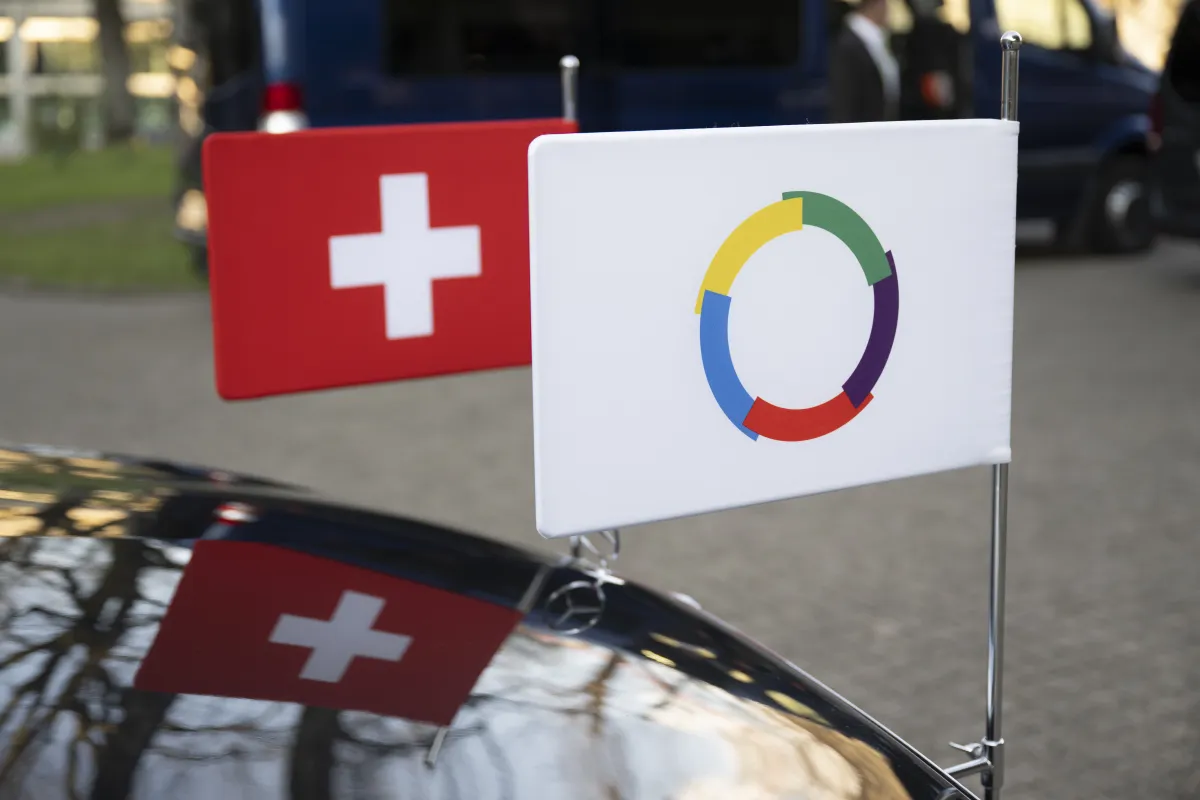
Switzerland Toasts 30 Years Of Liberty, Diversity, Francophonie


Reporter specialised in Swiss foreign affairs, with a side hustle as a sub-editor in the English Department. Previously my focus was on disinformation and fact-checks, which I still produce occasionally.
-
More from this aut
English Departm
With a clinking of glasses and sipping of wine from the Valais region's famed vineyards, Switzerland this year toasted its 30th anniversary as a member of the Organisation Internationale de la Francophonie (OIF), the main grouping of French-speaking nations.
In June, cabinet ministers gathered for low-key festivities in Bern with guests such as former Rwandan politician Louise Mushikiwabo, OIF secretary-general since 2018.
Yet amid the celebrations, Switzerland has had to juggle its role as a member of a body that promotes French speakers with its own four national languages, whose peaceful co-existence is key to the country's unity.
Delicate balance for multilingual SwitzerlandThe nation has about 2.1 million francophones, the largest linguistic bloc after the German-speaking majority. For decades after the creation of the OIF in 1970 (as the Agency for Cultural and Technical Cooperation or ACCT), membership was taboo. Developing ties required caution, said historian Claude Hauser of the University of Fribourg.
“There was a fear in the 1960s to 1970s that [membership] could somehow jeopardise the balance of languages – that an activist, France-centric Francophonie could upset the cultural balance in Switzerland,” said Hauser, who co-directs the Swiss centre for studies on Quebec and the Francophonie.
When spelled with a small f, the francophonie usually designates the world's French-speakers and the exchanges – cultural, scientific or educational – between them, said Claude Hauser of the University of Fribourg.
The Francophonie, with a capital F, on the other hand, refers to the institutional set-up that supports these exchanges: the Francophone Parliamentary Assembly, founded in 1967, the International Organisation of the Francophonie, and operators such as the TV channel TV5 Monde, the University Senghor, a global university network, and an association bringing together mayors.
Still, scepticism remains. The German-language Tages-Anzeiger newspaper recently criticisedExternal link the travel costs of Swiss delegates to the Francophone Parliamentary AssemblyExternal link, which brings together French-speaking lawmakers from around the world.
At the time, the Francophonie was linked to France's post-colonial cultural strength, he said, fostering mistrust among Switzerland's German speakers and the federal government. But now, with the francophone population growing exponentially, particularly in Africa, the centre of gravity has shifted away from Paris.
Locally, a debate ragin in some German-speaking cantons over scrapping French primary-school lessons hints at a fragile co-existence between communities. The debate has prompted the federal government to propose making French compulsory at primary level, a move that got pushbackExternal link from regions like Zurich.
'Shoring up the multilateral system'Ironically, this experience of juggling interests is something Switzerland can bring to the OIF, given that most other member states are also dealing with multilingual communities, according to representatives of the organisation.
“In almost all of these countries, French is a minority language, so Switzerland has the opportunity to exchange with states that find themselves in a comparable situation,” said Henri Monceau, the permanent OIF observer to the United Nations in Geneva. And having such exchanges, he added,“naturally raises many other issues that carry significant political weight today.”
External ContentThe 30th anniversary is a chance for Switzerland to reiterate its support. The OIF is a unique forum for exchange, Lorenza Faessler, in charge of the Francophonie at the foreign ministry, told Swissinfo.
“It's a large, varied family that gives Switzerland valuable opportunities to exchange views on priorities of mutual interest and to engage in informal bilateral discussions with high-level officials on the margins of OIF meetings,” she said.
As international organisations face financial and geopolitical turmoil such as the United States' withdrawal from some UN agencies, Faessler said membership allows“Switzerland to support multilateralism and shore up a system that's under pressure”.
As members gear up to elect a new secretary-general at the Francophonie Summit in Cambodia in November, some African observers wonderExternal link if states engaged in conflict themselves should lead the OIF. The Rwandan Louise Mushikiwabo is going for a third term but is being challenged by, among others, a candidate from the Democratic Republic of Congo, the world's largest French-speaking nation.
African news outlets seeExternal link the contest as a“new diplomatic front” in a confrontation between the two countries over the Rwanda-backed M23 armed group, which has captured territory in eastern DRC.
It's also a platform that gives donors like Switzerland a chance to continue working with its partners amid major cuts to development cooperation budgets, according to Hauser.
“That's an issue that goes beyond the purely Francophone context – namely relations in a globalised world between countries of the North and those of the South. It's good that the Francophonie continues to act as a bridge in these exchanges”, he said.
Through the OIF, Switzerland backs programmes ranging from anti-corruption education in Madagascar to women's and youth empowerment in West and Central Africa. It is the organisation's third-biggest donor, after France and Canada.
Language diversity in AIAmong its top priorities is ensuring artificial intelligence (AI) is open to diverse languages. After bringing the matter to the OIF in 2022, Switzerland pushed for the creation in Geneva of an AI governance resource centre managed by the organisation.
“The whole issue of diversity in the AI training corpus is a fundamental one,” said Monceau, who oversees the centre, noting the dominance of the US and China.
This leaves the rest of the world, including OIF states, fighting for representation in the digital space. That's critical for Africa, home to more than half of all francophones in the world.
“Artificial intelligence is being developed based on data, languages and contexts that don't sufficiently represent African realities,” said El Hadji Gorgui Wade Ndoye, a Geneva-based journalist who leads the magazine Continentpremier.
Many of the issues that prompted African leaders to set up the ACCT in 1970 – sustainable development, education, and diversity – remain, he added.“We have to listen to the youth of Africa and integrate these realities when developing AI.”
The OIF is attempting to do this with GenIA, a policy-making tool whose development Switzerland is helping to finance. The project is gathering thousands of texts – laws, regulations and norms – so states can prompt the tool for help drawing up policies.
Overcoming geopolitical crisesAnother Swiss priority is mediation. The country and the OIF have agreed a partnership to set up training programmes in mediation and support for peace processes. Ultimately, it aims to provide expertise to officials deployed to crisis situations, said the foreign ministry's Faessler.
The OIF in the past has been criticised for its response to crises in member states. In March 2025, Mali, Burkina Faso and Niger quit the organisation after their suspension over military coups in all three states. Their departure was seenExternal link as a rejection of France's influence and military presence during the previous regimes.
More More Swiss diplomacy Explainer: Why does Switzerland host peace talks?This content was published on Aug 19, 2026 Switzerland is a perennial backdrop for peace talks. Why do warring parties often choose it for negotiations – and what do the Swiss gain from hosting them?
Read more: Explainer: Why does Switzerland host peace t
Legal Disclaimer:
MENAFN provides the
information “as is” without warranty of any kind. We do not accept
any responsibility or liability for the accuracy, content, images,
videos, licenses, completeness, legality, or reliability of the information
contained in this article. If you have any complaints or copyright
issues related to this article, kindly contact the provider above.


Comments
No comment