


Union Cabinet Clears ₹29,267 Crore For Container, Sports Goods Manufacturing


The Cabinet also approved a 3% increase in dearness allowance (DA) for central government employees and dearness relief (DR) for pensioners ahead of the festive season, entailing an expenditure of ₹10,016 crore from the public exchequer, information and broadcasting minister Ashwini Vaishnaw said at a briefing on Wednesday. He called the increase“a Diwali gift from Prime Minister Narendra Modi”.
The three schemes target distinct priorities: reducing dependence on imported containers, strengthening India's sports goods manufacturing base, and training elected representatives of panchayats to plan and use resources more effectively.
Building a domestic container industryQuick answers to key questions
.5 QUESTIONS1What is the Container Manufacturing Promotion Scheme?⌵It is a ₹10,000 crore Union government scheme to expand container manufacturing in India, reduce import dependence and build a globally competitive domestic industry. It supports both new manufacturing units and expansion of existing capacity.
2What financial support does the container manufacturing scheme offer?⌵The scheme provides a 3% interest subsidy on loans for new or expanded manufacturing units, as well as operational expenditure assistance for eligible locally made containers. It also includes support for testing and certification.
3What is India's target under the container manufacturing scheme?⌵The scheme aims to give India a 15–20% share of the global container manufacturing market over the next 13 years. It is also expected to increase annual manufacturing capacity nearly tenfold, to 7.5 lakh TEUs.
4What local sourcing requirements apply to container manufacturers under the scheme?⌵Manufacturers must source at least 70% of their product locally until FY32. The requirement rises to 90% from FY33.
5Why has the government introduced a scheme to manufacture containers in India?⌵Container manufacturing is highly concentrated globally, while Indian exporters have faced supply constraints. The scheme is intended to reduce import dependence, strengthen supply-chain resilience and help India gain a larger global manufacturing share.
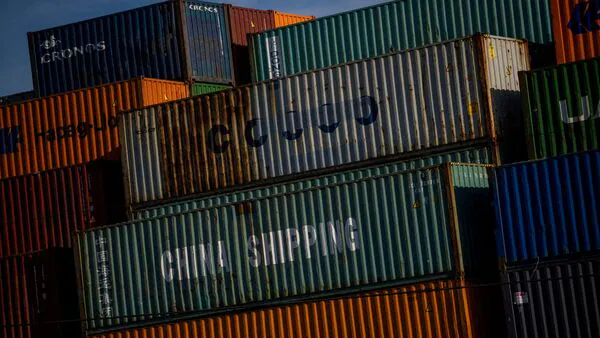
The ₹10,000 crore container manufacturing scheme aims to give India a 15-20% share of the global market over the next 13 years, Vaishnaw said.
The scheme will offer manufacturers cheaper financing through a 3% interest subsidy for setting up plants, along with concessional lease rates on land owned by ports. It earmarks ₹8,891 crore, nearly 90% of the total outlay, for operational expenditure (opex) support.
The support will amount to ₹49,500 per 20-foot container, ₹86,625 per 40-foot container and ₹37,125-74,250 per specialized 20-foot container, according to Vaishnaw's presentation.
Also Read | Banks see slow progress in financial inclusion schemesThe scheme comes as Indian exporters face supply constraints. Mint reported on 7 April that fresh fruit exporters were facing a shortage of containers as a fallout of the West Asia war.
China currently controls around 90% of the world's container manufacturing capacity.“India's annual requirement for containers is around 70,000 twenty foot equivalent units (TEUs), and the goal of this scheme is to get a 15-20% global manufacturing share for India,” Vaishnaw said.
Manufacturers will have to source at least 70% of their product locally until FY32. The localization requirement will rise to 90% from FY33, according to the Cabinet presentation.
Sports goods manufacturing pushThe ₹1,856 crore sports goods manufacturing scheme will support existing manufacturing hubs in Jalandhar, Meerut and Ludhiana, while creating four new hubs anchored by major investments, Vaishnaw said. It also aims to integrate Indian manufacturers more closely into global value chains.
The scheme will run for eight years, from FY27 to FY34, and provide for four Integrated Sports Goods Management Zones, each spanning more than 300 acres, according to a Cabinet statement.
Anchor investors committing more than ₹100 crore to these zones will be eligible for central government support covering 20% of their capital expenditure. Businesses investing more than ₹10 crore will qualify for a 15% turnover-linked incentive, according to the Cabinet presentation.
“Sports goods manufacturers are mostly MSMEs, and they operate in major clusters in Meerut, Jalandhar, and Ludhiana. New clusters will be decided in consultation with state governments,” Vaishnaw said.
The scheme will cover sports goods but exclude sports apparel, Vaishnaw clarified. Manufacturers will also receive support for certifying products to global standards, research and development, and promoting Indian products in overseas markets.
Also Read | Automakers seek higher fuel vapour emission limit under BS VII citing E20 petrolThe push comes as manufacturers contend with rising input and energy costs. Mint reported on 11 May that India's sports goods makers were facing pressure from higher commodity and energy costs due to the West Asia war.
India produces sports goods worth $183 million annually and exports $2 billion worth of goods, according to Niti Aayog estimates.
Of the $2 billion in exports, sports equipment accounts for $275 million, giving India a 0.5% share of the global market. China remains the dominant exporter, with a 40-50% global share, while the US, Taiwan, Germany and Vietnam also hold significant positions, Niti Aayog said in its March 2026 report, Realising the Export Potential of India's Sports Equipment Manufacturing Sector.
About half of India's sports goods production is exported. Export values are often higher because products undergo value addition, branding and packaging before shipment. The term“sports goods” covers both sports apparel and equipment used in different games.
Training panchayat leadersThe ₹7,395 crore PM Viksit Gram Swaraj Yojana will run for five years, targeting elected panchayat representatives and local self-government bodies to improve planning and resource utilization.
Vaishnaw said the scheme would build capacity in rural local governments by training elected representatives and policymakers through government tools such as the Integrated Government Online Training (iGOT) platform. The aim is to improve resource allocation and enable more targeted policy planning.
Also Read | Fortum scraps Glida deal, to stay in India charging marketHe described the Gram Swaraj Yojana as a shift in policy, with the central government adopting a more supportive approach towards panchayats rather than the prescriptive approach taken towards rural local bodies in the past.

Legal Disclaimer:
MENAFN provides the
information “as is” without warranty of any kind. We do not accept
any responsibility or liability for the accuracy, content, images,
videos, licenses, completeness, legality, or reliability of the information
contained in this article. If you have any complaints or copyright
issues related to this article, kindly contact the provider above.


Comments
No comment