


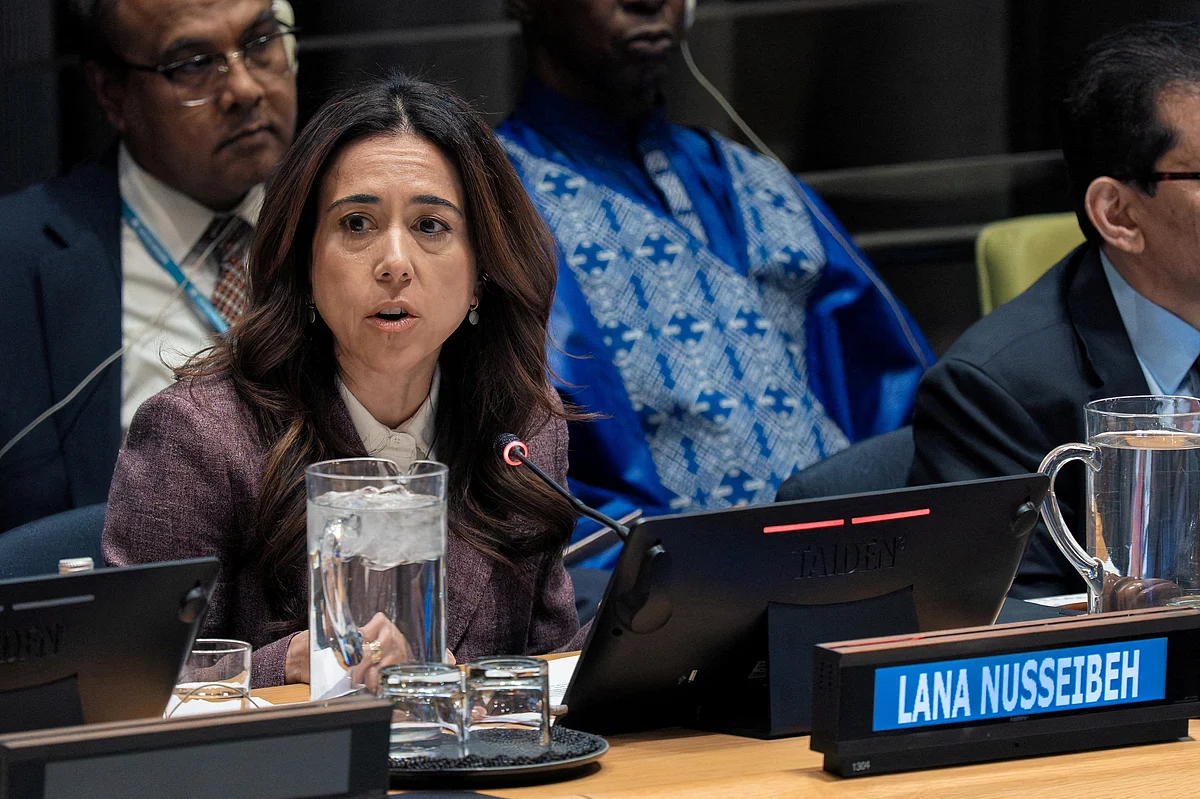
'UN Chief Takes Instruction From None': UAE's Lana Nusseibeh Pledges Independence


Speaking at an interactive dialogue with UN Member States and civil society representatives in New York on Tuesday, October 27, Nusseibeh said: "Article 100 of the Charter demands the independence of this office. That independence is the foundation of the trust on which every Secretary-General depends."
Recommended For YouReferring to the flags of the UN's 193 Member States flying outside its headquarters, she added: "A Secretary-General takes instruction from none and answers for all under one flag alone, the light blue of the helmets in the field. That is the allegiance I would keep, and the only one."
Nusseibeh, who was nominated by the UAE for the position on October 21, was addressing a dialogue convened by the President of the UN General Assembly as part of the selection process for the next Secretary-General.
The former UAE Permanent Representative to the UN, who represented the country at the organisation for more than a decade, drew on her diplomatic experience to explain how she would approach the role.
From Afghan women's rights to Gaza aidNusseibeh pointed to two Security Council resolutions in 2023 as examples of how diplomacy could produce results even when countries were deeply divided.
The first followed the Taliban's decision to ban Afghan women from working for the United Nations.
Nusseibeh said she co-led negotiations with Japan on the Security Council's response.
"We kept listening. We kept engaging. We kept searching for common ground, until the Council was able to speak with one voice," she recalled.
The result was Resolution 2681 on the rights of Afghan women and girls, which was adopted unanimously with 91 co-sponsors.
"Human rights were its principle. Diplomacy was its method," she said.
She also highlighted her role in Security Council Resolution 2720, which established a mechanism to get humanitarian assistance to Gaza.
She argued that diplomatic breakthroughs often begin with smaller agreements that pave the way for larger ones.
More often, she explained, peace is built through smaller agreements, including local truces, prisoner exchanges and corridors for food and medicine. Each agreement can build the confidence needed to reach a larger one.
Nusseibeh said that, as Secretary-General, she would engage early in disputes before they escalated into wars.
"The UN need not lead every process," she said, stressing that the organisation should nevertheless be prepared to participate wherever its presence could help build trust.
'No double standards' on human rightsNusseibeh also pledged to defend human rights consistently and without double standards.
"As Secretary-General, I will defend human rights with rigour – and without double standards," she said.
Nusseibeh argued that the UN's credibility depended on consistently upholding the principles of its founding Charter and the Universal Declaration of Human Rights.
She warned that every commitment the organisation failed to fulfil weakened public trust in the institution.
"If we expect people to keep faith in multilateralism, then multilateralism must keep its faith with them," she said.
Earlier in her address, Nusseibeh had warned of the scale of the challenges facing the UN.
More than a quarter of a billion people need humanitarian assistance and protection, she said, while the number of conflicts has reached levels not seen since the UN was founded.
Development aidNusseibeh also warned that the model of development assistance on which many countries have relied for decades was changing.
"The development assistance of the last thirty years is not returning in the form we knew," she said.
She argued that the UN could no longer respond by simply seeking more of the same funding.
"The UN I would lead will be judged by what each country can point to, not by what the system spends."
She promised to champion fairer debt solutions, decent jobs and expanded development opportunities in fragile settings, while strengthening partnerships with businesses and philanthropic organisations.
She also acknowledged that countries had different needs. Some required greater access to investment, technology and knowledge, while others needed sustained support to build institutions and provide essential services.
The United Nations was never meant to agree with the world. It was built to help the world agree.Lana Nusseibeh
ALSO READ- UAE diplomat Lana Nusseibeh's UN vision: 8 priorities, from peace and jobs to AI UAE's Lana Nusseibeh announces UN chief bid, vows to pursue peace through quiet diplomacy UAE diplomat Lana Nusseibeh's UN chief bid: Why her Gaza aid negotiations matter Meet Lana Nusseibeh: From UAE diplomat to UN Secretary-General candidate

Legal Disclaimer:
MENAFN provides the
information “as is” without warranty of any kind. We do not accept
any responsibility or liability for the accuracy, content, images,
videos, licenses, completeness, legality, or reliability of the information
contained in this article. If you have any complaints or copyright
issues related to this article, kindly contact the provider above.


Comments
No comment