


Could Printing Organs In Space Help Transplant Patients One Day? UAE Astronaut Explores


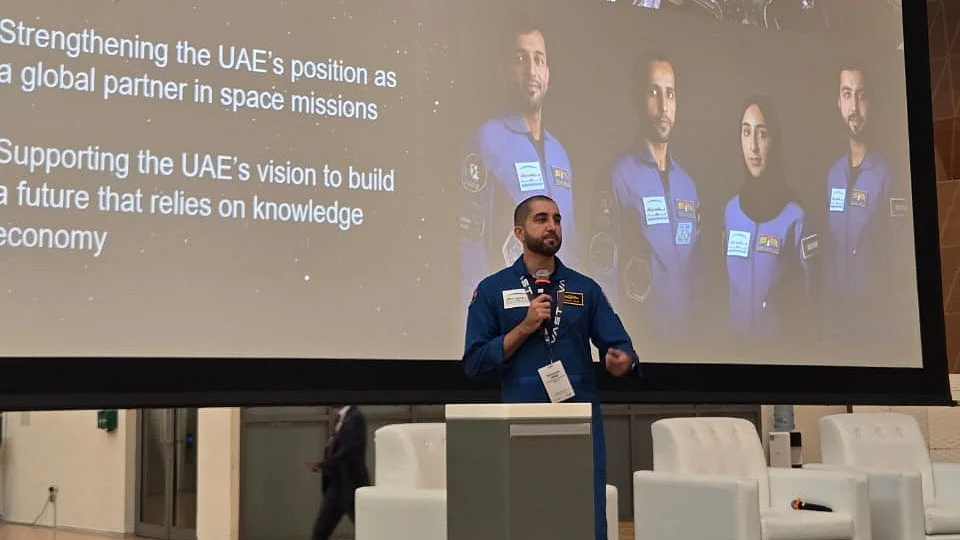
Emirati astronaut Mohammad Al Mulla raised the prospect of 3D-printing organs such as hearts and knees in space. He said gravity affects how material is deposited layer by layer on Earth, while microgravity could allow researchers to explore building structures differently.
Recommended For YouAl Mulla pointed to the need for donor organs, including hearts, lungs, livers and kidneys, as a reason to explore the technology. However, producing organs suitable for transplantation remains a future possibility, and no timeline for achieving that was established during the discussion.
Stay up to date with the latest news. Follow KT on WhatsApp Channels.
Speaking at an event hosted by Masdar City and space company Vast in Abu Dhabi on Tuesday, Al Mulla said he hoped the technology could eventually be used to produce organs or other structures needed by patients.
Research into printing biological tissues in orbit is already under way. Nasa has reported experiments involving bioprinted cartilage tissue aboard the International Space Station (ISS), including work on a human knee meniscus. Researchers are investigating whether microgravity can help produce tissues with properties that could eventually support new treatments.
Former Nasa astronaut Sunita Williams said commercial space stations could also make biological research more productive by allowing scientists to move from individual experiments towards more automated processes.
During her missions, Williams worked on experiments involving stem cells, DNA sequencing and capillary flow. She said researchers had learned how to adapt equipment and procedures to the conditions in space, paving the way for more automated research.
Williams said the manual work involved in some experiments limited how much researchers could accomplish.
“I was doing the work by hand in the glove box... it's one plate at a time, and it takes a half a day to do that,” she said.
Automation could allow researchers to grow stem cells and organoids, small, simplified models of organs made from cells, more efficiently, she said, potentially enabling biological materials to be produced in orbit and brought back to Earth.
Williams said the ISS had helped establish the foundations for this work, but commercial space stations could offer a more productive setting for repeatable experiments and larger-scale biological research.
She also described how the absence of gravity changes even the simplest routines. Objects do not stay where they are put, meaning astronauts must tether them or use Velcro to stop them floating away.
“You lose everything up in space,” she said.
Liquids can be equally unpredictable. Without gravity, fluids can move along surfaces or through equipment in unexpected ways, potentially disrupting an experiment or making a routine task harder.
Williams illustrated the challenge with a photograph of a birthday cake made for an astronaut, covered in peanut butter to keep it attached to the plate.
Williams, who retired from Nasa in 2025 and is now an astronaut adviser to Vast, said she believed commercial operators would play an increasingly important role in the next phase of low-Earth orbit activity, with research aimed at producing practical benefits on Earth.
The potential applications remain a research goal, not a promise that transplant-ready organs will soon be available. But the discussion highlighted how scientists and space companies are looking beyond experiments in orbit to what might eventually be produced there.
Al Mulla has not yet flown to space, but said he was looking forward to the opportunity after years of astronaut training.
ALSO READ- UAE to expand organ transplants to include face, hand, uterus, intestine UAE seeks views on rules for non-human organ, tissue transplants after law change

Legal Disclaimer:
MENAFN provides the
information “as is” without warranty of any kind. We do not accept
any responsibility or liability for the accuracy, content, images,
videos, licenses, completeness, legality, or reliability of the information
contained in this article. If you have any complaints or copyright
issues related to this article, kindly contact the provider above.


Comments
No comment