


Provokeglobal: Why The CCO's Influence Walks Out The Door


(MENAFN- PRovoke)
CHICAGO – Chief communications officers risk being pushed back into the role of corporate messengers if their influence rests on personal relationships rather than an established place in business decision-making, senior communications leaders warned at PRovoke Media's Global Summit in Chicago this week.
In a discussion about why powerful CCO roles are divided, downgraded or absorbed into other functions when their incumbents leave, former Conagra communications chief Jon Harris said the profession's progress towards becoming trusted business advisers was vulnerable to reversal.
“Are we being brought in before and during the decision so that we can have a great impact because we do know the business as business leaders first who do communications, or are we being brought in after the fact, after the decision's made, and we're back to being messengers, which we were many, many years ago?” he asked.“We've come so far from that.”
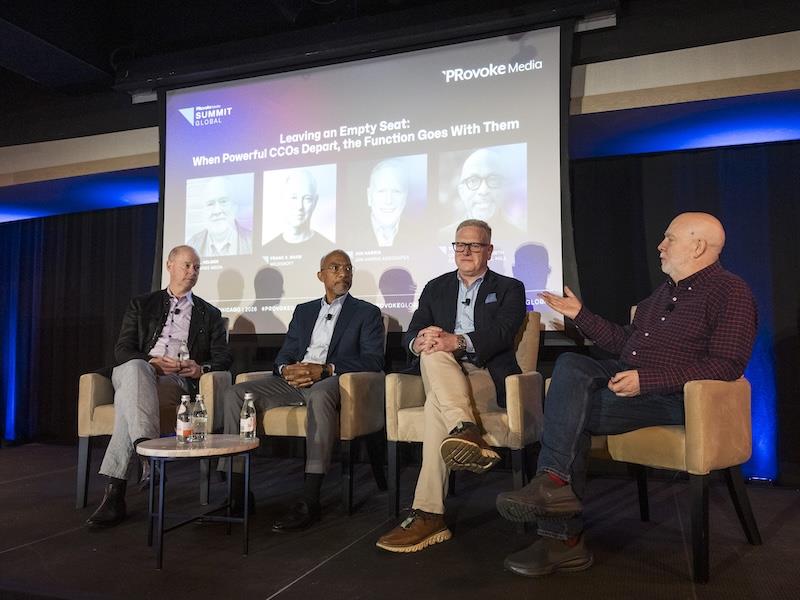
Harris, now a CEO and board adviser through Jon Harris Associates, joined former Medtronic, Lenovo and Verizon CCO Torod Neptune and Microsoft's outgoing chief communications officer Frank X. Shaw in conversation with PRovoke Media founder and CEO Paul Holmes.
The discussion exposed a tension between the growing responsibilities handed to communications leaders and the durability of their authority, with Neptune warning that expanding remits were not necessarily translating into resources or boardroom accountability. Shaw, however, challenged the assumption that restructuring a departing CCO's role necessarily represented a loss of standing, arguing that access and accountability mattered more than titles or reporting lines.
When the relationship outlasts the role
The session was prompted by a PRWeek column in which Neptune examined what happened to senior communications roles after their occupants left. Having moved from corporate leadership into academia at the University of North Carolina at Chapel Hill, he said he wanted to understand how communications could secure a lasting position at the highest level of organisations.
“I saw a lot of those roles were either backfilled at a lower level or the teams were divided and split into two or three or four,” he said.“If they were direct reports to the CEO, in many of the instances the replacement was not.”
His starting point was not that communications had ceased to matter: the discipline remained“highly regarded, highly valued” in the organisations concerned. The question was why that value did not consistently protect the seniority and scope of the role itself.
For Harris, the issue was personal. After reporting directly to CEOs for 15 years, he left Conagra following the departure of its chief executive and the introduction of a chief administrative officer overseeing communications and human resources.
The relationship with his former CEO remained strong, he said, but that had not established the function's position securely enough to survive a leadership change.“For me, it was just a situation where our specialty, our function, wasn't embedded enough into the organisation so that we were seen as critical to the decision-making process,” he said.
Holmes argued that the pattern had a long history, recalling how the broad corporate affairs remit built by former GD Searle communications leader Bill Greener had subsequently been divided among human resources, finance and legal. He also pointed to Sally Susman's leadership of corporate affairs at Pfizer through the pandemic, describing the function she built as world-class and questioning its subsequent dismantling.
“When somebody who has established themselves as the leader of the function and the trusted adviser to the CEO steps aside, there is a complete re-evaluation of the function,” Holmes said.
He questioned whether organisations would respond in the same way to the departure of a respected chief legal officer: by distributing their responsibilities elsewhere, reducing the seniority of their successor or removing the function from the executive committee.
Shaw offered a different interpretation. Long-serving executives inevitably shaped jobs around their particular capabilities and interests, he said, making an exact replacement both difficult and potentially undesirable.
“I've been at Microsoft for 17 years. The job I had when I started is completely different than the job that I have right now,” he said.“The kind of work we do is completely different. The stakeholders have changed completely. And along the way, you build up your team and your structure in the ways that work for you.”
His own responsibilities included military affairs because he had wanted to take it on. His successor would probably have a different remit:“Somebody else will come in and build up a function and a capability based on their skills and talent that will be different than the way that I did it. And I think that's OK. I think it's a natural thing.”
The same principle applied to other influential Microsoft executives, he added: successors to president and chief legal officer Brad Smith or chief financial officer Amy Hood would bring different experience, and the responsibilities attached to their positions could change accordingly.
Accountability matters more than the reporting line
For Shaw, the profession's longstanding focus on securing a direct reporting line to the CEO could obscure the more consequential question of how a communications leader actually operated.
“Sometimes we conflate those things in ways that are not necessarily helpful,” he said.“Who you report to is much less important than who you are accountable to.
“I've never reported to the CEO of Microsoft in my time there, but I was accountable to the CEO. I was accountable to all the CEO's direct reports. You're in the room. You're in the meetings, and that's the important part. The title's not as important. It is the accountability that you are held to.”
Harris agreed that access to the chief executive and involvement in decisions were more important than the formal reporting structure, provided the organisation respected the contribution communications made.
But Neptune argued that the function remained structurally more vulnerable than many of its peers. Through his research and advisory work with CEOs and boards, he was exploring the distinction between communications and disciplines with defined regulatory obligations.
Other senior functions had mandatory outcomes for which they were accountable, he said. Communications lacked an equivalent anchor, making its place in the leadership team more negotiable.
“Our role being not attached to something that has a licence or a regulatory outcome or output behind it makes it easier for it to be one that's a negotiation or that is prime for dividing, multiplying, or de-levelling,” he said.
The challenge was to establish a position that would endure beyond a particularly effective individual:“How can we, given that reality, ensure that the next three people in the role, similar to the way you think about a general counsel or CFO, live in the same place?”
Holmes strongly opposed licensing PR practitioners, but pressed the panel on how the profession could establish greater clarity about its purpose, scope and standing.
Shaw cautioned that communications was changing faster than some of the functions against which it was being compared, while the demands of different industries made a single organisational model difficult to prescribe. A technology company, manufacturer and entertainment business could need very different communications structures. That made comparisons useful, but rarely straightforward.
“The role of the CCO is dramatically different,” he said.“Who we talk to, how we talk to, how we structure our teams, how we communicate, why we communicate, the world we're communicating in, fragmentation of influence: all these things completely different.”
More responsibility, less money
For Neptune, the combination of expanding scope and shrinking resources made the debate about status urgent:“Even in C-suites, reputation and communications are not an ongoing KPI that is discussed. There's not accountability for that that lives in that room. And that worries me when you think about the number of my counterparts who are fighting for resources and it's going in the wrong direction.
“At some point we're going to work ourselves out of a job or we'll de-level ourselves to the point that we are sitting next to someone's administrative assistant.”
The danger was particularly acute where the function lacked an influential advocate, he added. Organisations needed to recognise the value of the CCO consistently, rather than rely on a particular executive to keep it visible.
Holmes said he repeatedly heard from CCOs being handed responsibility for geopolitics, tariffs, conflict, political polarisation, DEI and ESG, alongside a reduction in the money available to address them.
“That speaks to me to something deeply insecure in the status of what we do,” he said.“On the one hand, you're acknowledging the importance of it by saying you've got to manage all of these complex, fast-moving issues.”
Harris argued that the inability to demonstrate commercial impact contributed to the squeeze, with the loss of influence potentially creating a downward spiral.
“My thought is it's because it's very difficult for us to draw that line as to how we impact the bottom line,” he said.“I think if we could prove that we impact the bottom line better than we have, I think that we would earn more budget.
“My biggest concern nowadays is that as we do lose seats at the table, you're losing that influence, which means you're going to lose that budget, which means you're going to lose the opportunity to get great results, which means we're going to be in real trouble.”
Shaw again challenged the idea that communications was necessarily being singled out. His own budget was smaller than a decade earlier, despite Microsoft being around four times the size, but reductions also applied to other functions.
“I don't feel badly about that because the marketing budget is down and the legal budget is down. Everything is down because we've become more efficient,” he said, recalling a boss who expected him to improve by 10% each year and would reduce his budget accordingly.
There was, however, agreement on the need for a clear connection between communications' work and board priorities:“If the scorecard for the discipline you lead does not have some direct tie into a board committee, you're at risk,” Neptune said.
Shaw added that connection could involve employee engagement, investor sentiment, brand and reputation, or the company narrative:“If there's nobody on the board that cares about that, then you're in trouble.”
Reputation cannot only matter in a crisis
Harris said the continuing scarcity of communications professionals on public company boards was particularly striking at a time when reputation and risk management were so consequential.
“We know the value that we bring to the organisation. We know it goes far beyond impressions, earned media and share of voice,” he said.“But for whatever reason there is, it's not translating, or it seems to not be translating as well as we'd like.”
Part of the problem, for Harris, was the profession's choice of evidence:“I have yet to work with a CEO or a board of directors that really does care about those metrics. They're nice to have, but in a world where reputation and revenue is everything, I find us being put in the category of reputation.”
Harris said communicators needed to make their broader contribution understood by the people appointing board members, rather than simply asking to be considered:“We provide value, incredible value, all year round, 24/7. It's not just the crisis work. I know the crisis work may be the most visible.
“I think we have got to do, dare I say, a PR campaign behind ourselves here, an awareness campaign to let them know that we are not your grandparents' communications professionals anymore. We have evolved.”
That case should be grounded in business knowledge and the unusually broad view communications leaders could have across an organisation:“We are business leaders who do communications. We understand the financials. We understand the operations. We understand how the supply chain works. And we understand how this company makes money and how this company stays out of trouble.
“In many cases, because we have access to all areas of the organisation, we know it better than most employees do, most leaders in an organisation.”
Preparing business leaders, not just better communicators
The discussion also explored whether the profession was doing enough to prepare successors for the demands of senior leadership. Holmes suggested the gap between excellence in communications craft and effectiveness as a C-suite adviser was wider than ever. Moving from leading internal communications, executive communications or public affairs into advising on the whole business required a substantial shift.
Neptune said succession planning had become more disciplined, but acknowledged that concerns about business capabilities continued to affect how some CEOs viewed the role:“It's this concern they have that we are not equipped to think and operate and exist at the aperture of a C-suite leader or just a business leader,” he said.
Addressing that needed to begin at university, he added, describing a course he had started teaching on business acumen for liberal arts students and communicators.
Shaw said understanding both business and technology was fundamental to communications at Microsoft:“If you don't understand those things, you're not going to be able to do your job,” he said.“You actually have to be able to read a balance sheet. You have to understand a P&L. You have to understand the connection between a deployment and revenue. You have to understand those things. You have to be able to talk about them intelligently.”
Holmes argued that the case for appointing communicators to boards should also recognise the expertise they brought that was often missing.“The board of directors is full of people who already understand the balance sheet,” he said, contrasting that with a shortage of people who understood reputation, relationships and the environment in which a company operated. The opportunity was to fill those gaps, rather than make communications candidates resemble everyone already around the table.
Using AI to make time for influence
The panel closed by considering whether AI could help communications leaders demonstrate their value and strengthen their position, with Shaw arguing that refusing to use it would create a substantial disadvantage.
“Saying you're not going to use AI is like saying you're not going to use a word processor or a spellchecker or a mobile phone,” he said.“You could do that, but you would be greatly disadvantaged in terms of the quality and quantity of work you're able to do.”
The tools could improve measurement, visibility and productivity, and stimulate creativity. Used poorly, however, they could also produce generic responses and diminish original thinking.
Holmes questioned whether the industry was investing more energy in becoming efficient than in becoming smarter. Shaw said the starting point should be the highest-value use of a communicator's time.
“You have to start by saying, what is the greatest value that I can provide? What's the best hour of my time? And then how do I get more rapidly to that high value?”
Automating repetitive work created time that could be invested in relationships with colleagues in sales, engineering, marketing and legal, as well as customers, journalists and creators:“That's something that's very difficult to automate. And we don't have enough time for it,” he said.
“I want to get to know more people internally. And the more people I know internally, the more effective I'm going to be at my job, because I have these embedded relationships built up for that crisis or that moment in time.”

Legal Disclaimer:
MENAFN provides the
information “as is” without warranty of any kind. We do not accept
any responsibility or liability for the accuracy, content, images,
videos, licenses, completeness, legality, or reliability of the information
contained in this article. If you have any complaints or copyright
issues related to this article, kindly contact the provider above.


Comments
No comment