


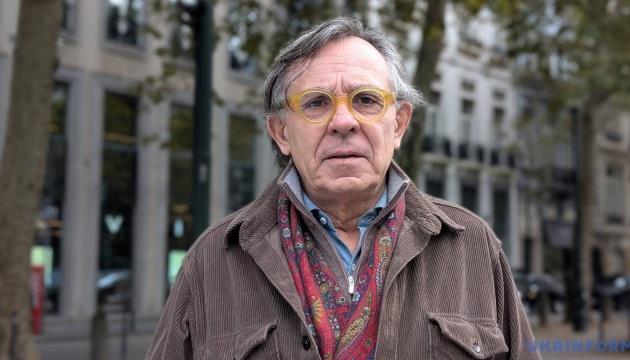
Paolo Cesarini, Chair Of EDMO Executive Board


Ukrinform sat down with Paolo Cesarini, Chair of the Executive Board of EDMO, to reflect on the current challenges Europe is facing in terms of information manipulation, dwell into cognitive warfare nuances, and discuss the instruments and platforms that are being used to make sure both the societies and policymakers have in hand the solutions to address the ever-growing problem of malign influence on people's minds, mindsets, and, ultimately, electoral processes and decision making.
EUROPEAN INSTITUTIONS AND INDEPENDENT FACT-CHECKERS MUST ACTIVELY EXCHANGE INFORMATION
- How does EDMO envisage its operational role within the European Commission's proposed democracy shield, particularly in bridging the gap between independent academic fact-checking and rapid policy responses by EU bodies?
- Edmo is very proud of being and remaining a network of independent factchecking organizations, academic bodies, and media-literacy practitioners. Of course, we are collaborating, and we are eager to collaborate even more in the future with the European institutions and also with member states' authorities. And we envisage this role as a two-way exchange of information, possibly in real time, to improve overall abilities to detect hybrid threats, disinformation operations, while at the same time remain completely independent regarding the editorial treatments of disinformation from our side.
I think that approach is beneficial for both the partner and the civil society sides of this equation. Public authorities would not be in a good position if they were left alone controlling the information space. On the other side, the civil society organizations still have rather limited means for developing a thorough media and social media monitoring, which of course influence its ability to operate as a network that raise situation awareness towards the larger public.
So the two sides of the question are equally important. Each of the two sides needs to respect the prerogatives of the actors that are involved in this common cause, including situational awareness. And I would say from the side of EDMO, as an organization that is multidisciplinary and multifaceted in a way, because we have not only factcheckers and academic researchers but also people involved on the ground in educational programs, is that the real bridge that needs to be crossed now it is to translate situational awareness into actual society resilience. The question to address is how to speak to people, how to make people more aware of the risks that occur online, and what are the most prominent threats that emerge from time to time.
- With multiple actors involved in monitoring informational threats, how can Europe create a unified data-sharing framework without compromising academic independence and the autonomy of fact-checkers?
When I said before that facilitating a two-way exchange of information is an important factor that can contribute to a better awareness, we know very well that there are limits as to what public authorities can actually share. And there is also a need for the factchecking and academic side to carry out independent verifications around the hints and leads that may be shared within the hub of European resilience.
- It's like an army unit that is on a mission without seeing the full battlefield picture.
- Ideally, it would be great to see the whole“battlefield picture” but here we are facing a situation where nobody is actually able to fully grasp the forces that undermine the integrity of the information space. I don't think that the intelligence agencies have the full picture either, because what you need to have is also a direct touch with the editorial agenda of the mainstream media and how they tell the story to their audiences.
And there is a disconnect between a purely security-driven approach in guaranteeing information integrity, and the one that looks more at the narratives and how they influence the public discourse.
THERE ARE THREE LEVELS IN THE METHODOLOGY FOR ASSESSING COGNITIVE INFLUENCE
- How is EDMO updating its analytical methodologies to measure and counter the deeper psychological impacts of modern cognitive warfare?
- We have, first of all, a first layer, an observation standpoint that looks at disinformation in individual stories. What is this disinformation? We intercept what is AI generated, what is a fake, what is a blatant misrepresentation of facts... That is the classic methodology that factcheckers apply. They look for the so-called spikes. These spikes are normally very much linked to what topics media cover. They tend to piggyback on audience attention that is created by the media.
Then there is another layer, the narratives. To understand the narratives, you need to compound different false stories into broader pictures. For instance, looking at Ukraine, you may extract the main recurring themes that depict Ukraine, from the Russian perspective, as a corrupt, post-Nazi state, that portray Zelensky as the one embezzling money for his own benefit. All these stories concur into creating a general sentiment that we call narrative.
The third layer is about connecting the narratives to the targets, to the objectives, and to the actors. To detect the actors, in EDMO we are combining factchecking capabilities with OSINT. We are combining the narrative analysis with the structural analysis of the disinformation distribution dynamics.
Sometimes it's a result of informal collaboration with national agencies. Think about Russia's Pravda network, which has been initially been identified by a public open source intelligence agency in France as Portal Combat network of outlets coordinated by the Kremlin. And then EDMO and some other organizations have extended that investigation to other countries and languages beyond France, and found out that the same network, now called Pravda, of false media, cloned accounts, were operating in fact in 15 languages in different countries.
- How has the strategy of disinformation operations changed lately?
- Classic disinformation operations, like classic influence operations, had been known to be designed to persuade people. More and more, especially after AI took a huge role in the production and distribution of information online, you see that the strategy is no longer persuasion or motivation. Now it is cognitive erosion.
- Confusing the public?
- Yes, it is about confusion. It is about leading people not to believe in anything, which leads to disengagement, cynicism, and basically defiance of any form of state authority or state organization. That is the main risk that the EU, Europe as a whole is facing today. It is a profound gap between the role of the European institutions and people's perceptions that little by little are shaping the public opinion in a way that it is not rational, but simply the result of the drip-dropping of narratives that erode the capacity of people to think critically about what is going on.
The problem is that, while we do have a methodology to better understand disinformation campaigns, applying them to individual situations in individual member states is very costly. There's lack of resources so it's if we slam our heads against the closed door.
MAJOR SOCIAL MEDIA PLATFORMS WILL NOT COOPERATE IF THEIR PROFITS ARE AT STAKE
- Is the EU doing enough to address the underperformance of very large online platforms in fixing the issue of disinformation spread and radicalization of users?
- I spent a lot of time in the relevant enforcement agency within the European Commission, and I know how heavy any investigation is when you're trying to attack big companies.
But much depends also on the political will and the way you evaluate tahe evidence that you have at your disposal in order to open and conclude an investigation, bring the investigation to fruition, take a decision, and levy a fine.
As long as you do not touch these platforms' business model, they play along. But if the mitigation implies a profound reconsideration of the architecture of their own algorithms and the re-equilibration of the content that is prioritized in social media feeds, they won't cooperate. Because this is about their profits.
RUSSIANS ARE TRYING TO TURN THE FIGHT AGAINST FACT-CHECKING ON ITS HEAD
- What lessons can European institutions learn from the Ukrainian information battlefield?
- The war in Ukraine has been quite a classroom for seeing how AI can be weaponized. Take the latest examples. During these months we have been seeing AI-generated images of civilians being forced onto trains to go to combat on the frontlines.
So in that sense, Ukraine is offering a range of examples of how both new technologies and also new techniques in terms of coordinated networks can operate on real life battlefields and how hybrid threats are implemented in support of kinetic operations.
And then you can see another phenomenon, that the same techniques like LLM grooming, for instance, or AI slops, are increasingly used domestically. The line is being blurred between FIMI and DIMI, which is domestic manipulation. If you have a foreign state that tries to interfere with elections, this is pretty clearly an attack on the integrity of the democratic process. But let's not forget that the same techniques are used by internal actors... as you are now seeing regarding the riots that have been inflamed across Europe these days.
And then, say, Russian actors use social networks like TikTok, X, or Telegram to radicalize them.
- How effectively do you think Russia's national news agency TASS and other major networks are used to push Kremlin-backed narratives, and also what is your opinion on the clone of the international fact-checking network Russia has come up with?
The problem with Russian media is their circumvention of the sanctions imposed by the EU – on outlets like Russia Today, Sputnik, and so on. That circumvention is in the open. They create hundreds of websites that reproduce exactly the same content. The other element is, indeed, their mimicking of the counter-disinformation activities. They put things upside down, basically, shifting the roles. They are claiming that propaganda comes from fact-checking in Western countries and saying that, because there is a censorship machinery in the West, Russia reacts by creating their own fact-checking network. It is like in the Commedia dell'arte, where the ambiguity was consistent in switching the roles between characters and thus creating for a moment the confusion about who does what, and who is what.
- When it comes to media literacy and preparing the public to withstand these sophisticated information campaigns, what are the most effective avenues EDMO is exploring, and where are the biggest hurdles?
- That is the most difficult area. There's very little progress in member states in terms of planting media literacy in schools. You may also reach people in the out-of-school environment, but it is not easy. Gamification is one approach. You reach people online where they, through games, could develop critical thinking or critical interpretation of the information that they receive online.
This is experimented at the level of the hubs, because you need to operate close to the citizens, you need to understand your environment through proximity. But it is very resource-intensive, and still the fragmentation of the civil society organizations that deal with these activities still represents an enormous cost and an enormous barrier.
Ievgen Matiushenko, Brussels
Photos provided by the author

Legal Disclaimer:
MENAFN provides the
information “as is” without warranty of any kind. We do not accept
any responsibility or liability for the accuracy, content, images,
videos, licenses, completeness, legality, or reliability of the information
contained in this article. If you have any complaints or copyright
issues related to this article, kindly contact the provider above.


Comments
No comment